The rise of Bryan Eiseb
In 1987, Bryan Eiseb pumped petrol on Friday nights at a service station at Katutura.
The busiest shifts ran until the station closed at 22h00.
“I enjoyed filling up vehicles, especially on Friday nights,” he says on his LinkedIn account.
Eiseb later joined the police and was promoted to commander of the drug unit.
Nicknamed ‘KGB’ after Russia’s intelligence agency, Eiseb climbed the ladder of power when he was appointed as head of the Financial Intelligence Centre (FIC) in 2023, the country’s top financial crime investigative agency in the country.
Nearly four decades later, he has been asked to run the institution charged with fighting corruption in Namibia.
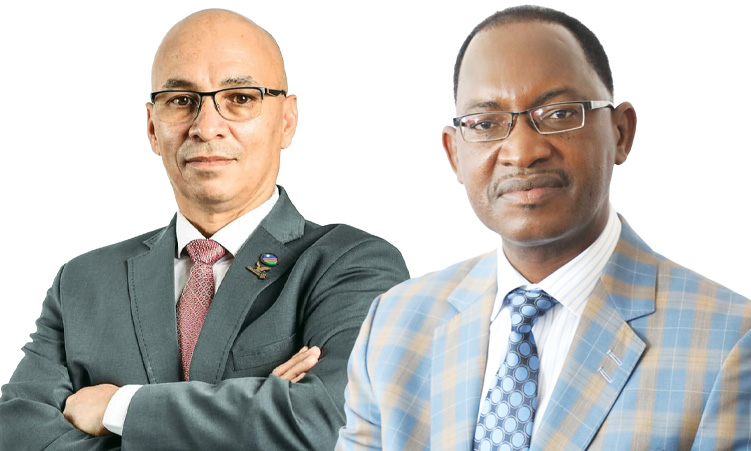
Eiseb (55) has been nominated by president Netumbo Nandi-Ndaitwah to lead the Anti-Corruption Commission (ACC).
He is expected to succeed Paulus Noa, whose term as director general comes to an end this month after serving at the helm of the ACC since its establishment in February 2006.
Prime minister Elijah Ngurare on Tuesday tabled a motion in the National Assembly seeking parliamentary approval for Eiseb’s appointment.
Eiseb currently heads the FIC at the Bank of Namibia. He previously served as board chairperson of Namib Desert Diamonds (Namdia) and as acting executive director in the former Ministry of Mines and Energy.
Also listed on his CV is a position as candidate attorney at Conradie and Damaseb Legal Practitioners.
Eiseb, who was born at Tses in the ||Kharas region, says he was a petrol station attendant at Hakahana Petrol Service Station in Katutura from March 1987 to October 1988.
Eiseb served as chairperson of the Namibia Institute of Pathology (NIP) board from December 2019 to March 2024, and as deputy chairperson of the Namibia Sovereign Wealth Fund Law Development Committee of the Bank of Namibia.
He was also the acting director of banking services in 2014, the head of exchange control, and a former chairperson of the Anti-Money Laundering and Combating Terrorism Council.
Acting High Court judge Gladys Pickering describes Eiseb as “a very strict person” since his childhood days.
“I will know because the two of us grew up together,” she says Pickering, a close relative of Eiseb.
Former Keetmanshoop mayor Annelize Knouwds yesterday said: “Bryan is my own brother. But I’m not going to comment on him at all.”
Former Bank of Namibia governor Johannes !Gawaxab describes Eiseb’s proposed appointment as timely, saying it came at a key juncture, following the 2022 Financial Action Task Force evaluation.
“Mr Eiseb’s extensive experience in law enforcement, coupled with his experience and extensive network within the criminal justice system, combined with his past role as director of exchange control and legal services at the Bank of Namibia, make him the ideal candidate to head Namibia’s financial intelligence unit,” he says.
‘GO AFTER THOSE EATING’
Former police inspector general Sebastian Ndeitunga remembers Eiseb as demonstrating “a high level of leadership, and specialised skills in the drug law enforcement unit”.
“He must ensure any person making themselves guilty of corruption and eating the nation’s resources unlawfully are not spared the gavel,” he says.
Ndeitunga has thanked the president and her advisers for nominating a person from the security cluster to be an ambassador at the ACC.
“If we could draw the files and records, I could have told you how many discoveries and prosecutions were done successfully during his time,” he says.
Bank of Namibia spokesperson and colleague Kazembire Zemburuka describes Eiseb as a person of high integrity.
“He would do the right thing, even when no one is watching,” he says.
Meanwhile, Asoli Progressive Party president Josef Kauandenge says it is disheartening that there is no statutory requirement saying such a high-profile position must be advertised.
“It is unheard of that in a democratic state like ours such a high-profile position is left in the hands of the president alone to appoint,” he says.
Kauandenge says there is little in terms of Eiseb’s history one can use as a yardstick for his competence.
“Does he have backbone and is he capable of holding this explosive and demanding position? Only time will tell,” he says.
Swanu of Namibia president Evilastus Kaaronda says the most preferred candidate for the ACC job should have nothing to lose and who would, therefore, not take the position as a career advancement opportunity.
Independent Patriots for Change shadow minister of justice and labour relations Elvis Lizazi has urged lawmakers not to approve the nomination without scrutiny.
“The parliament must not simply rubber-stamp this appointment. We cannot continue recycling failure from one institution to another. We have many qualified young Namibians who are clean and have the energy needed to drive the ACC’s mandate,” he says.
While acknowledging Eiseb’s qualifications, Lizazi questioned his credibility, citing his previous involvement in matters investigated by the ACC during his tenure as board chairperson of the NIP.
Activist Michael Amushelelo also rejects the nomination.
“The ACC should be a shield for the people, not a retirement cushion for the bureaucratic elite,” he says.
He claims while serving as NIP board chairperson, Eiseb oversaw and defended the procurement of luxury vehicles valued at about N$5.3 million for senior executives.
Amushelelo says the ACC later cleared the transaction after it received approval from the Ministry of Finance.
“Just because someone found a legal way to spend millions on luxury vehicles does not mean they have the financial discipline or ethical standing required to fight corruption,” he says.
Eiseb did not respond to calls or text messages on the allegations by the time of going to print.
Esieb led Namdia from 2019 to 2024 as board chairperson.
His brother, Namdia security chief Francis Eiseb, was shot dead in a robbery at the company last year.
Around N$314.9 million was stolen. Eiseb was still the chairperson at the time.