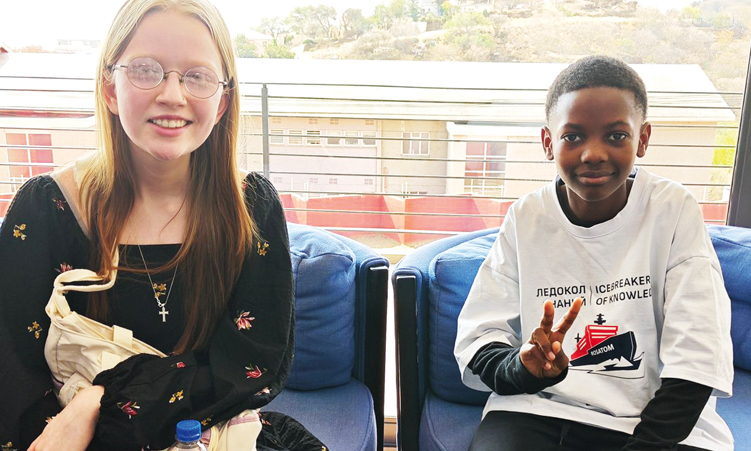
Namibian teenager Tironnen Kadhikwa has returned from a 10-day expedition to the North Pole.
Kadhikwa (14) travelled to Russia in early August for an expedition, called Icebreaker of Knowledge, organised by Russian state atomic energy company Rosatom.
Speaking at Headspring Investments (a Rosatom subsidiary) in Windhoek yesterday, Kadhikwa said he is just a Namibian pupil who loves science.
“It was fun and exciting. I was nervous before I went, because what was I going to do in Russia? But it was the best experience,” Kadhikwa told The Namibian yesterday.
To be able to go to the North Pole, students entered a science competition. The winners are from countries around the world, flying to Russia to spend 10 days on the ‘50 Years of Victory’ nuclear icebreaker vessel.
Icebreakers are specialised ships that can travel in ice waters. 50 Years of Victory has a nuclear power plant on board that powers the ship’s propellers.
The ship travels from Murmansk in the Arctic circle to the North Pole.
Kadhikwa said he entered the competition because he loves science and nuclear energy. After this programme, he said loves it “even more”.
Every day, the students on the ship woke up to morning activities. They attended lectures before and after lunch.
“I learned more about nuclear reactors. I learned about every single part of the reactor, why it’s there, and what it does. I’m really thankful for that,” Kadhikwa said.
Seeing a polar bear was his best experience, he said.
“We went to sleep at 20h00 every day. That day, at 23h00, our team leaders came rushing into everybody’s rooms saying there is a polar bear outside. I was so confused, I thought it was a dream at first,” he said.
Kadhikwa follows Teaghan Beresford (16), who attended the same programme in 2025. Beresford was the first Namibian teen to go to the North Pole.
She has said she entered the competition because she loves physics and wants to study theoretical physics.
“This was the most amazing experience of my life. I thought the cold and the white nights would be an issue, but it wasn’t,” she said at the time.
“The air smells so clean, so fresh. The Arctic Ocean is really dark blue, but when the ship goes over it, it turns an electric light blue,” Beresford said.
She said she had made many friends and was still in contact with them a year later.