






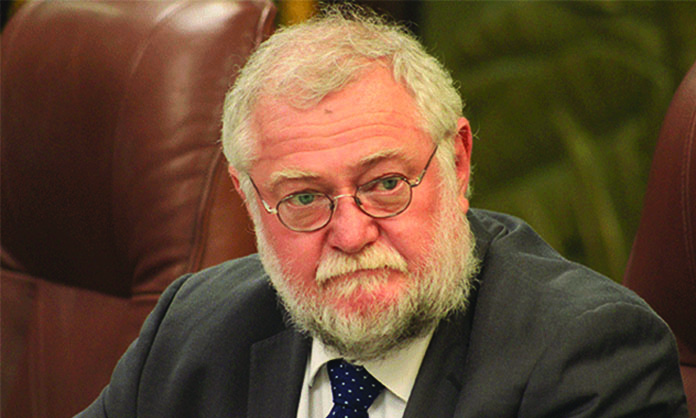
Minister of agriculture, water and land reform Calle Schlettwein says the frequency of drought and floods has increased by 18% in the last four decades, compared to the same period before.
The minister, whose statement was read on his behalf by the deputy executive director of water supply and santitation coordination, Elijah Ngurare, was speaking at the opening of a two-day national workshop on water security and climate change in Windhoek yesterday.
He said it is pertinent to develop strategies and plans to adapt to climate change.
“In recent years, Namibia has experienced an increase in natural disasters, thus indicating the relationship between the increase in water-related disasters and global warming, which is the key contributor to climate change,” Schlettwein said.
He said surface temperatures have risen by 1,2 degrees Celsius in the last 100 years, which is evidence of how climate change affects the country.
“Businesses and the economy are already feeling the impacts, but the most vulnerable are the communities whose livelihoods depend on natural resources such as subsistence agriculture,” Schlettwein said.
He said regardless of all these efforts Namibia is still faced with challenges such as deteriorating water quality, infrastructure, limited technology capacity and fragmented investment in the water sector, as well as delayed implementation of the relevant water policies and strategies.
“The theme tells us that water security cannot be addressed by one entity,” he said.
The workshop is hosted under the theme ‘Enhancing Synergies and Breaking Down Silos in Water Resource Management for Sustainable Development in Namibia’.
Speaking at the same event, NamWater chief executive Abraham Nehemia said: “The workshop aims to foster knowledge exchange and cooperation towards water security, building resilience to climate change and promoting sustainable water management practices in Namibia.”
Senior water and sanitation engineer and African Development Bank task manager in Namibia, Zambia and Lesotho Herbert Chinokoro highlighted that water security underpins sustainable development and plays a crucial role in achieving Agenda 2023.
“The development potential of Africa’s water resources is constrained by a huge infrastructure gap which is holding back the continent’s transformation and risks compounding the impacts of climate change, “ he said.
The average per capita water withdrawal in Africa is 40% of the world’s average, Chinokoro said.
This can be attributed to the huge infrastructure gap that affects the quality of life of millions of Africans.
Chinokoro said the African Development Bank recognises that climate change provides an opportunity for Africa to adopt a resilient climate pathway.
He mentioned the five-year water strategy that was launched in November 2021, which aims to increase water security for Africa.
For the strategy to be effectively implemented, increased funding from all sources, including the private sector and climate change funds, are necessary, he said.
Khomas governor Laura Mcleod-Katjirua in her welcoming remarks, delivered by Windhoek West constituency councillor Emma Muteka, committed to contributing to these efforts and encouraged participants of the workshop to do so too.