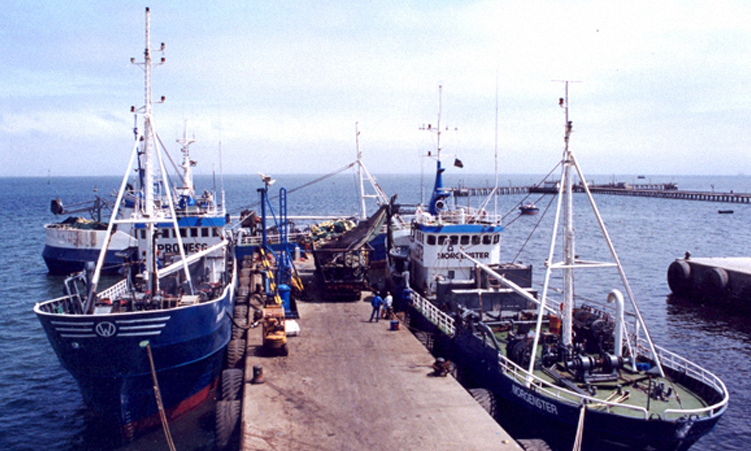
The lockout at Marco Fishing affecting about 300 employees is still ongoing three weeks later.
Namibia Food and Allied Workers Union (Nafau) ||Kharas regional coordinator Simon Mattheus has confirmed the ongoing lockout.
The company has been engaging in wage negotiations with Nafau, which is demanding a one-year deal that includes N$800 plus a fish commission, bringing the total to N$1 100, as well as N$27 per hour for land-based employees, including transport and housing allowances, among other benefits.
Mattheus says since workers aren’t earning income during the lockout, the prolonged period is damaging to employees and their families.
Work in the factory is being carried out by supervisors and other employees who fall outside of the bargaining unit.
“We are facing a damaging situation on a personal level for every employee.
Should this month end while the lock-out is still in place, nobody will have a cent to take home.
However, the lockout is a legal option that is helping the company to save money,” Mattheus says.
He says the union’s initial proposal was a salary increase of N$2 000 for seagoing personnel, whose current basic salary is N$4 000.
However, the company offered a 5% increase over three years.
“Meaning the employees will only receive N$800 on top of N$4 000 in three years, which is not in the best interest of the employees.
We want this to be given in one year. We also proposed that there can be no negotiations in 2027.”
However, he adds that the union and the employees are flexible in their demand to meet the needs of both the company and the workers.
Meanwhile Marco Fishing chief executive Steven Rajzman issued an invite to the union for a follow-up round of negotiations last Friday to meet on a date to be agreed.
Marco Fishing instituted the lockout of its employees on 24 July at 07h00.
Rajzman says the decision followed extensive engagement, which indicated to the company that it had no viable alternative but to implement a lockout in order to safeguard the long-term sustainability of its operations, preserve employment where possible, and ensure the business remains able to continue operating.
He says during the course of negotiations, the union also indicated its intention to commence strike action during November and December.
“As this represents the most commercially critical period for the company’s operations – when vessel utilisation, factory throughput, export commitments and cash flow are at their highest – the prospect of industrial action during this period presents a significant operational and financial risk,” Rajzman says.
He says this intended strike action was one of the factors considered by the company in reaching its decision.
“Marco Fishing recognises that this situation creates uncertainty for employees and their families and sincerely regrets that these measures have become necessary.
However, the company believes that taking responsible decisions now is essential to protecting the future of the business and the livelihoods that depend on it,” he says.
Earlier, Rajzman had said the company has been facing an extended period of severe operational and financial pressure on the longline hake business, driven by sustained poor catches due to a decline in average hake catches over the past five years by more than 45%.
He says the decline is also contributed to by the limited access the company has to historical fishing grounds south of Lüderitz and the increasing difficulty of maintaining a commercially viable operation under current conditions.