






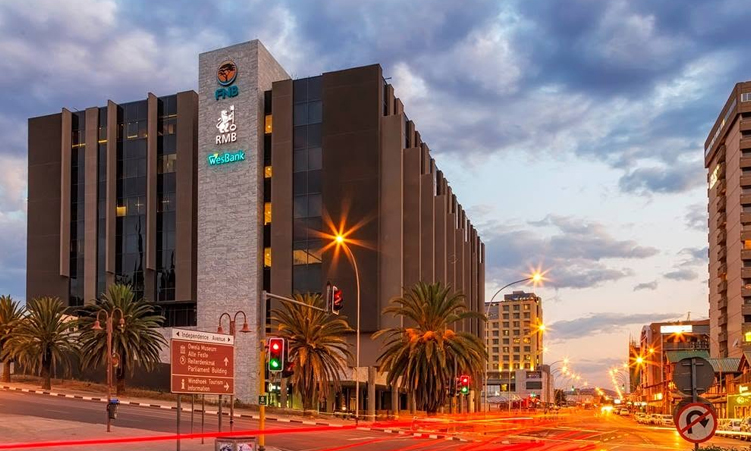
Firstrand Namibia reported a N$2.15-billion net profit for the year ended in June, boosted by corporate lending and reduced bad-debt provisions.
The group, which owns FNB Namibia and RMB Namibia, increased its profit from N$1.91 billion in the previous financial year.
Profit before tax rose by 12.7% to N$3.01 billion, while the group’s return on equity remained high at 28.5%.
FirstRand Namibia paid N$555 million in dividends to shareholders during the financial year, while customers earned N$2 billion in interest on their savings and investments, the group says.
The group says the dividend payout was made as it reported headline earnings of N$2.1 billion for the year and customer deposits of N$52.1 billion.
The majority of FirstRand Namibia’s shareholders are Namibian institutions and investors, according to the group.
FirstRand Namibia chairperson Otto Shikongo says the group had managed to grow despite the uncertain environment.
“Against a backdrop of global uncertainty and domestic economic resilience, FirstRand Namibia delivered a sound financial performance,” he says.
The bank earned its N$6.18 billion total income from two main sources.
Interest on loans made up 57% of income. Money earned from interest charged on loans (minus the interest paid to savings accounts) rose 9.4% to N$3.67 billion (up from N$3.36 billion in 2025).
Bank fees and services accounted for 43% of income. Earnings from transactional fees, card usage, insurance, and investments grew by 2.8% to N$2.77 billion (up from N$2.70 billion in 2025).
This increase came despite the bank scrapping fees on local debit card swipes and lowered charges on everyday transactions like CashPlus and internal money transfers.
MONEY SPENT
Running the bank cost N$3.12 billion in 2026, an 11.5% increase from N$2.80 billion in 2025.
The bank spent N$1.8 billion on its 2 486 employees (up 10.8% from N$1.6 billion in 2025).
N$658 million was spent upgrading information technology systems and digital banking tools (up from N$553 million in 2025).
N$1.8 billion was paid in direct and indirect taxes to the state fiscus.
Ordinary shareholders received 668.34 cents per share, a 40.3% jump compared to 476.34 cents per share in 2025.
The bank gave N$19.1 million to social community projects through the FirstRand Namibia Foundation (up from N$17.2 million in 2025).
The bank kept 87% of its procurement spending within Namibia to support local suppliers.
Chief financial officer Lizette Smit says: “The group delivered a strong financial performance in a changing operating environment, supported by a resilient customer franchise, disciplined balance sheet growth, prudent risk management and continued investment in operational capacity.”
THE LOAN BOOK
Overall, total money lent out by the bank (gross advances) grew by 9.2% to N$42.81 billion, up from N$39.22 billion in 2025.
Large Corporates were the largest borrowers with their loan book going up by 35.0% to N$11.0 billion (up from N$8.1 billion in 2025).
Corporate lending now makes up 25% of all bank loans, up from 20% last year.
Borrowing by individuals went up by 3.0% to N$24.3 billion (up from N$23.6 billion in 2025). Home loans made up 44% of the bank’s total loans, a decrease from 46% in 2025.
Lending to local businesses stood at N$8.9 billion (slightly down from N$9.0 billion in 2025).
The group’s credit loss ratio fell to 0.6%, from 1.3% a year earlier.
Non-performing loans remained at 3.8%, below the banking industry average of 4.2%.
Money set aside for bad loans decreased by 52.8% to N$249 million (down from N$527 million in 2025).
Chief executive Conrad Dempsey says: “Disciplined risk management remains fundamental to protecting shareholder value, maintaining financial system stability and preserving the capacity to support customers through economic cycles.”
The report warns about several risks that could impact the bank and its customers.
It says fraud attempts and online scams continue to rise, with operational losses reaching 0.45% of gross income (up from 0.40% in 2025).
Finding specialised technical and risk management talent in Namibia remains difficult, forcing the bank to spend N$18.1 million on employee training.
Global conflicts (like tensions in the Middle East) risk causing higher shipping costs and price inflation in Namibia.
Severe droughts continue to strain farmers, creating repayment risks for agricultural loans.
FUTURE PLANS
Looking ahead, FirstRand Namibia plans to focus on expanding its footprint.
The report says the bank is preparing specialised financial services to support local businesses supplying Namibia’s emerging offshore oil, gas, and green hydrogen projects.
The bank is planning on expanding its CashPlus agency network from 371 agents in 2025 to 486 agents in 2026, while helping small business owners access credit through its SME Digital Hub.
Reflecting on the year, Dempsey says: “The 2026 financial year was characterised by disciplined execution, resilient franchise growth and a continued focus on creating shared value for stakeholders.”