



Noun fem·cee ‘fem-se: A woman who raps or freestyles. The feminine equivalent of ’emcee’.
The gradual growth of hip-hop culture in Namibia has seen old and new artists alike contribute to a genre that wasn’t acknowledged a few years ago.
Even though it faces serious competition against popular genres such as kwaito, house, gospel and Afro-pop, there have been artists who have left their mark on the industry.
Undeniably, when digging deeper into the genre, it’s easily noticed that hip-hop is mainly dominated by male artists.
While it is harder for artists in this genre to break into the mainstream, female emcees, or ‘femcees’ for short, are hardly recognised.
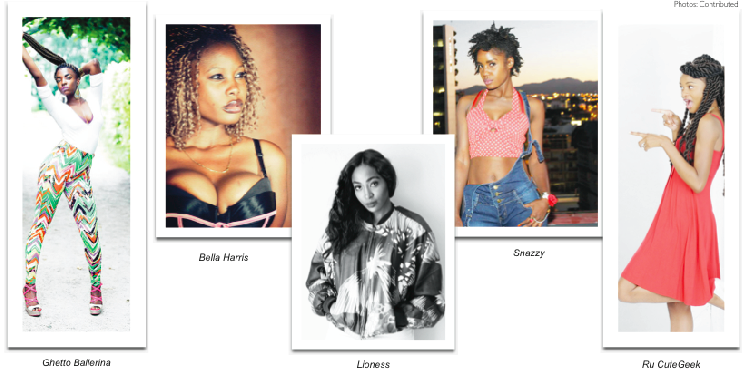
The Weekender sat down with Lioness, Ghetto Ballerina and Bella Harris, and now retired femcees Snazzy and Ru CuteGeek who spoke about their journey and the challenges of breaking into the industry.
Lioness, real name La-Toya Mwoombola, is a 23-year-old medicine student at the University of Namibia. Her interest in music started in 2008 when she would watch her sister, producer GinaJeanz, make music.
“I was very intrigued by how she put different sounds together to create one sound,” she said. At the time, Gina was producing a beat for female rapper and friend, Snowflake.
“I decided to write something to that beat with hopes of her recognising that I had talent. She acknowledged my effort but that was it,” she said.
Lioness was then asked to participate in a female cypher at RUK Studios and was well-received. Since then, she has worked with artists such as Quido, Catty Catt and Sinna G.
“Slowly but surely, I started getting noticed by other hip-hop giants such as KK, KP Illest, D-Jay, Reyne (Mad Boy Genius) and Low Ski (now Just Robert) as well as other artists.”
She is currently working on her second EP, ‘Ill 4: The Sequel’.
Twenty-seven-year-old veterinarian Ghetto Ballerina (Esmeralda Garus-oas) said Moscow was where she started her career as a hip-hop artist while at university.
For ‘Middlefinga In The Air’ rapper Bella Harris, it started out as a favour for a friend. “I started out writing rhymes for a friend who ended up convincing me to try rapping myself, and it worked! It wasn’t a priority for me then but at some stage I got into it to the point that I’ve made sacrifices for my music.”
Throwback femcee Ru CuteGeek decided to jokingly record a song to one of her friend’s beats, which turned into the release of her single ‘Million Dollar Chick’.
“Before long, I had people contacting me to perform it at shows and the demand for more CuteGeek music was growing,” she said.
Another female rapper worth reminiscing about is Snazzy, whose ‘Say My Name’ single won her two awards at the 2003 Sanlam NBC Namibia Music Awards.
“When I was 14, I was part of the Pepsi Star Search competition and since there were other girls who could sing too, I wanted to be different and I wanted the judges to consider me. I also wanted to have something they could remember me by, so I started rapping to be different,” she said.
A major factor that comes with being a woman in the hip-hop game is the perception the audience or male rappers have about their appearance.
“I am always conscious about how I dress and how I represent myself. People usually expect us to show more skin and use our bodies to accentuate our skill,” Lioness pointed out.
As an independent artist, Ghetto Ballerina says that she does not feel the need to bare all to get people to ‘vibe’ with her, which could be expected from artists signed to bigger labels.
“I actually believe we have a lot of talented female hip-hop artists in Namibia, but because we are female, we just expect our music to work for us, which is not the case at all,” said Ru.
She added that she used to use fashion to her advantage to look peculiar and out of the ordinary as opposed to provocative.
However, for a female rapper in the industry, Bella mentioned that men have made indirect advancements in professional settings, making the work environment uncomfortable.
“This is the reason I invested in my own studio so that I don’t have to be subjected to such disrespect.”
Female rappers have clearly been underestimated locally.
Lioness said that in some instances, men have disregarded her skills simply because she is a woman. People are said to make typical patriarchal comments about women not being able to get the job done as well as men and imply that they add little value to the industry.