EMILIE Hausiku is just a few metres away from reaching the Nathaniel Maxuilili Centre at Okahandja Park in Windhoek. Holding on to her two children, the 41-year-old mother hurries to the gated centre, fearing they won’t get anything to eat.
The centre is home to the Kobi and Hana Alexander soup kitchen.
When she reaches the centre, she quickly unties the baby carrier in which she carries her younger daughter. Her older daughter is standing beside her waiting for her directions.
“Now go, go I said,” she says to them.
Pleased with herself, she cautiously watches from a distance as they walk hand-in-hand to join a group of other underprivileged children lining up outside the soup kitchen.
She sighs with relief and quickly hurries back home after saying, “Just making sure they also get a plate to eat”.
Funded through the Kobi and Hana Alexander Charitable Foundation with help from the City of Windhoek, the Nathaniel Maxuilili soup kitchen is the largest in the country. Each school day 350 children from the informal settlements of Okahandja Park and Babylon line up at noon and in the afternoon to receive what may be their only meal for the day.
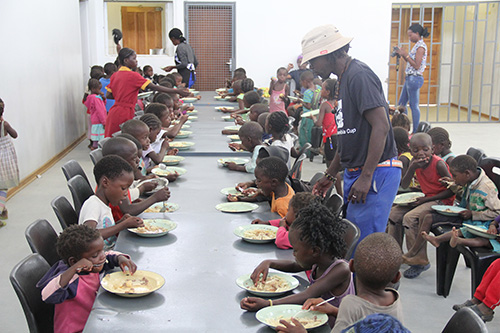
Inside the centre, Maria Shikongo (14) and her younger sister Ndapandula Shilomwenyo (3) have already secured a place to sit.
Amazed by the sight of the tables full of plates, they ready themselves to receive today’s meal – elbow macaroni pasta and ground beef (mince) – as the kitchen supervisor, Eunike Hedimbi (39) guards the doorway where another group of 96 children are waiting to be attended to.
Holding a registry list, she glanced through the door to inspect the growing line outside, and begins to carefully tick off each child’s name as they enter the hall. Among the group Petrina Kondja (13) and Daniel Magameno (2) have been waiting in anticipation all afternoon. They have a “finally” expression on their faces as they eventually pass through the entrance of the soup kitchen after being allowed in.
Hedimbi said parents register their children every year to include those that come to the kitchen for the first time, a precaution taken by the foundation to make sure that underprivileged and orphaned children like Kondja and Magameno are not left out.
Although her sole responsibility at the moment is to count the number of children entering the kitchen, she is easily distracted as they push and stomp on one another’s toes. Their little heads loom in the bright light, struggling against one another as they reach out their hands with a hunger-tortured expression on their faces.
“It is really sad to see that there are a lot of children out there that are not getting any food to eat. What the soup kitchen is doing is really good for these communities,” Hedimbi said.
Jimmy Jacobs, who manages the soup kitchen, said the idea for the project first came to Kobi and Hana five years ago when they saw the need to enrich and transform the lives of vulnerable and orphaned children from poverty-stricken communities. At the time the Alexanders were also managing another soup kitchen in Kuisebmond, Walvis Bay.
Then in 2010, they decided to expand the project to Windhoek. Today they feed up to 500 school children per day and care for dozens of homeless children, including disabled ones.
A single and unemployed mother of one, Martha Jonnas (24) herded her five-year-old child through the line. “Don’t give her too much as she won’t finish it,” she instructed. “She is only looking forward to desert.”
A few minutes later, Naemi Sheetekela, a full-time employee at the soup kitchen, hands her child a golden apple and Easter egg for desert. “For now we only give one apple and one Easter egg per person,” she said with a pleasant gap-toothed smile.
Although parents are required to enroll their children, Sheetekela added that there are usually a few more children in line that have not been catered for. As a result, the soup kitchen makes provision for those children.
“Look, it is hard to refuse food to people, especially children. So we also give food to those that came with others although they are not on the list. This is what a soup kitchen does,” she proclaims.
To date the Kobi and Hana Foundation has delivered over 500 000 good nutritional meals to vulnerable and orphaned children who visit the soup kitchens in Walvis Bay and Windhoek. Children of the likes of Shikongo (14) and Shilomwenyo say the kitchens have brought about a big change in their lives.
Hedimbi said before the establishment of the soup kitchen children went begging for food in the streets of Katutura and searched for leftovers in riverbeds and trash bins.
“They were not eating at home as most of their parents are unemployed. Those that have jobs must be at work when they come from school so nobody is there to give them lunch,” she said.
Petrina Kondja, the youngest of six children, said she only eats once a day.
“If I don’t eat here, there is nowhere else I can get food, except on some days when the neighbours decide to give me some of their food,” she said.
She said the kitchen has given her the opportunity to make friends and, most importantly, “to feed my empty stomach because I don’t eat at home”.
In an age of information overload, Sunrise is The Namibian’s morning briefing, delivered at 6h00 from Monday to Friday. It offers a curated rundown of the most important stories from the past 24 hours – occasionally with a light, witty touch. It’s an essential way to stay informed. Subscribe and join our newsletter community.

The Namibian uses AI tools to assist with improved quality, accuracy and efficiency, while maintaining editorial oversight and journalistic integrity.
Stay informed with The Namibian – your source for credible journalism. Get in-depth reporting and opinions for
only N$85 a month. Invest in journalism, invest in democracy –
Subscribe Now!