ABSALOM SHIGWEDHA WHAT do communal conservancies really do? What is it like living far from the city comfort with wild animals in your backyard?
That is what a group of Natural Resources students at the Polytechnic of Namibia wanted to find out when they recently took a 10-day trip to some communal conservancies in the north-west of Namibia. There, they explored the natural wilderness and beautiful landscapes and learned valuable lessons from communal conservancy managers.
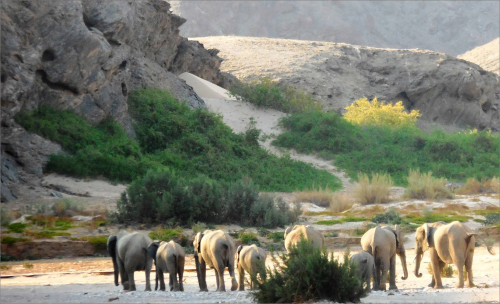
Sleeping outside near Hoanib in an unfenced community campsite at Khowarib and Purros, the students were exposed to wild animals such as elephants, lions and black-backed jackals.
According to the students’ trip report, they heard geckos at sunset, pearl owlets and scops owls at night as well as morning calls of red-billed francollins and others.
They saw soil exposed to severe erosion due to overgrazing and deforestation, noted severe stream bank-erosion along the meandering Khowarib, deep gulleys in the Hoanib tributaries and tunneling in the badlands near the Sesfontein turn-off.
The group visited different conservancies such as Sorris-Sorris, Torra, Anabeb, Purros and //Khoadi //Hoas, the Integrated Rural Development and Nature Conservation (IRDNC) and Save the Rhino Trust (SRT). At Sorris-Sorris conservancy, the students met Davis Uiseb, while at Torra they sat with Emil Roman. At Anabeb conservancy, they were met by Steve Kaisuma alongside committee members and game guards, to share their experience.
At Sesfontein, the group was shown the Vanishing King video by Emsie Vervey, who works with predators in the river and at Purros conservancy (fountain area), they were welcomed by Edison Kasupi, who introduced them to the conservancy committee and staff.
A member of the traditional authority showed them a perfume extracted from commiphora wildii.
Twice, they enjoyed welcome swims at the Khowarib community campsite so well run by Josephine and Memory and on their last day, they were welcomed with a meal of oryx and pap and a wealth of information freely shared by Holge-Lisa Gawises at //Khaodi //Hoas.
“We learn that all conservancies are aimed at conservation, promoting sustainable management and utilisation of natural resources to benefit the community through economic empowerment. We also came to realise that conservancy life is not easy. Although the people aim to live in harmony with wildlife, they do experience human-wildlife conflict, mostly with elephants and spotted hyaenas,”said the students.
They also learned that to avoid these conflicts, communities have predator-proof kraals and elephant-protected water points, often with alternate water points for elephants.
They were inspired by real life stories from legendary conservationist Axel Hartmann of the SRT, of how rhino trackers do regular patrols over 30 km daily to monitor and save rhinos from poachers.
All in all, the trip was fun and they will always remember sitting on top of their truck with binoculars watching out for wildlife and hanging on.
The students were accompanied by their lecturers, Shirley Bethune and Richard Kavari.
absalom.shigwedha@gmail.com