





Having completed a curatorial bootcamp facilitated by the National Gallery and the Goethe-Institut Namibia earlier this year, Buhle Ndhlovu is one of Windhoek’s newest and most promising curators.
This is clear in her curatorial debut exhibition ‘Ephemera’, which opened at the Goethe-Institut on 5 November and will run until 22 November.
In it, Ndhlovu emphasises how impactful art can be in interrogating and questioning societal norms, constructs and issues.
Collaborating with three women artists – Bupe Chiwala, Neige Moongo and Julia ‘JuliArt’ Hango – ‘Ephemera’ centres on feminism and the positions of women in a Namibian context, and expressed through performance art.
“It’s about things that are transient and temporary and only last for a day, and it relates to practices, rituals, events that are short-lived and that can – if not curated, collected and dissimenated – pass from memory,” says Ndhlovu.
From Chiwala’s opening night performance piece in which she used movement and dance to express different stages of womanhood to a screening of Hango’s previous perfomance piece ‘The Witch as the Feminist Archetype – Witches, Sluts and Feminists. The Trifecta of Terror for Patriarchy. A Radical Gesture and Ode to John’s Mother’, which interrogates the intersectionality of colonial and cultural oppression on Aawambo women.
‘What is Freedom’ is a piece where Hango sits with a group of Himba women selling jewellery at Swakopmund and holds a conversation with them about expression, freedom and nudity. Where their nudity is culturally perceived as acceptable, hers as an artist who likes to explore the body and its relations to nudity is often not.
Ndhlovu’s style of curation broke away from the traditional, where there are images on the wall to be gazed at by spectators, partly due to the performance aspect of the works. The exhibition and the opening in particular emphasised audience involvement and removed the veil between the spectator and the spectated, and in Moongo’s piece ‘H.u.man’, the blurred lines of division were only made more clear.
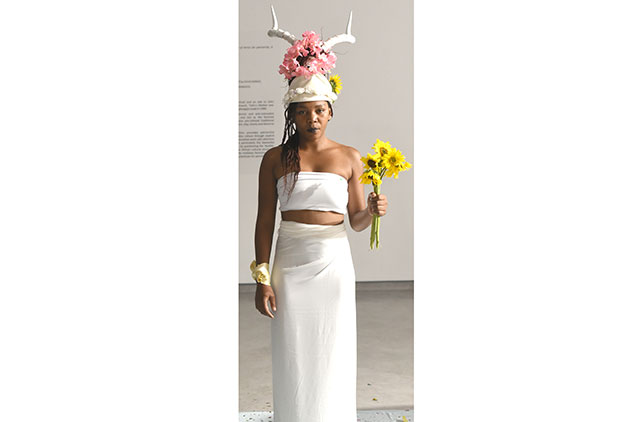
Walking into the exhibition hall, the audience is met by Moongo, dressed in a white gown and a crown of sun-bleached horns. To her left is a table draped with a white tablecloth. A gun, flowers, eggs, a packet of condoms and other random objects are placed on the table and a message invites the audience to participate and interact with the artist using any of the objects on display.
Looking at Moongo standing defiantly but eerily quiet in the centre of the room, and looking to her left back at the table, the audience hesitantly starts to engage with the objects, inspecting them and thinking about what to do with them, before walking over towards Moongo and interacting with her.
It starts innocently enough, a man places a pink flower garland on her horns, another lays flower petals at her feet and someone puts sunflowers in her left hand.
And then it gets weird. People get more bold. Some start writing on her with markers and paint. Another breaks and egg over her shoulder, another binds her with rope, someone handcuffs her. Another offers her red wine to drink.
Someone puts a red thong in her mouth; I remove it. Someone puts a bandage over her lips; I remove it. With the initial shyness and hesitation gone, the audience almost seems like they are in a trance and become completely unaware of the cameras filming their interactions. But after almost an hour, they start to trickle away and head outside, some out of boredom at having been given the freedom to do whatever they wanted to the artist.
A homage to Marina Abramovic’s work ‘Rhythm 0’ (1974), which reached violent extremes of what people thought was acceptable to do to the artist, Moongo’s crowd was a little more tame in their interactions. But there was something uncomfortable about watching how people interacted with her, particularly because there were no limits placed on what they could do. Some felt jusitified to interact with her in ways that would normally be considered abusive.
It showed how often, when we think about the violence and abuse of women, we may think of clear stark expressions, but we forget the quiet forms of violence, the overstepping of boundaries and not asking for consent.
It was interesting to talk to the other ‘spectators’ about how they felt. Some were uncomfortable with what others were doing to Moongo, but were afraid to intervene. Others like myself felt the need to protect her. Some hugged and cleaned her and the whole experience left all of us questioning our engagement with the artist – and perhaps our own complicity in abuse, violence and the celebration or reverence of women and their bodies quite often in a public space.
‘Ephemera”s ephemerality was poignantly clear. The exhibition can still be viewed at the Goethe-Institut, albeit only through screenings of the performances from the opening night.
Having been there in person to experience and feel the sense of connectedness and transience of the performances, the energy was palpable. As was witnessing the energy in the room become part of the art itself.

