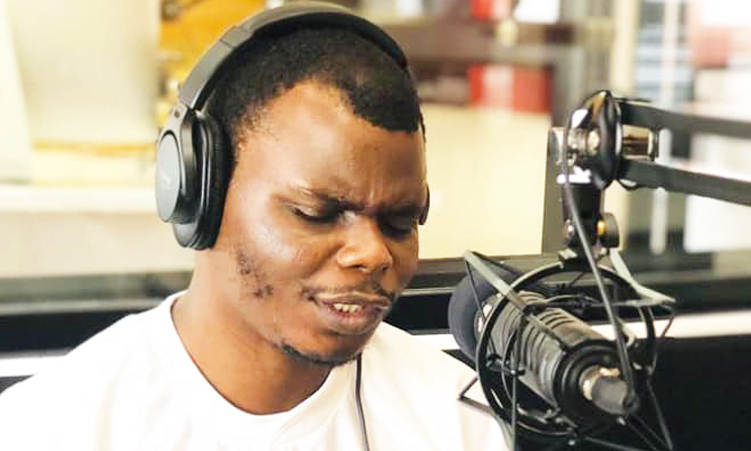
When Frans Sinangela (41) was young, his father called him Steve Kekana, after the legendary blind
South African musician whose music inspired many across the continent.
At the time, it was an affectionate nickname motivated by a little boy’s love for music.
This was almost prophetic.
Sinangela has grown into a respected radio journalist, musician and disability rights advocate whose voice reaches audiences far beyond the airwaves.
His journey, however, began with challenges many could never imagine.
Born blind in the Zambezi region, Sinangela was once told he could not attend school because there was no way to teach him to read or write.
It would take years before he found a school where he truly belonged, laying the foundation for a career built on resilience, faith and the determination to challenge perceptions of disability.
The Namibian spoke to Sinangela on the ‘WeSpeak’ podcast, a platform that gives people with disabilities the opportunity to tell their own stories under the slogan ‘Nothing About Us Without Us’.
Q: Who is Frans Sinangela?
A: My full name is Frans Akayombokwa Sinangela. I was born at Schuckmannsburg village [Luhonono] in the Zambezi region. I grew up there before later moving for school. Today, I’m a radio journalist and anchor. I focus on international geopolitics, history, religion and culture. I’m also passionate about disability advocacy and music.
Q: What passions have shaped your life?
A: Music is one of my biggest passions. I would say I’m 70% music and 30% other things. I love creating music and learning production so I can express what I hear inside myself.
Radio is another passion. In our days, radio was everything. We had no television and no cellphones. We listened to presenters who inspired us. That planted something in me. I also value faith. Christianity gave me strength when life was difficult.
Q: What role did faith play in your upbringing?
A: When I was born, many people believed blindness was a curse. Imagine growing up hearing that. It can confuse and hurt you deeply. What helped me was believing there is a God who understands me. My faith is personal, because I’ve experienced help and protection in my life.
Q: What was it like being a blind child in Namibia?
A: It was not easy. My parents were teachers, and I grew up near schools. Teachers could see I was smart, but they said I couldn’t continue because I couldn’t read or write like others. There were no Braille machines and little understanding of how to teach blind pupils.
I remember asking my father why I couldn’t go to school. He said others could read and write, but I couldn’t. That broke me, because every child is told education is the road to the future.
Q: When did things begin to change?
A: Around 1995, my father heard about a school for the blind in the Oshana region. That brought hope. Later I moved and entered a system that could accommodate me.
On that first day when I realised everyone at the school was blind, I was happy. I met older boys also living like me. It made me feel I belonged. For the first time, I was not alone.
Q: Were there setbacks at the time?
A: Yes, I should have been in Grade 6 by then, but I had to go back to Grade 1 so I could learn Braille and basic skills. It was difficult, but necessary.
Q: One of your proudest moments was voting in Braille. Tell us more.
A: Braille ballots were available in 2004. I voted at Katima Mulilo. To read the names myself and choose privately was profound. It meant dignity. It meant my vote was truly secret. I felt respected as a citizen.
Q: How do you view progress for people with disabilities in Namibia?
A: There has been progress, yes. Some blind pupils have completed school, some have gone for further studies, and some have become teachers. Seeing blind teachers return has inspired many of us.
There are treaties and policies, but many remain words on paper. There are victories here and there, but much more needs to be done.
Q: Is enough being done to create jobs for people with disabilities?
A: No, not enough. But the issue must be looked at fairly. Many people with disabilities have been denied equal education and support from the start. Then later, they are expected to compete equally in the job market. That is not fair.
The problem is not that people with disabilities are incompetent. The problem is incompetence by design. Society fails to prepare them, then blames them later.
Q: What should the government and employers do differently?
A: They must understand equity properly. Equity means meeting people where they are and helping them reach the same level of opportunity.
Do not judge someone by their appearance. Look at their ability, potential and what support they need. Give people a chance to prove themselves.
Q: What message do you have for people with disabilities?
A: I speak frankly. I tell people not to wait for pity. Pity does not pay electricity. Pity does not recharge your phone.
Learn a skill. Work hard. Build yourself. Rights are important, but we must also be ready to contribute to the economy.
Q: Tell us about your music journey.
A: At school I found instruments like guitars, drums and keyboards. I loved music from childhood. My father used to call me ‘Steve Kekana’. Later I played the keyboard in church for about 12 years.
I also made an album in 2014. It did not go as far as I had hoped, but people appreciated it. Music has also helped me survive through performances at weddings, memorial services and events.
Q: What is your final message to Namibia?
A: Stop judging a book by its cover. Read the content first.
People with disabilities are not unable. They simply have a disability. Give them opportunities. Let them prove themselves.
And to people with disabilities: Build skills, keep pushing, and never believe you’re less than anyone else.
– This article was produced in partnership with the NMT Media Foundation. Check out our YouTube channel for the full interview.