







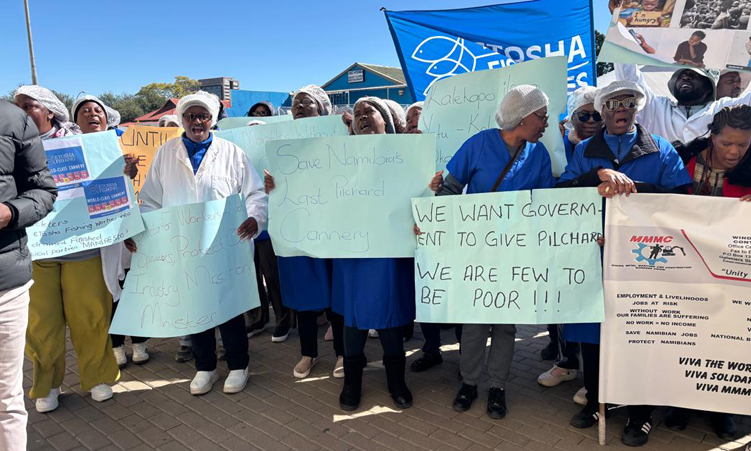
The Cabinet has approved the allocation of a horse mackerel quota to Etosha Fishing Corporation, bringing relief to hundreds of workers who have been without employment for seven months.
The announcement was made by the deputy executive director in the Ministry of Agriculture, Fisheries, Water and Land Reform, Ueritjiua Kauaria, at a demonstration by Etosha Fishing Corporation employees in Windhoek yesterday.
“The quota which was given to us by the Cabinet.
I can assure you that the horse mackerel should be allocated to you by next Tuesday.
Not pilchard, but horse mackerel, which should keep you busy in the meantime while we are sorting out the pilchard quota,” he said.
However, he did not indicate how much quota has been allocated.
The workers, who travelled from Walvis Bay, handed over a petition demanding fishing quota to enable the company to resume operations and re-employ its workforce.
Etosha Fishing is Namibia’s only operational and internationally accredited pilchard cannery and employs about 430 seasonal workers.
Many of these employees have been out of work for seven months due to the lack of fishing quotas.
Responding to demands for a pilchard quota, Kauaria explained that no company currently holds valid pilchard fishing rights following the collapse of the stock and the subsequent moratorium.
He stressed that Etosha Fishing is not being singled out or targeted by the government.
According to him, the company is particularly affected because its operations depend almost entirely on pilchard processing.
As a result, the government previously granted a precautionary quota to help sustain the cannery and protect the investment.
“We understand the plight of the workers.
We understand that you need an income and that is why quotas can be allocated to support employment.
It is unfair to create the impression that the government or the ministry does not care about the people. That is not correct,” he pointed out.
Kauaria also rejected claims that ministry officials are indifferent to the workers’ situation, saying officials continue to work daily to resolve challenges surrounding quota allocations.
One of the workers, Elizabeth Shefike, who has worked for the company for more than 20 years, welcomes the development but questions why it took a protest for action to be taken.
“I am grateful because next week we can return to work, buy food and pay school fees for our children.
However, why does the government always wait for us to demonstrate before acting? Must we first suffer before our struggles are noticed?” she asks.
Meanwhile, Metal, Mining, Maritime and Construction Workers Union secretary general Joseph Garoeb calls for seasonal contracts to be replaced with permanent employment.
He also urges the government to ensure that pilchard catches are processed locally rather than exported frozen while local canneries remain underutilised.
“Every month of delay reduces economic activity at Walvis Bay and throughout Namibia.
Workers believe an allocation of between 10 000 and 30 000 tonnes would protect jobs and support value addition without jeopardising stock recovery,” he says.
Garoeb further announced plans to establish a trust wealth fund for fishing employees to cushion them against future industry disruptions.
The developments come as Swapo parliamentarian Salomon April has tabled a motion in parliament calling for an investigation into the country’s fishing quota allocation system amid concerns that it disproportionately benefits a few wealthy individuals.