




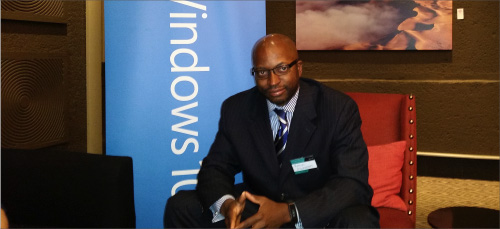
KAWELA M’ULE AN intimate roundtable discussion on ‘Empowering Your Business’ took place on Tuesday at the Windhoek Country Club and Resort hosted by Microsoft experts from around Africa.
The customer roundtable discussion was held by several Microsoft experts in Sub-Saharan Africa such as Sebuh Haileleul, Rami Azzi, Dele Akinsade and the Windows Business Group director Rotimi Olumide.
The discussion, divided into a customer and partner discussion, centred around the growing trend in the digital world of managing copious amounts of data businesspersons interact with on a cloud service.
CLOUD COMPUTING
Managing information on a cloud system allows files to be shared easily with employees in a department, according to Windows business group director Rotimi Olumide, who added “what we do is provide you with the platforms to manage your systems efficiently.”
Olumide explained that cloud computing involves managing data and information over third-party data centres on the internet as opposed to using computer hard drives to store information. A common cloud service that people use to store and share documents would for example be DropBox.
The migration from using local storage to that of cloud storage allows for flexibility. Businesses can easily gain access to these cloud services from anywhere over several devices. You are therefore not limited to working for one device because your storage system is managed over the internet, as explained by Sebuh Haileleul, the general manager for Microsoft East Southern Africa .
The only limitation that will come about from using such services is the access to fully functioning ICTs.
BRIDGING THE DIGITAL DIVIDE
Haileleul said Microsoft’s aim is to have “a PC in every home.” Haileleul acknowledged that despite this movement to cloud computing, “we know there is still a tremendous amount of opportunity to bridge the gap, in terms of bringing the citizens around the world online. This is especially important in African countries”.
He added that this was the motivation behind Microsoft’s chief executive officer Satya Nadel launching Windows in Kenya in July. Haileleul said Nadel’s plan was to observe technology development in Africa and how it affects users, especially the youth.
Olumide also said he noticed that access to technology in Africa was more expensive than in countries such as the United States where he had worked before. He believes that Africa is in fact not far behind as they are more innovative than their counterparts in the West.
The main business concerns today are securing data, especially when managed on a cloud system. In his presentation, Azzi talked of ‘Reinventing Productivity with Microsoft Office.
Azzi said the company had continued to “make sure it is a secure plan”. Microsoft’s approach of late seems to cater more to enterprises around the world, with Windows 10 Enterprise being offered as an upgrade to companies holding a large volume licence of people who have owned the Windows business edition licence.
Although Microsoft claims to have a more comprehensive data centre than its competitors, there is no such data centre available in Africa. It was however indicated that Microsoft is in the process of choosing which country will host this data centre.
CLOUD SERVICES IN NAMIBIA
Document management company The Document Warehouse use both cloud and local servers for their customers and their internal management.
They make use of services such as M-Flies Cloud services, Google Services including Google Works, Enterprise Mail and Evernote Cloud Services, stated in an email by managing director Wouter van Zijl.
“The Document Warehouse offers an in-country hosting service for use in cases where the location of data is a legal or security issue and offer electronic archiving services, either in country or in the cloud,” van Zijl added.
In addition to issues of security, access to reliable internet is another hindering factor of making full use of cloud computing, said Vanessa Maresch, business development manager from local ICT service provider Salt Essential IT.
“Cloud is useless if you cannot get to it,” emphasised Maresch. She cleared this up by saying that the functionality of cloud computer is primarily internet-based. Of late, the prices for faster and more reliable internet connections are on the decrease. More people have access to more reliable internet connections, she said.
Businesses utilising cloud computing are buying redundant connectivity. With more than one internet connection they are able to have a back-up connection in case their other internet connection fails on them, said Maresch.