





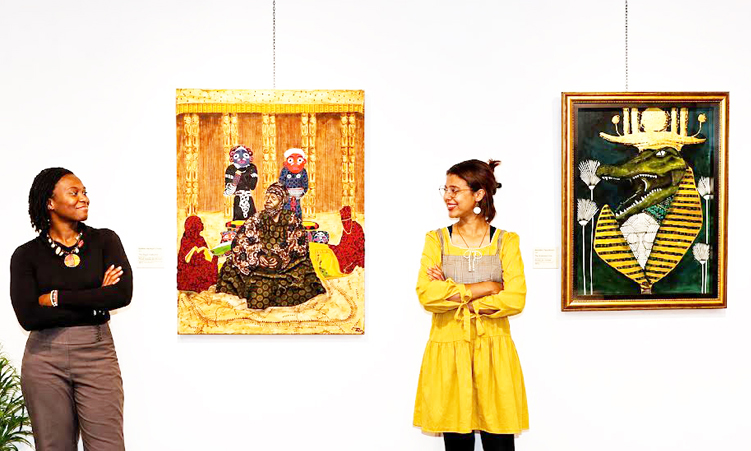
Legends of kings, queens, deities and heroes among men echo through a grove conjured by artists Esneya Zulu and Jodine Strauss at the National Art Gallery of Namibia.
Surrounding the green is the artists’ ‘Giants of Africa’, an illuminating collection of portraits and pieces celebrating influential African figures rendered in paint, traditional fabric, beads, cowry shells and imitation gold leaf.
For patrons stepping into the upper gallery, faux grass depresses underfoot as one moves around a reconstruction of various African cultures’ sacred sites of ritual, ceremony and healing.
Past a wooden throne, silent drums, items chronicling process and a wealth of leather, one comes face to face with such formidable figures as Emperor Menelik II and Empress Taytu of Ethiopia, Queen Ranavalona I of Madagascar, the Nigerian goddess Oya, and the praying mantis of local San mythology.
“The giants of Africa are leaders, kings, queens, emperors, empresses and deities from different countries and cultures across Africa, all from various eras, who played important roles in shaping the histories of their peoples,” says Zulu.
“Whether it was through employing ingenious military and political tactics to ward off colonial invaders like Ethiopia’s Menelik II and Taytu Betul, or fostering innovative infrastructural, cultural and educational development in their kingdoms like Cameroon’s Njoya of Bamum and Congo’s Shamba Bolongongo.
“Simply put, the giants were sons and daughters of Africa who loved and fought for her.”
The admiration the artists feel for each of their featured giants is evident in their canvases.
Sharing a mixed media language of beads, gold leaf, paint, chitenge and charcoal, Zulu and Strauss present a series of intricate and arresting frames filled with striking symbolism and subtext, mirrors and metaphor as well as insight into diverse African cultures, folklore and triumphs.
In Zulu’s imagining of an Ethiopian emperor and empress, the artist’s composition and sense of balance are inspired by a deck of cards.
“The artwork is designed to resemble the king and queen in a deck of playing cards, with Menelik mirrored by Taytu and vice versa,” says Zulu in the text alongside the artwork.
“The juxtaposition aims to illustrate how the two of them worked together in ruling the Ethiopian empire, most importantly during the Battle of Adwa, which allowed them to successfully protect it from European invaders,” Zulu says.
“Menelik wears his crown and wields his royal staff, showing his head-on role in the war. Taytu wears her crown and has chess pieces below hers, showing her role as the strategist.”
Somewhat lacking in featured Namibian giants in an intentional move to explore the continent and lesser-known figures, ‘Giants of Africa’ is an ambitious and promising showing by two recently graduated artists, one of whom assures a future ‘Giants of Namibia’.
“Jodine and I met at the College of the Arts in 2020 and have been pretty much inseparable ever since. We worked alongside each other on various projects at the college, and each explored the topic of culture for our final year – me with my Bemba/Nsenga culture and her with her Baster culture,” says Zulu.
“We both learned a lot from that experience and decided to continue with the same research-based approach to building a body of work.”
Zulu and Strauss are the first cohort of the gallery’s emerging artist programme.
The programme supports artists with fewer than two years of professional artistic practice, supporting the development of their artistic voice and the realisation of cohesive bodies of work under the guidance of the gallery.
It also gives artists the opportunity to work with curators, and receive curatorial feedback and facilitates conversation with more established practitioners and sister galleries.
This year’s professionalisation programme was supported by the National Museum of Namibia, the Namibian Arts Association, Space Dimensions, Ongoma Drum and Tuli Mekondjo.
“The emerging artist programme gave us a wonderful opportunity for this exhibition. This was not necessarily an easy journey and both the gallery and we, as a team, learned a lot,” Strauss says.
“Being the first on this project meant we helped shape this programme for future artists and we hope to create an easier path for other emerging artists.”
For Zulu, the programme had its challenges, but it was also a rare and blessed opportunity.
“We had a great team who took us under their wing. The curators, Ndeenda Shivute-Nakapunda, Buhlebenkosi Ndhlovu and Bayron van Wyk, really helped us grow as artists and gain a better understanding of the inner workings of the industry,” says Zulu.
“Of course, we cannot leave out the drivers, technicians and framers who helped us handle our artworks and create the incredible grove setting of the exhibition.
“Another part of the programme was connecting us with artists who could mentor us, such as the amazing Tuli Mekondjo, whom we had the pleasure of sitting down with one afternoon. She gave us some insightful advice and encouraged us to dream big.”
Meanwhile, the young artists invite patrons to the grove, which Zulu says is a sacred space for sharing knowledge and passing down cultures – intentions at the heart of ‘Giants of Africa’.
“We want to encourage people, especially young Africans, to educate themselves on the countless giants in Africa’s history whose stories and contributions have been erased and excluded from our history books,” says Zulu.
“Whether through academic research papers, essays or artistic expressions like music, dance, poetry or theatre, we hope to ignite a fire in them to tell their stories.”
– martha@namibian.com.na; Martha Mukaiwa on Twitter and Instagram; marthamukaiwa.com