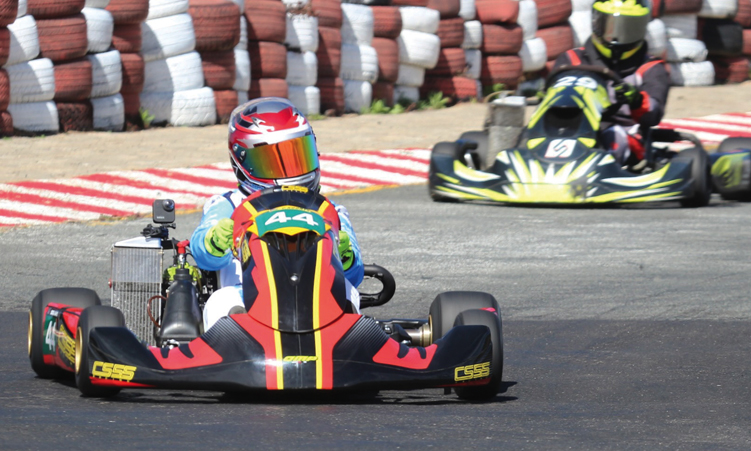
The Tony Rust race track outside Windhoek made history this past weekend as the first three electric-powered go-karts on the continent took to the track.
While a first for Africa, the karts are still being closely scrutinised by local racers accustomed to the roar of internal combustion engines and the intensive mechanical tuning required before a race.
In contrast, electric karts are quiet, require minimal maintenance, and are tuned via computer.
“This is an awkward thing,” Mandume Kaiyamo (12) said on Saturday.
Describing the experience, he said: “The cars are very slippery against our two-stroke karts, and there is no sound.”
Kaiyamo and his brother, Nande, compete in South Africa under the GR brand.
Both are formidable competitors with sights set on local and international success.
Nande echoed his brother’s sentiments after his first drive in an electric kart: “It is actually nice, but it’s weird without any sound as we are used to the Rotax engines.”
Nande said the head-to-head racing with his brother was excellent, featuring several “switchbacks” – a racing manoeuvre used for overtaking.
While the youngsters’ excitement was evident, the long-term viability of the sport remains to be seen for those raised on two-stroke Mini Max engines.
Jurg Goldbeck, who spearheaded the initiative after extensive research and international travel, says this is a continental first.
The karts were featured in a show race during the third leg of the National Karting Championships.
The goal is to have the karts officially competing during the fourth leg in Windhoek next month.
Goldbeck says the class is already formalised as E-10 Mini and E-10 Bambini.
These are divided into two age groups (seven to 10 and nine to 13 years), comparable to the Micro Max and Mini Max categories.
He says while the units are essentially maintenance-free, the chain-driven engine sprocket still requires occasional attention.
Despite strong winds, the championships saw fierce competition across the Mini Max, Senior, and Junior Max categories, with narrow winning margins.
Cecil Koorts of Cema Racing describes the day as highly competitive, noting significant driver improvement since the first leg of the season.
“I’m glad they improved and are getting better; competition is always good,” he says.
Beyond the track, the karting community collected pet food and blankets for the Windhoek Society for the Prevention of Cruelty to Animals.
Koorts says the gesture was a way for racing families to support neglected animals and alleviate their plight.
The results are as follows:
Bambino: 1. RJ van Tonder; 2. Franco Steyn; 3. Luma dos Santos
Mini Rok (A): 1. Milla Botha; 2. Hermann Schouw; 3. Zune Viviers
Mini Rok (B): 1. Rocco van Eeden; 2. Milko Botha; 3. Francois Gouws
Mini Max: 1. Nande Kaiyamo; 2. Mandume Kaiyamo; 3. Milan Fischer
Junior Max (A): 1. Cecil Koorts (Jnr); 2. Noah Holtz; 3. Nicolais Mostert
Junior Max (B): 1. Marius Zandberg; 2. Heinrich Roos
DD2: 1. Kian Fussell; 2. Armand Botha; 3. Ezequiel dos Santos

The Tony Rust race track outside Windhoek made history this past weekend as the first three electric-powered go-karts on the continent took to the track.
While a first for Africa, the karts are still being closely scrutinised by local racers accustomed to the roar of internal combustion engines and the intensive mechanical tuning required before a race.
In contrast, electric karts are quiet, require minimal maintenance, and are tuned via computer.
“This is an awkward thing,” Mandume Kaiyamo (12) said on Saturday.
Describing the experience, he said: “The cars are very slippery against our two-stroke karts, and there is no sound.”
Kaiyamo and his brother, Nande, compete in South Africa under the GR brand.
Both are formidable competitors with sights set on local and international success.
Nande echoed his brother’s sentiments after his first drive in an electric kart: “It is actually nice, but it’s weird without any sound as we are used to the Rotax engines.”
Nande said the head-to-head racing with his brother was excellent, featuring several “switchbacks” – a racing manoeuvre used for overtaking.
While the youngsters’ excitement was evident, the long-term viability of the sport remains to be seen for those raised on two-stroke Mini Max engines.
Jurg Goldbeck, who spearheaded the initiative after extensive research and international travel, says this is a continental first.
The karts were featured in a show race during the third leg of the National Karting Championships.
The goal is to have the karts officially competing during the fourth leg in Windhoek next month.
Goldbeck says the class is already formalised as E-10 Mini and E-10 Bambini.
These are divided into two age groups (seven to 10 and nine to 13 years), comparable to the Micro Max and Mini Max categories.
He says while the units are essentially maintenance-free, the chain-driven engine sprocket still requires occasional attention.
Despite strong winds, the championships saw fierce competition across the Mini Max, Senior, and Junior Max categories, with narrow winning margins.
Cecil Koorts of Cema Racing describes the day as highly competitive, noting significant driver improvement since the first leg of the season.
“I’m glad they improved and are getting better; competition is always good,” he says.
Beyond the track, the karting community collected pet food and blankets for the Windhoek Society for the Prevention of Cruelty to Animals.
Koorts says the gesture was a way for racing families to support neglected animals and alleviate their plight.
The results are as follows:
Bambino: 1. RJ van Tonder; 2. Franco Steyn; 3. Luma dos Santos
Mini Rok (A): 1. Milla Botha; 2. Hermann Schouw; 3. Zune Viviers
Mini Rok (B): 1. Rocco van Eeden; 2. Milko Botha; 3. Francois Gouws
Mini Max: 1. Nande Kaiyamo; 2. Mandume Kaiyamo; 3. Milan Fischer
Junior Max (A): 1. Cecil Koorts (Jnr); 2. Noah Holtz; 3. Nicolais Mostert
Junior Max (B): 1. Marius Zandberg; 2. Heinrich Roos
DD2: 1. Kian Fussell; 2. Armand Botha; 3. Ezequiel dos Santos

In an age of information overload, Sunrise is The Namibian’s morning briefing, delivered at 6h00 from Monday to Friday. It offers a curated rundown of the most important stories from the past 24 hours – occasionally with a light, witty touch. It’s an essential way to stay informed. Subscribe and join our newsletter community.
The Namibian uses AI tools to assist with improved quality, accuracy and efficiency, while maintaining editorial oversight and journalistic integrity.
Stay informed with The Namibian – your source for credible journalism. Get in-depth reporting and opinions for
only N$85 a month. Invest in journalism, invest in democracy –
Subscribe Now!