






Global forest health has plunged to “dismal” levels and threatens the well-being of humanity, warns a damning report that highlights how financial systems are pouring money into land clearance and undermining efforts to reduce destruction.
Since 2021 when world leaders and corporate executives promised to halt deforestation, the new study found that forest loss has increased, driven by subsidies for livestock, monocrops, logging and other extractive industries.
Last year, 8.1m hectares of forest were burned, pulled or cut down.
A GRIM TREND
The world is now 63% off track to reach that goal, according to the latest Forest Declaration Assessment.
“Every year, the gap between commitments and reality grows wider, with devastating impacts on people, the climate and our economies,” said the lead author, Erin Matson of Climate Focus.
“Forests are non-negotiable infrastructure for a liveable planet. Continued failure to protect them puts our collective prosperity at risk.
“We already know what works to stop forest loss, but countries, companies, and investors are only scratching the surface.
And even those initial efforts are facing strong pushback from the standard bearers of an economic system built on forest destruction.”
Behind the grim trend is a grotesque imbalance between the finances devoted to extraction and conservation.
Agricultural industries, which have been responsible for 85% of forest loss over the past decade, have received average annual subsidies worth US$409 billion.
This is almost 70 times more than the US$5.9 billion of international public finance provided each year for forest protection and restoration.
“Efforts to protect forests don’t stand a chance as long as our economic system keeps rewarding quick profits from forest destruction,” said Franziska Haupt, a partner at Climate Focus.
“To truly tackle deforestation, leaders must work collectively to implement bold, binding reforms that will transform the system that still generously rewards forest loss.”
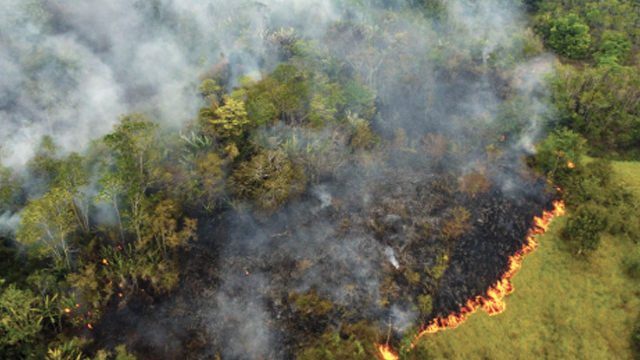
A growing cause of alarm is the spread of fire, which hit staggeringly high levels in the Amazon last year after record droughts turned swathes of the normally moist tropical rainforest into a tinderbox.
Many blazes are started deliberately to clear land and spread out of control.
The carbon dioxide released by the burning Amazon last year was seven times higher than the average over the previous two years and more than the total greenhouse gas emissions of Germany.
The fires are said to be pushing the forest closer to a point of no return.
‘OBSCENE PROFITS’
Private financial institutions are further tipping the balance.
A separate report released by Global Witness found that banks have made US$26 billion from financing deforesting companies since the Paris agreement was signed in 2015 – averaging around US$7 million every day.
United States banks earned the most globally, making US$5.4 billion, according to the watchdog group.
Chinese financial institutions secured US$1.2 billion, despite the country’s green finance policy supposedly restricting lending for companies with environmental or social governance concerns.
“We are witnessing major banks bankroll a fire sale of the world’s rainforests,” said Global Witness forests lead Alexandria Reid. “And they’re reaping obscene profits from the ashes.
“As long as tearing down forests remains more profitable than protecting them, the world will not meet its 2030 goal to halt deforestation, with catastrophic consequences for the climate.”
PRESERVATION
Hopes for change are focused on next month’s COP30 in Belem, the first climate summit to be held in the Amazon.
The host, Brazil, has shown in the past that it can dramatically slow the speed of deforestation by stricter enforcement of the law.
At COP30, it will also be proposing a new conservation funding mechanism, the Tropical Forests Forever Facility, which aims to raise US$125 billion for countries that preserve their standing forests.
“The overall numbers are dismal, but the future of forests doesn’t have to be,” said Matson.
– The Guardian. This article has been shortened; read it in full at the guardian.com