



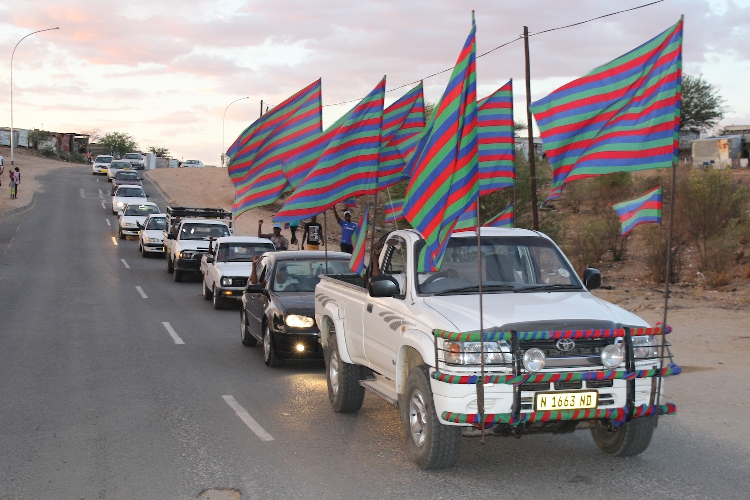
THE Swapo Party has won control of all of Namibia’s regional councils for the first time since the country’s independence – and with it the total domination of the National Council.
With Swapo candidates sweeping to victory in the majority of constituencies in Friday’s regional council elections, the ruling party has for the first time won the majority of seats in the Kunene regional council, which had been Namibia’s only opposition-controlled regional council.
Opposition party candidates were elected as regional councillors in only eight of Namibia’s 121 constituencies. With one independent candidate also scoring a surprise win over a Swapo rival and three opposition candidates in the Omaheke constituency of Otjombinde, Namibia’s voters have elected 112 regional councillors on a Swapo ticket, four for National Unity Democratic Organisation (Nudo), two representing DTA of Namibia, one each from the United Democratic Front (UDF) and United People’s Movement (UPM), and an independent.
Swapo won control of 54 of Namibia’s 57 local authorities, Nudo won the majority in two local authorities, but in another, the Aroab Village Council, opposition parties scored a combined majority over Swapo.
The Electoral Commission of Namibia had not yet announced a final voter turnout in the elections by late yesterday.
However judged by the emptiness of polling stations and absence of long queues at many venues on Friday, a low turnout of voters is expected – as had been experienced in most of Namibia’s previous regional and local authority elections.
Swapo won control of the Kunene regional council after ruling party candidates defeated opposition party rivals in the Khorixas, Kamanjab and Sesfontein constituencies, where the UDF had previously been the strongest party.
The only remaining opposition holdouts in Kunene are the Epupa and Opuwo rural constituencies, which were retained by the DTA of Namibia.
Having gained control of the Kunene regional council, Swapo now has majorities in all of Namibia’s regional councils, and all the 42 members of the next National Council – for which each of the country’s regional councils will elect three members from within their ranks – are expected to be from the ruling party.
While the UDF suffered heavy defeats at Khorixas, Sesfontein and Kamanjab, a victory for the party’s candidate in the Dâures constituency in Erongo, which the UDF lost to Swapo in 2010, sugar-coated the bitter pill of defeat that the party had to swallow.
Nudo held on to the three constituencies which it also won in the 2010 regional election – Aminuis and Otjinene in the Omaheke region, and Okakarara in Otjozondjupa – and bagged another constituency in Otjozondjupa, Omatako, which had been won by Swapo in 2010.
The Rally for Democracy and Progress lost the Windhoek East constituency, which it won in the 2010 regional council election, to Swapo, leaving the RDP with no wins in the 53 constituencies in which it had fielded candidates.
In the Hardap constituency of Rehoboth Urban West, agriculture deputy minister and Swapo candidate Theo Diergaardt lost his seat to Laurena Christ, a candidate nominated by the UPM, after Diergaardt received 1 479 votes to Christ’s 1 975.
Swapo went into the regional and local authority elections with a head start over its rivals, scoring uncontested wins in 26 constituencies in which its regional council candidates faced no competition from other candidates and in five local authorities where Swapo was the only party to nominate candidates.
PARTIES REACT
Swapo secretary general Nangolo Mbumba yesterday said the ruling party was pleasantly surprised by the results. With Swapo having won more than 90% of the regional council constituencies, the party would now have to get back to work to develop the country, he said.
“We are the owners of the land. We thank all those who participated in the process. We are humbled by their support,” Mbumba said, calling on citizens who did not participate in the election to do so next time.
DTA secretary general Elma Dienda also expressed happiness with the results.
“We have gained support in constituencies and other areas where we had nothing before. So it is a big deal, we are happy. In places like Karasburg, Lüderitz, Zambezi, Oshakati and Ondangwa where we had no support at all, we have now gained one or two [local authority] seats,” she said.
“I am happy we increased our seats at local authority level. I think the party did well during the campaigning process and also having youthful people as candidates brought in a lot of support from the youth, “ said Dienda.
RDP spokesperson Nghiningilwandubo Kashume attributed Swapo’s runaway victory to the use of electronic voting machines.
He said the results confirmed that “EVMs have been structured in a way that 80% of the votes goes to the ruling party and 20% is left for the opposition to share.
“In a democracy one cannot excuse oneself from the election process just because EVMs are being used. This is not the end of RDP. It is clear that [the] electorate wants to keep their party afloat but this gives us more courage to redouble our efforts and work hard,”Kashume said.