Going through some of my cookbooks I once more became aware of just how much cooking used to be a communal activity. Many great and classic dishes have been created around gatherings, events, social occasions and social structures such as clubs, associations, teams, churches and so forth.
To frame it in sociological terms, cooking is often an expression of the social cohesion of a community, a measure of the amount of social capital in that community.
There was a time when these communal efforts were published as cookbooks. I still own a fair number of these produced by various churches, cultural associations, agricultural unions and other organisations which we collectively call civil society.
The golden strand that connects all the organisations and their books, is volunteerism, i.e. the act of providing labour to communal projects without expecting or receiving financial reward in return.
Over the years, these collective cookbooks have all but completely disappeared. They have been replaced by individual authors such as relentless, celebrity chefs pushing their restaurants, or food cults or fulltime culinary nerds telling us how to cook the food we grew up with.
Then there is the internet and its over-sanitised, easy-to-use, technique-deprived culinary content.
It is no exaggeration that communal culinary artefacts such as cookbooks are dying because the very entities that produced them are dying; and they are dying because social capital and volunteerism are on a steady decline.
To paraphrase Robert Putnam, we are “cooking alone” as we are becoming increasingly disconnected from one another and as our social structures are disintegrating as a result.
Perhaps one of the best-known “community cookbooks” in our part of the world is ‘Indian Delights’, published by the Women’s Cultural Group of Durban. The first edition was published back in 1961 and it is currently in its 15th edition. It sold several hundred thousand copies over the years.
This book is not just a treasure trove of recipes, ingredients and techniques, but it also offers great insight into the life, customs and culture of the people who created it. It is so insightful and comprehensive that it was used for many years to teach young women basic culinary and household skills for the day she leaves her parents’ house.
In many respects, this book keeps the culinary traditions of South African Indians alive, while teaching outsiders all about the culture. This is a book with a purpose, and it is a treasure for all South Africans.
Another recent book in this vein is the Cape Women’s Agricultural Association’s collection of recipes contributed by its members over the past 90 years since its establishment in Franschhoek on 15 October 1929.
Published in Afrikaans as ‘Die VLV-Kookboek: Resepte van Toeka tot Nou’, the recipes in the book provide insight into how a particular segment of Afrikaner cuisine evolved over the past 90 years.
I would have thought the current pandemic would have brought local organisations or associations together to publish a cookbook or two to raise some funds or to lift our spirits. As far as I know, there has been no such efforts.
Is it too late for us? Are we “cooking alone”? Have we already severed ties between the old and the new? Have we already buried the traditional to plant the modern? Is there anyone left to write our culinary history and preserve our precious culture-specific Namibian recipes?
24 frozen oysters (or fresh)
Two tablespoons plain flour
Two tablespoons unsalted butter
500 millilitres milk
Two teaspoons medium-hot curry powder, or more to taste
Crispy, deep-fried onions, for garnish
1. (Skip this step if you are preparing fresh oysters) Preparing the oysters: Start by thawing the oysters. Place the oysters on a tray to catch all liquid as they are thawing. Their lids would pop open when they are defrosted. Once they are fully defrosted, it is time to loosen the flesh from the shells.
2. Prepare the oyster for baking. This is done by running a knife under the lid and cutting through the top muscle attached to the lid. Remove the lid and discard. Drain the liquid from the oyster and cut through the second muscle attaching the oyster to the shell at the bottom. Your oyster is now ready for cooking.
3. Pre-heat your oven to 200ºC.
4. Start by making a classic Béchamel (white) sauce. Melt the butter in a pan over medium heat. Whisk in the flour and curry powder to make a curry roux and heat until a smooth paste forms. This will allow the raw curry powder to cook out a little. Keep whisking to prevent the roux from sticking to the bottom.
6. When the sauce is done, set aside and start to prepare the oysters for grilling.
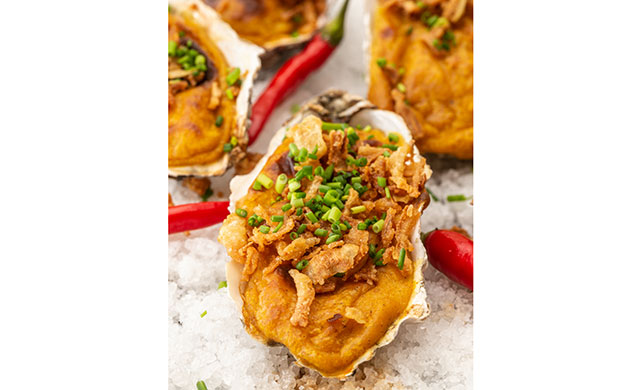
7. Prepare the oysters for grilling by lining a baking tray with coarse sea salt. Push each oyster lightly into the salt to make sure they are level and stable. Spoon curry sauce over each oyster making sure that they are well covered.
8. Place the tray with oysters into the pre-heated oven and bake the oysters for about 10 minutes or until the sauce starts to bubble and the crust is toasted golden brown. You could also place the oysters under the oven grill for about 5 or 6 minutes until they are ready.