•Laurent BANGUETEight hundred metres under the Antarctic ice, in the pitch dark, a vibrant community of rock-munching microbes are thriving in a submerged lake, researchers said on Wednesday.
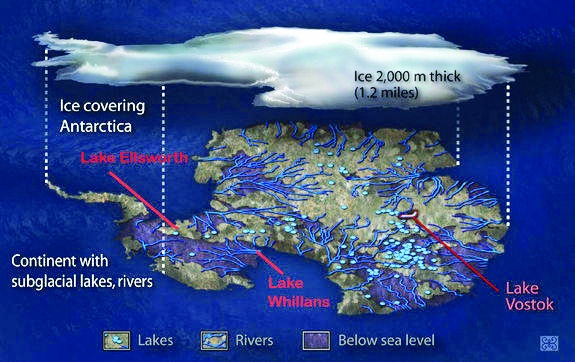
The water in Lake Whillans had been isolated from the surface for thousands of years, hidden under part of an ice sheet of 13 million square kilometres and scientists had no idea what kinds of life, if any, lurked there.
Until they drilled through the ice last year, that is, and took samples of the rock and sub-zero-degree-Celsius water of the lake.
The results, they reported in the journal Nature, may have implications for the likelihood of life existing in other extreme environments – on Earth and elsewhere in the Solar System.
The team found a “diverse microbial community” of at least 3 931 different species or groups of species, “many members of which can mine rocks for energy and use carbon dioxide as their source of carbon”.
“Given that more than 400 subglacial lakes and numerous rivers and streams are thought to exist beneath the Antarctic ice sheet, such ecosystems may be widespread,” said the US National Science Foundation (NSF), which funded the project dubbed Whillans Ice Stream Subglacial Access Research Drilling (Wissard).
A previous discovery by Russian scientists in 2012 of a potential new bacterial life form in Lake Vostok, the largest lake under the Antarctic ice sheet and one of the largest on Earth, was later thrown into question as contaminants were found to have been introduced by the research itself.
For the new study, a research team from the United States, Italy and Wales used a specially designed hot-water drill, fitted with filters and a germ-killing UV system to take what they called “pristine” water and sediment samples.
They drilled a well 60 centimetres in diameter through the 800 metre-thick ice sheet over four days in January 2013, at a point where the lake underneath was 2,2 metres deep.
The water was supplied mainly by surrounding ice melt.
In analysing the DNA of the micro-organisms in the samples, the team found that 87% were related to bacteria and 3,6% to single-celled organisms called Archaea.
Nearly 800 of the organisms could not be classified.
“The latest Wissard announcement is the first to provide definitive evidence that a functional microbial ecosystem exists beneath the Antarctic ice sheet, confirming more than a decade of speculation about life in this environment,” said an NSF statement.
In a comment also published by Nature, Martyn Tranter of the University of Bristol’s School of Geographical Sciences said the research showed that glaciers and ice-sheet beds were not sterile environments.
“The authors’ findings even beg the question of whether microbes could eat rock beneath ice sheets on extraterrestrial bodies such as Mars.”