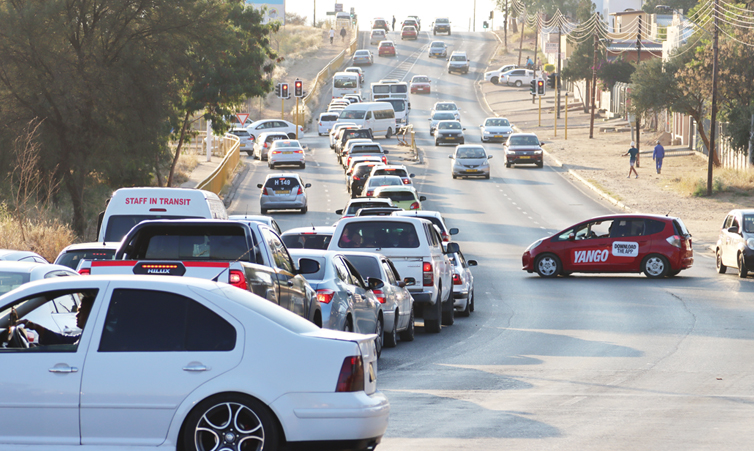
The City of Windhoek says traffic congestion in the capital is not a road problem, but an ‘urban mobility challenge’ that cannot be solved by building more roads alone.
In a media statement issued on Thursday, the city says congestion is “a symptom, rather than the underlying challenge”, adding that the city’s focus should be on providing safe, reliable, affordable and sustainable public transport for its growing population.
The city says commuters’ frustrations are justified, but international experience has shown that no major city has successfully eliminated congestion by continually expanding roads or upgrading intersections.
“The question is, therefore, not whether Windhoek needs better roads, to some extent it certainly does, but whether roads alone can provide a sustainable long-term solution. The answer is an overwhelming no,” the statement reads.
According to the municipality, most residents, particularly those living in the northwestern suburbs where congestion has become more noticeable, rely on public transport.
However, in the absence of a modern mass transit system, demand is almost entirely met by four-door sedan taxis, which contribute significantly to traffic volumes during peak hours.
The city says successful cities around the world combine strategic road infrastructure with efficient public transport, walking and cycling facilities, allowing thousands of people to move using far less road space than private vehicles.
It attributes Windhoek’s failure to establish such a system not to poor planning, but to inadequate funding.
The municipality says urban public transport requires both substantial capital investment and ongoing operational subsidies, and Namibia has yet to establish a sustainable funding mechanism to support such a system.
The city says over the past year it has been engaging the Ministry of Works and Transport and the Ministry of Urban and Rural Development to develop a sustainable funding framework for urban public transport.
The city says it is updating its integrated transport master plan, which includes traffic counts, travel demand forecasting and transport modelling to determine how people and goods will move across Windhoek over the next two decades.