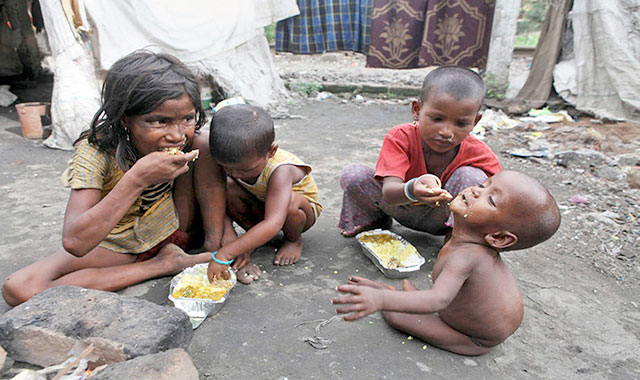
DHAKA – Fourteen-year-old Lamia, who uses a single name, looks younger than her actual age. She has been living in a slum in Bangladesh’s capital city of Dhaka.
The girl’s mother, Laila Begum, said malnutrition has affected her daughter both physically and mentally.
Begum and her day labourer husband cannot make enough money to even basically feed their five children, including Lamia.
Poverty-ridden Laila Begum has been living in the slum in Dhaka’s downtown Rupnagar area after they migrated to the capital city from Bhola, a southern coastal district, nearly 18 years ago when a swollen river devoured their land and home.
“I have five daughters. Among my daughters, Lamia is suffering the most from malnutrition. Everybody advised me to take her to a doctor. But we cannot afford at all to go and seek proper treatment for her.”
Like Lamia, many children living in Bangladesh’s slums suffer from malnutrition. The stories of most of the slum dwellers in Bangladesh cities and towns are almost identical.
Most of them had migrated from rural villages for economic reasons, but ended up living in unhealthy and inhuman conditions. Laila Begum’s slum is no exception.
Dhaka slums usually lack basic services, and often have many people crowded into small spaces.
Laila Begum, her husband and four daughters live a in a tiny room, with her eldest daughter leaving to get married easing the burden to some extent.
Urban slum children in Bangladesh often face hardships on a daily basis that include hunger, poor access to clean water, lack of education and threats from predators.
Many children are forced to take care of younger siblings, or to work, often precariously, instead of going to school.
Unicef Bangladesh has long been engaged with the Bangladeshi government’s efforts to support children living in the slums in Dhaka and other cities and towns elsewhere in the country.
Monira Parveen, nutrition officer of Unicef Bangladesh, said the overall nutrition situation in Bangladesh has been improving. But the rate of reduction is not satisfactory yet, she said.
“We still have a long way to go before we reach a satisfactory situation on nutrition.”
For urban slum children, Unicef and affiliated NGOs run schools which offer a stipend to inspire their parents to send them to school instead of sending them to work.
According to the country’s 2013 survey conducted in urban slums, half of children under five years old were stunted in growth. A more recent survey conducted in 2016 found 40% of the slum children were stunted, said Parveen.
“But if I look at the absolute number, the absolute number has been increased from 1,5 million to 2 million,” she said. “So, this is very, very alarming.”
Parveen said they live in extremely poor conditions, including in terms of hygiene and the environment.
“So, they have been suffering from a number of underlying causes. There are numbers of underlying factors contributing to the high rates of under-nutrition among the urban dwellers.”
For example, she said, the pregnant women and new mothers living in the slums are less likely to receive antenatal and post- antenatal care services, compared to the rural areas.
“And talking about underlying factors, like the water and sanitation conditions in urban areas, only two in 10 households have improved sanitation.”
She went on to explain that another health issue was a lack of hygiene, including correct hand-washing practice.
According to a 2016 child well-being survey, half of the households in the slum don’t have a proper place to wash their hands, Parveen said.
“So, these are the factors, causes and reasons for the high rates of malnutrition among urban slum dwellers,” she summarised, adding that “two-thirds of the children within six months to 24 months are underfed.”
Bangladeshi health minister Mohammad Nasim said nutrition would be another area where Bangladesh would prove its leadership under prime minister Sheikh Hasina’s active supervision. He said the Bangladesh National Nutrition Council has been revitalised, while the national plan of action for nutrition is being finalised.
He underscored the need for multi-sectoral coordination among global platforms, UN agencies, donor partners and civil society to help Bangladesh better serve its urban slum people where Lamia, like many children, hope for a better life.
In an age of information overload, Sunrise is The Namibian’s morning briefing, delivered at 6h00 from Monday to Friday. It offers a curated rundown of the most important stories from the past 24 hours – occasionally with a light, witty touch. It’s an essential way to stay informed. Subscribe and join our newsletter community.

The Namibian uses AI tools to assist with improved quality, accuracy and efficiency, while maintaining editorial oversight and journalistic integrity.
Stay informed with The Namibian – your source for credible journalism. Get in-depth reporting and opinions for
only N$85 a month. Invest in journalism, invest in democracy –
Subscribe Now!