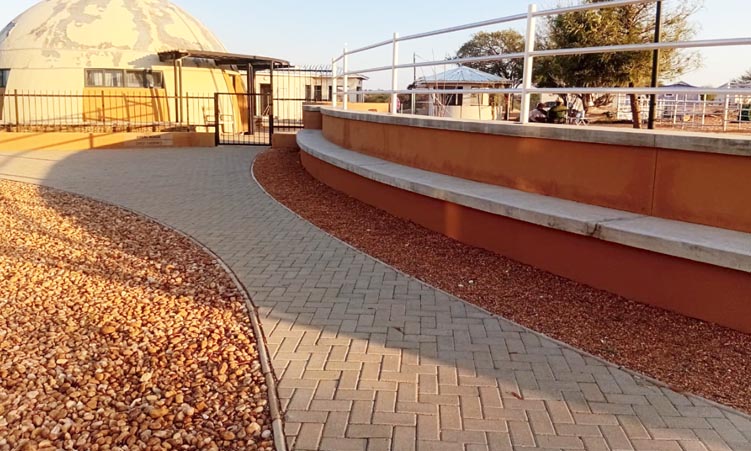
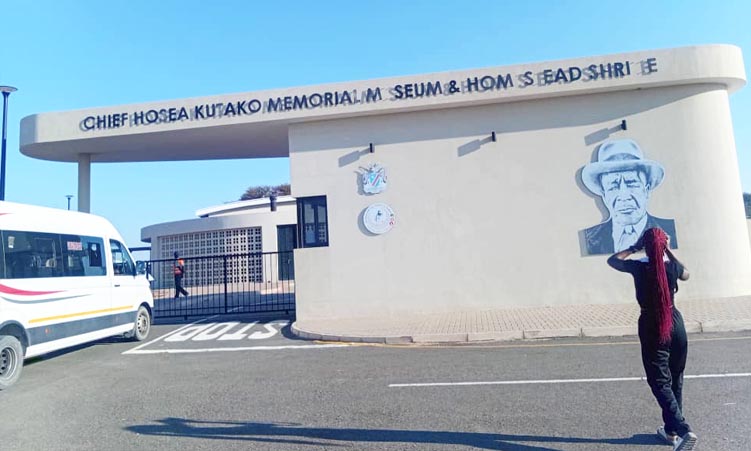
The Chief Hosea Kutako Memorial Museum and Shrine at Toasis village is a fitting tribute to a man who contributed so much in the fight for the country’s independence.
After touring the Omungwa salt pan in the Aminuis constituency of the Omaheke region on 3 August, the ministry of home affairs team that was conducting an e-ID awareness campaign also visited the shrine – to see the place that has become a tourist attraction, and pay tribute to the late national hero.
The shrine was officially inaugurated on 10 December 2024 by then president Nangolo Mbumba, honouring the legendary Ovaherero leader and national hero, Chief Hosea Kutako (1870–1970) who led resistance against German colonial and racist South African rule, and was among the first people to petition the United Nations against the illegal occupation of Namibia.
Homestead tour guide Ephelberth Teek, says the inauguration on 10 December coincided with the 65th anniversary of the forceful and bloody relocation of people from Old Location to Katutura in Windhoek on 10 December 1959, where Kakurukaze Mungunda, the only woman among the casualties, was shot dead. She was related to Chief Kutako.
Also named in his honour is the main international airport outside Windhoek, the Hosea Kutako International Airport.
Arriving at the imposing Hosea Kutako Memorial Museum and Shrine at Toasis, one is struck by that majestic aura of mystery, a link to the spiritual realm and feel of sacredness.
Chief Kutako’s historic dwelling place, which was declared a national heritage site in 2019, was renovated by the government and transformed into a museum and shrine to preserve his legacy of unity and freedom.
He was instrumental in uniting the different nationalist groups like Swanu and Ovamboland People’s Organisation under one umbrella group, the South West Africa People’s Organisation (Swapo).
The shrine has boosted local tourism and helps to educate future generations about Namibia’s liberation history.
On entering the complex, one is embraced by the awesome beauty and tranquillity of the place.
Even the tour guide of the day, Ihekua Kamburona from the National Heritage Council, spoke and gave directives in whispers, heightening the reverence.
The first stand-out landmark one sees upon entering the complex is the big tree with three big chairs next to it.
Under its shade Chief Hosea Kutako and his advisers drafted the petition to the United Nations for Namibia’s independence.
Next to the tree is the assembly area, what used to be the chief’s court.
The complex features a commemorative museum showcasing local community history and a traditional way of life.
In the centre of the courtyard stands the bronze bust of the late chief, symbolising his immortal fighting spirit that helped to bring Namibia’s independence, and elements centered on the sacred ancestral fire.
Chief Kutako helped Sam Nujoma go into exile on 1 March, 1960, helping him cross into Botswana to petition the United Nations and build the international and armed struggle for Namibia’s independence.
Other nationalists like Theo-Ben Gurirab and Hage Geingob used the same route into Botswana, where the chief had established reliable networks.
Kamburona led the visiting ministry delegation into the dome-shaped museum, where the chief’s traditional mud-and-cow dung hut once stood.
On display inside the museum are pictures of the late chief, depicting his life from childhood to old age, including with the people he rubbed shoulders with.
Also on display is the Lord’s prayer (in Otjiherero and translated into English) he wrote at the time of petitioning to the United Nations.
Kamburona confided that chief Kutako was a Christian pastor and founded the Protestant Unity Church (Oruwano), which was also reconstructed outside the homestead grounds, but he never abandoned his traditional beliefs.
Also on display in the museum is late chief’s shortened family tree from Ndjamo to Kujambera, Kamuatjimbonde, Kutako, and Henditja Mutanga Kutako up to Hosea Kutako.
Where the chief’s hut stood is a zinc structure housing chief Kutako’s personal belongings.
Before entering the ‘hut’ Kamburona gave a stern instruction: “Please do not touch anything inside . . . these were the late chief’s personal items.”
These include a table and chair on which he sat and wrote, a bed on which he slept, his bow and arrows for hunting, his walking stick, the calabash in which his omaere (milk) was kept, and the small gourd which contained his traditional perfume.
Beyond the museum is the holy place (onganda).
This is fenced from the museum and not everyone goes there. This is where visitors get traditional Herero blessings from the patriarch of the homestead, Vitara Mungendje.
Women wearing trousers are barred from entering the sacred courtyard. And due to this, most of the team’s female members did not visit this place.
Teek says most visitors to the place are school children who come to learn about Namibia’s history.
“The place still needs a lot of marketing for more foreign tourists to come here,” he says, adding that the completion of the tarred road between Aminuis and Aranos would boost numbers passing through the shrine with tourists travelling from South Africa to Etosha in the north, and even to the Okavango Delta in Botswana.
“The government, the Herero Traditional Authority and the people at the homestead should sit down and decide how the place can be managed for commercial benefit,” he says.
– email: matthew@namibian.com.na