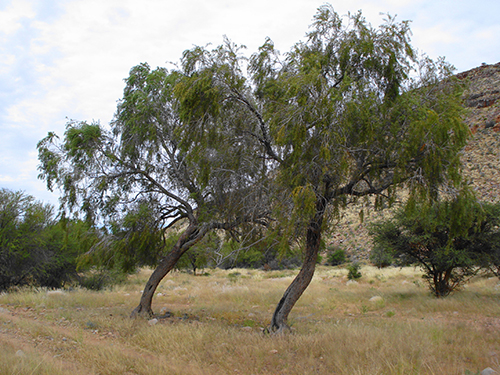
• LUISE HOFFMANNTHIS tree is always conspicuous because it grows in the dry sandy watercourses of the Namib and the adjacent semi-desert areas, spreading into the country south of Keetmanshoop.
The small, narrow leaves typically stand away from the thin, drooping twigs like bristles of a bottle-brush. Where old branches have broken off, the black heartwood is clearly visible.
Names: A. abikwa, ebbehoutboom; G. Ebenholzbaum; H. omuzema; N/D tsawib/tsawis.
The Greek word Euclea, meaning ‘fame or glory’ refers to the famous wood of the true ebony which the wood of some Euclea-species resembles. However, true ebony is derived from a tropical tree. The term ebenus is derived from an Egyptian word describing dark coloured objects, in this case the black heart wood of these trees. Therefore pseudebenus means ‘false ebony’. Wild ebony trees may be found as far inland as Aughrabies in the south, up to Windhoek in the central parts and up to Ruacana in the north. The tree has been planted on both sides of the steps leading up to the ‘Tintenpalast’, the old part of the government buildings in Windhoek as well as in some gardens in Windhoek. Place names like ‘Tsawisis’, ‘Ebony’ etc. refer to places where these trees grow or used to grow.
Ebony trees usually have a single trunk, which may become up to 30 cm in diameter and reach a height of 3 – 9 m. The gracefully hanging twigs with small, narrow leaves are most conspicuous when swaying in the wind. Many-stemmed trees similar to those in front of the ‘Tintenpalast’ also occur. In areas experiencing extremes of temperature and strong winds they often look somewhat untidy.
The trunk is dark grey, rough and deeply fissured, the black heartwood conspicuous where branches have broken off.
The leathery leaves are ten times longer than wide, pointed at both ends with a very short leaf-stalk. Cream-coloured, small, bell-shaped flowers appear from August to December. Male flowers arranged in small racemes and female flowers sitting singly in the leaf axils grow on separate trees,.
Pea-shaped fruits borne in the leaf axils cause the twigs to droop even more. When ripe, they are black. They are edible though not very tasty, but birds love them and also spread the seeds.
Uses: In its natural distribution area the wild ebony tree is an important and very welcome shade tree. Although the leaves are not very palatable they are browsed by stock and game. The hard, black wood which can be polished to a fine sheen is much sought after for carving. Along the Namib it is also used as firewood, for the construction of traditional huts and stockades and to fashion various utensils. The roots are chewed to clean the teeth and the fruits are fed to hens to give their eggs a strong shell.
Cultivation: Due to the harsh conditions in its natural area of distribution this tree often appears quite unkempt. However, with a little attention and relatively small amounts of water it becomes a graceful, shady garden tree, especially suited to hot, dry areas. It also attracts many birds. It is fairly easily raised from seed but must be transplanted when still quite young because it grows a long tap root very soon after germinating.
In an age of information overload, Sunrise is The Namibian’s morning briefing, delivered at 6h00 from Monday to Friday. It offers a curated rundown of the most important stories from the past 24 hours – occasionally with a light, witty touch. It’s an essential way to stay informed. Subscribe and join our newsletter community.

The Namibian uses AI tools to assist with improved quality, accuracy and efficiency, while maintaining editorial oversight and journalistic integrity.
Stay informed with The Namibian – your source for credible journalism. Get in-depth reporting and opinions for
only N$85 a month. Invest in journalism, invest in democracy –
Subscribe Now!