… as UNODC support to prison farms pays offMOSES MAGADZA in LILONGWE
GIVE a starving man a fish, and you feed him for an hour; teach him to catch (and cook) fish, and you enable him to take care of himself for the rest of his life, so goes the time-worn proverb.
In Malawi, the United Nations Office on Drugs and Crime (UNODC) has embraced this wisdom and is helping the Malawi Prison Service (MPS) to boost crop production on its prison farms to improve nutrition – a major challenge affecting the country’s approximately 15 000 inmates.
Towards the 2018-2019 crop farming season, the UNODC Malawi Office, with financial assistance from the Norwegian Embassy in Malawi, supported three farms of Chitedze, Mpyupyu and Kasungu Prisons, respectively with inputs that include seeds, fertiliser, agrochemicals and general agriculture production. Additionally, UNODC is providing agriculture technical support to Malawi Prison Service in scaling up crop production.
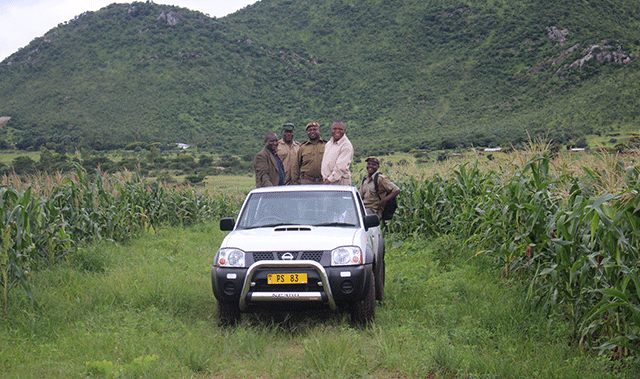
Last week, Commissioner Clement Kainja, who is in charge of farms and industries under the MPS, accompanied by UNODC staff and other prison staff, embarked on crop supervision exercise to supported farms.
The first place to visit was Kasungu Prison farm, which is about 125 km from Lilongwe where he appreciated the maize crop.
“I did not know what to expect as I came here,” he said in an interview at Kasungu Farm. However, what he saw greatly uplifted his spirits.
Kasungu Prison Farm has 100 hectares of arable land. At the time of this visit, it had 453 inmates, more than double its carrying capacity, according to senior superintendent Kalirani J.C. Mwale, officer in charge of Kasungu Prison.
The farm, like most parts of the country, relies on rainfall for its agriculture production. With support from UNODC, it has put 75 hectares under maize production for the 2018-2019 farming season. This represents a marked increase given that during the 2017-2018 farming season, it had 49 hectares of land under maize, enabling it to harvest 175 metric tonnes of maize.
In addition to the 75 hectares of maize, Kasungu has put 2,5 hectares under soya beans, four hectares of land under cassava, and 3,5 hectares of land under sweet potatoes. It has 35 pigs.
Senior superintendent Mwale explained: “Last season we cultivated 49 hectares of maize and the yield was about 175 tonnes, lower than expected due to the drought which affected our performance. This year our projection is 350 metric tonnes, which is beyond our consumption need.”
He expects this to improve with irrigation agriculture.
“We recently sent 100 bags of maize to Lilongwe (Maula) Prison. Over the past two months, we sent 200 bags of maize Nkhotakota Prison and another 300 bags of maize to Dedza Prison. We always grow enough, and we can support other prisons,” superintendent Mwale elaborated.
Commissioner Kainja said: “We have a beautiful maize crop at Kasungu despite some challenges with rainfall. We are impressed with what we have seen.”
He explained that the Malawi government’s policy on reforming prisons seeks to reduce inefficiencies that violate prisoners’ human rights.
“Prisoners have a right to health, life and food,” he said and added that the MPS was determined to ensure that prisoners access good health services, sufficient and nutritious food.
“Currently with UNODC we are working on a project to build a sustainable food production system within the Malawi Prison Service so that we may be able to produce enough, and also may be at the end generate income to help us manage our penal system in Malawi,” he said.
Commissioner Kainja revealed that the MPS was working hard to build the capacity of agricultural extension officers within the prisons, to boost production on its farms.
“Related to this we are looking at how we can improve their mobility. We need motorbikes to enable our officers to attend meetings with their colleagues at the district level where they share ideas.”
He admitted that the crop production systems on the MPS farms were not sufficiently mechanised.
“We rely on prisoners working manually. If these prison farms were fully mechanised, we could achieve more. We need planting machines because planting is time-sensitive.”
He said overcrowding remained a significant challenge in Malawi prisons. “We are happy that within the component of the UNODC-led project, we are also looking at how we can tackle overcrowding and improve the accommodation conditions through among others, introducing bunk-beds and improving ventilation in the cells.”
Commissioner Kainja revealed that whereas the carrying capacity of Malawian prisons was at 7 000, the reality was that approximately 14 000 inmates were cramped in the country’s prisons on any given day.
“Our facilities are almost operating at more than 200% beyond the holding capacity.”
He said plans were underway to develop certain prison farms into “bread baskets” to support other prisons.
“We have earmarked Kasungu prison as one such prison. We have drawn up a distribution system which ensures that whatever surplus is produced will be taken to other prisons.”
“The crop at Kasungu is very vibrant. We don’t expect a harvest of less than five tonnes per hectare if prevailing climatic conditions hold. This is a critical time for maize development,” he said.
Going by what is happening at Kasungu Prison Farm, it can be said that the provision of inputs such as fertiliser and agrochemicals has gone a long way toward helping the farm to produce food. This is in line with the strategic objective of the Malawi Prison’s Service which among others includes improved nutrition and general health of prisoners.
An assessment conducted by UNODC last year threw light on a plethora of challenges facing Malawi prison farms.