




Sovereignty must be defined as supreme and unrestricted power.
That is, a person or an entity exercising supreme authority, independent of outside authority.
To quote chairman Mao Tse-Tung’s cardinal principles: “We must have faith in the masses. If we doubt this principle, we shall accomplish nothing.”
Namibia’s dependence on South Africa is historical from the days of apartheid, having been the fifth province of the union.
Well into our 36th year of uhuru, dependency on South Africa continues.
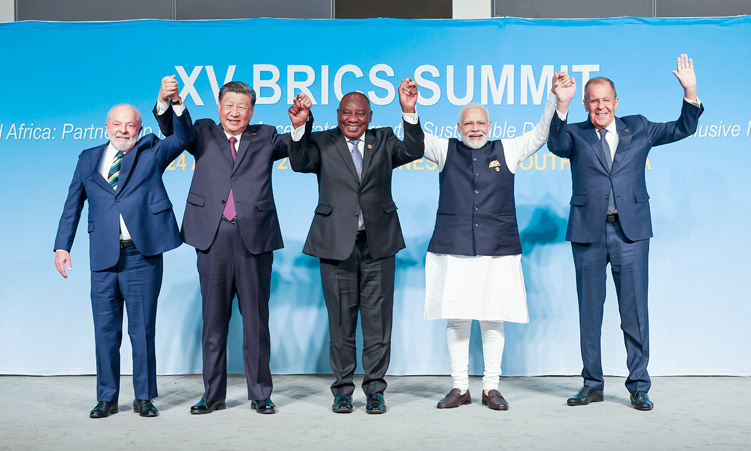
Consequently, regardless of its internal challenges, our neighbour happens to be among the prime members of the Brazil, Russia, India, China and South Africa (Brics) intergovernmental organisation.
Analysis would conclude that the recent state visit of the Indian prime minister, Narendra Modi, whose country is also among the founding Brics members, would enthuse Namibia’s leadership to request an invitation or sovereignly suggest measures to join the undoubtedly salvaging entity.
Unexpectedly, we chose to remain pro neocolonial, unipolar subjects of plunderers. I doubt whether we dared to send representatives to the recently concluded and successful Brics summit held in Rio de Janeiro, Brazil.
DECOLONISATION
Decolonisation is real. It should be a vehicle for formerly colonised, annihilated and extremely suppressed anti-imperialists.
However, Namibia seems to doubt whether its allegiance would be tainted or rights reduced by joining the entity which is busy shaking the foundations of our former oppressors.
The latter continues to syphon both our natural and human resources for their selfish interests. The quadrillion-dollar question remains whether we are content with the usual crumbs we are fighting for, falling off the colonisers’ tables.
The wait-and-see stance of the Namibian government concerning Brics is understandable.
It reflects the policy of ‘enemy to none and friend to all’. Consequently, the scepticism emanates from Brics not yet having been well established.
Its common currency, for example, is still under negotiation. Some of the member countries are still socio-economically and politically linked to the West.
The current tariff wars are another cause for scepticism. However, controlling powers and exclusion cannot last among earthlings yearning for inclusion and multi-polarity. Criticism cannot continue to be seen as betrayal. Empires must be broken for justice, peace and liberation to prosper.
MULTI-POLARISATION
Multi-polarisation is the future of the world.
It should, therefore, be retrogressive for a country inundated with revolutionaries like Namibia to lag behind on what many can see or experience. The need to seek solidarity, social and economic justice and unify former colonised countries was expressed at the Bandung non-aligned conference in 1955.
It was an attempt to break away from neocolonial, unipolar hegemony. Unfortunately, by then, time, resources and understanding were not in place for many. The disproportionality of nations in our world has no room to continue.
The adage of divide and conquer if not replaced will end up in the usual dependency theories. Change is thus an excruciating inevitability.
Currently, during the 21st century, many countries have gained more confidence, are more educated, partially industrialised and have gained sovereignty.
These are all valid reasons to avoid clinking to the oligarchic hegemonies that destroyed progress. The non-aligned movement remain the predecessor of the stronger, inclusive, multilateral and organised Brics, which is indisputably growing both in size and influence, currently representing more than 44% of the global gross domestic product.
The Brics New Development Bank in Shanghai, headed by former Brazilian president Dilma Russoff, is an indispensably great alternative to exploitative Bretton Woods institutions like the International Monetary Fund and the World Bank.
The New Development Bank offers to assist member countries in both their local currencies and exchange with other member countries monetary units at reasonable exchange rates. The new alliances are working on ‘DE dollarisation’ for everything globally, which is constantly gaining momentum.
MORE THAN NECESSARY
Brics is more than just a necessity. It has rekindled a new kind of world which is inclusive and multi-polar. This is the opportunity to have both our livelihoods, currencies, resources, identity and dignity respected. Being part of Brics is thus a clear statement of our ruined past, reflexive presence and conscientious future.
Our sovereignty cannot continue depending on doubt or allegiance. We must carefully decide our sovereignty, because future generations will scrutinise our current policies and practices.
To conclude with chairman Mao’s wise quotes: “As for criticism, do it in good time; don’t get into the habit of criticising after the event.”
This is clarified by his explanation that, “taught by mistakes and setbacks, we have become wiser and handle our affairs better. It is hard for any political party or person to avoid mistakes, but we must make as few as possible. Once a mistake is made, we should correct it, and the more quickly and thoroughly, the better”.
The absence of prompt actions to mistakes for alleviating the status quo compels Namibians into destructive complacency through which society ends up believing in false hierarchies, accepting the unacceptable and devoid of constructive criticism.
Namibians are prone to making mistakes from colonial and exile times and upon independence. Acting swiftly on mistakes have been, and continue to be, unattainable. As a result, indecision, false allegiances, fear of both the known and the unknown, greed, patronage, entitlement and pretense stall our creativity and stagnate our republic into submission.
Socrates was explicit to state that an unexamined life is not worth living.
I believe that under the banner of Brics, our country’s negative stance of third-most unequal country in the world will change.
Should we, therefore, be waiting to be invited, or as an independent republic take the sovereign decision to join Brics – the multi-polar global order, south-south cooperation, inclusive, and just Brics?
The hour of reckoning is long overdue.