


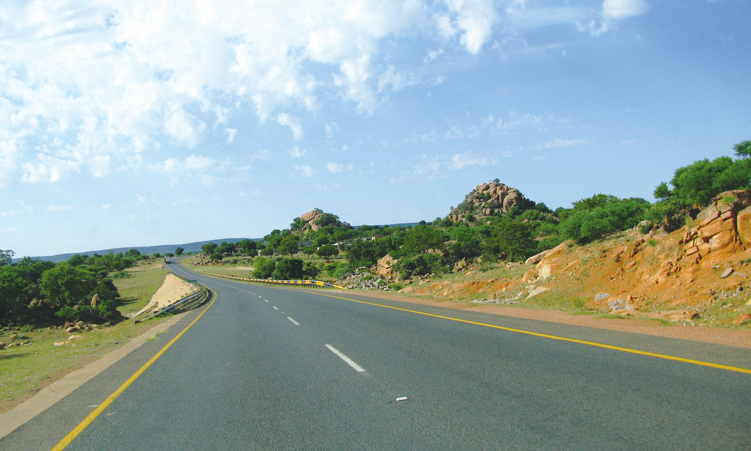
On the evening of Friday, 3 May, a tragic accident claimed the life of a middle-aged man along the Trans-Zambezi Highway.
The driver of a truck had struck the man, later identified as Oscar Sitali by his family, at Kongola village near Liyamukulo.
Sitali died at the scene at around 18h30, and the Zambezi police registered a case of culpable homicide.
They say Sitali had attempted to cross the road when he met the oncoming truck.
“The driver was heading from a western to an eastern direction along the Trans-Zambezi Highway, and upon approaching Liyamukulo, the pedestrian was crossing the road from north to south.
“The driver was sober as per the breathalyser tests done by traffic officers and he has a valid driving licence,” Zambezi head of community policing Kisco Sitali told the media at the time.
Not far from this accident scene, Glen Shebo, a Kongola resident, four months ago witnessed another death on the same highway.
The scene of the pedestrian being run over keeps replaying in his mind like a horror movie.
The Trans-Zambezi Highway and Singalamwe-Kamenga Road have become known to those who live at Kongola as ‘the road of death’.
The highway in the Zambezi region is linked to the Walvis Bay corridor – a crucial route for logistics and tourism industries.
The Trans-African Highway network is Africa’s most ambitious road project. It is regarded as one of the safest roads in Africa in terms of hijackings.
In Namibia, the highway is a corridor that provides a direct route from the port of Walvis Bay and Windhoek in central Namibia, through to Botswana and Pretoria in Gauteng, South Africa.
The Trans-Zambezi Highway passes through the heart of the fast-growing Kongola settlement to connect Namibia with the Southern African Development Community through the Katima Mulilo and Ngoma border posts.
On any given day, trucks carrying valuable goods pass here, but so do pedestrians.

Shebo says he has witnessed three men, including Sitali, die on this road within a space of months.
One lost his life attempting to cross the road near Sinai in January, the second was hit by a truck near Liyamukulo, and the third was hit by an oncoming vehicle last September.
Shebo is scarred for life.
“There was blood everywhere,” he recalls.
“One of the men was hit 100m away from where I was. Out of curiosity, I hurried to see. However, I wish I never went there . . ,” he says.
The worst part is that there was nothing he could do to help.
“No human should see another human or loved one in such a state,” he says.
Shebo’s experience is shared by many Kongola villagers.
“Their deaths cannot be forgotten, especially by those who have witnessed it. The blood stains are still on the roads,” he says.
YOUNG LIFE CUT SHORT
The Singalamwe-Kamenga Road also cut short the life of a Grade 1 pupil at Sesheke Combined School who was headed home from school with his cousin on 10 June.
Mandandi Mubala (7) tried to cross the road to get home, but did not make it.
Mandandi was hit by a bakkie at Sesheke village of which the driver’s driving licence had expired.
He sustained serious injuries and was rushed from the local clinic to Katima Mulilo District Hospital, where he succumbed to his injuries the next day.
Mandandi’s great-uncle Vilho Bissa says he had a special bond with Mandandi.
Bissa says Mandandi on the day went to pick up his cousin from kindergarten when he was struck.
“The thought that I will never see this playful, shy boy is heartbreaking.
“It’s a difficult time for our family – especially for his mother who has lost her first-born while pregnant with her second child,” he says.
Bissa, who is a teacher at Sesheke Combined School, says Mandandi was an exceptional pupil.
LIVING IN THE DEATH ZONE
Kongola village’s 12 069 inhabitants have no choice but to frequently cross ‘the road of death’ to get to their homes, schools, clinics, shops, and recreational areas.
Similarly, the Singalamwe-Kamenga Road also connects Namibia to Zambia through the Kamenga border, and is used by tourists daily to access various tourist attractions in the area.
Local traffic also makes use of these roads on a daily basis.
Local motorist Patrick Maiba says villagers are putting themselves in harm’s way as they either walk on the tarred road or too close to it.
“As a driver you need to be very vigilant when you drive on these roads. The villagers, livestock and dogs think they own these roads,” he says. Kongola constituency councillor Bennet Busihu says he wants to check with the police before commenting, adding that he needs figures from them.
URGENT SOLUTION NEEDED
For Kongola villagers like Shebo, the carnage along the highway will continue unless something is done.
Shebo recommends pedestrian zones and for drivers to drive 60km within them.
He says a traffic circle is also imperative at the junction of C49 road and B8 road for easy traffic flow.
“We need pedestrian crossing zones at all school entry levels. Speed cameras should also be installed, and sign boards should also be installed to notify drivers of activities happening ahead.
“Additionally, they should create pedestrian crossing zones and the roads should be expanded. Lastly, street lights should be installed, and long-distance truck drivers should drive between 06h00 and 18h00 only,” he suggests.
STAGGERING FIGURES
Statistics released by the Motor Vehicle Accident (MVA) Fund indicate that pedestrian-related deaths in the Zambezi region increased from five in 2024 to six from January to 13 June this year.
According to MVA Fund spokesperson Jane Ikela, these deaths include another pupil (9) in the Zambezi region who lost her life while crossing the road this year.
“Her story, sadly, mirrors those of many children, innocent, vulnerable, and failed by a society of irresponsible road users. Children aged zero to 14 accounted for 109 (23%) of all pedestrian injuries in this period, with 16 (18%) deaths, highlighting their heightened risk on Namibian roads,” she says.
Ikela says further data collected in the Zambezi region indicates that pedestrian-related crashes are caused by reckless and negligent driving, as well as poor visibility.
“The reckless and negligent driving accounted for the most significant increase in injuries, rising from one to 10 cases. This was followed by incidents involving pedestrians crossing the road, which increased from two to nine injuries,” she says.
Questions sent to national police spokesperson deputy commissioner Kauna Shikwambi went unanswered.