



MINIBUS and seven-seater operators are at loggerheads in an industry where only one can survive.
With the recent confusion over the restriction of seven-seater buses that have now been allowed to operate on long-distance routes, minibus drivers are calling for regulation, claiming that they are losing business.
A minibus takes two to three hours, if not more, to load enough customers to travel, while within less than an hour a seven-seater can fill its seats. Because of this, minibus drivers are struggling to survive in this industry, which they once dominated.
The Namibian went to some of the loading areas and spoke to a few drivers.
Loadmaster at Monte Christo service station in Windhoek, Johannes Iipinge, has been working in the industry for 14 years. He said the business has changed in the last five years, despite once flourishing.
Loadmasters ensure that the vehicles leaving the ranks are roadworthy by checking if the licence disc has expired, and whether there is a fire extinguisher and a spare wheel in the vehicle.
Iipinge claimed that some of the challenges they are facing are because some seven-seaters are poaching their customers, as well as the lack of premises from where they can operate, adding that they have tried asking the ministry of works to intervene.
He said they are presently using a property owned by Engen service station, where they are required to pay N$1 500 every year.
The municipality has built a loading zone at Okuryangava for minibuses to operate from but the place is vacant, as drivers believe that it is too far away. In addition, the toilets are always locked at the area and parts of the fence have been vandalised.
“Seven-seaters take our passengers, especially young people who like seven-seaters. If you go to the highway right now, people are standing there waiting for seven-seaters, but before they just came to the buses,” he said.
On the scene, there were eight buses, with only one loading passengers while the others stood empty. Vendors were walking around trying to sell airtime and portable chargers.
Iipinge, however, says they have managed to stop seven-seaters from operating in the area, insisting they would also have to pay the N$1 500 fee.
Some of the issues attributed to these operators are the speed at which they drive, which could endanger other drivers on the road or cause accidents.
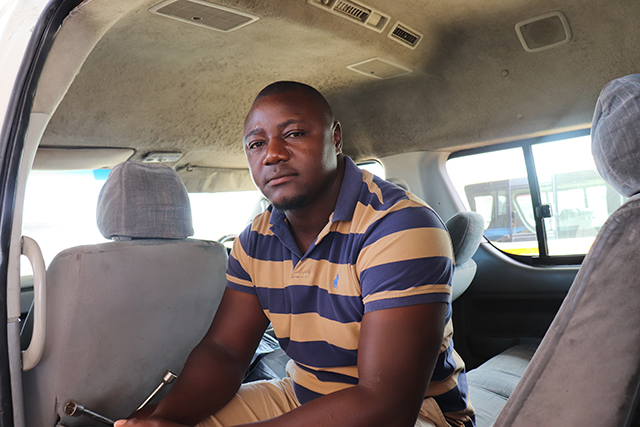
Natangwe Mupupa, a minibus driver, said the reason seven-seater and minibus drivers speed is that they fail to fill their vehicles when they initially load, so they rush to the next town to get the next customer. He charges N$270 to travel to the north.
“That’s where the trouble comes in, because speeding causes a lot of damage. But, if we can load and drive full, then there is no need to speed. You will drive at 100km/h, because you also want to save on your fuel,” he said.
Mupupa, who is the family’s sole breadwinner, says there are sometimes scuffles to grab a customer and fill the vehicle.
“At every key point where people are looking for transport, there will be a seven-seater, which makes it difficult for us. Especially for us, as we will travel without any customers. We also pay for logbooks for kilometres travelled, which does not apply to seven-seaters,” he said.
At B1 City mall, situated along Independence Avenue, opposite the Katutura Intermediate Hospital, the tension between seven-seater and minibuses is quite visible.
Upon arrival, while this journalist spoke to the rank manager, Edison Handura, we witnessed him giving a minibus driver a tongue-lashing after he parked his vehicle at the entrance of the loading zone.
Handura later explained that when he is not around, the minibus drivers do as they please and park their vehicles there to get the customer before a seven-seater driver does.
“The seven-seaters park in front of our rank, so our problem is that when a customer gets out of a taxi they (seven-seater operators) immediately grab them. We are disturbed by them, that’s why we stand in the driveway instead of the shade built for us,” he says.
Handura also says the owner of the Bonjour service station allows the seven-seaters to operate from his business premises. A sign, translated in local languages, runs at the entrance of Bonjour encouraging passengers to seek assistant from loadmasters.
“Passengers, please make use of the loadmasters dressed in red overalls.”
Handura says there are also ‘zula boys’, who stand by the highway looking for customers and they have written to the police complaining about their actions.
The so-called ‘zula boys’, who either operate seven-seaters or look for customers on their behalf, stand by the highway heading to Okahandja. Curious after seeing the camera, the ‘zula boys’ decided to give their side of the story.
“Passengers come voluntarily. We don’t disturb people’s peace. We look for customers for other vehicles and the drivers give us something for helping them. We are just trying to survive,” Tjombe said.
The others chimed in that they would rather do this than go back to the streets and not have a job. While speaking to these ‘zula boys’, a private vehicle travelling up north stopped by looking for passengers. One of the ‘zula boys’ climbed into the private vehicle to assist the driver with customers down the road.
Tjombe said they also helped private vehicles look for passengers. He further said at roadblocks, the police do not question the passengers in the private vehicles, as they look like family members of the driver.