





Three of the city’s most robust art galleries are currently home to an array of eclectic Namibian art, most of which will find its way to the esteemed halls of our ministries where visitors, lawmakers, officials and foreign nationals can enjoy the spirit of Namibia as filtered through creative expression.
Currently adding notable bursts of colour to the walls of the National Art Gallery (NAGN), the Franco-Namibian Cultural Centre (FNCC) and the Goethe Centre, the more than 200 artworks selected from over 500 entries for the Art Inside project are by and large skillfully made and distinctly Namibian in terms of subject matter and technique.
Though the exhibition may be the most significant element of this project to the public, Art Inside, an art project for government, has been ongoing for several months, beginning with a call to entry last July.
These artists submitted in the hopes of having their work purchased by the NAGN on behalf of the government which allocated funds for the purchasing of local artworks to be included in the GRN collection, and be installed on government premises.
With regard to effect, Art Inside is an art awareness project organised by the NAGN in collaboration with the Ministry of Youth, National Service Sport and Culture (MYNSSC) which hopes to foster an appreciation for visual art as an inherent part of government’s working environment.
Featuring works by renowned artists such as Nicky Marais, Paul Kiddo, Kay Cowley, Alpheus Mvula and Ndasuunje Shikongeni as well as striking up-and-comers like Tity Tshilumba, Elizabeth Mbumba and Elias Shiwoohamba, the Art Inside exhibition at the NAGN is a cache of creativity that celebrates Namibia’s beauty as well as its banes.
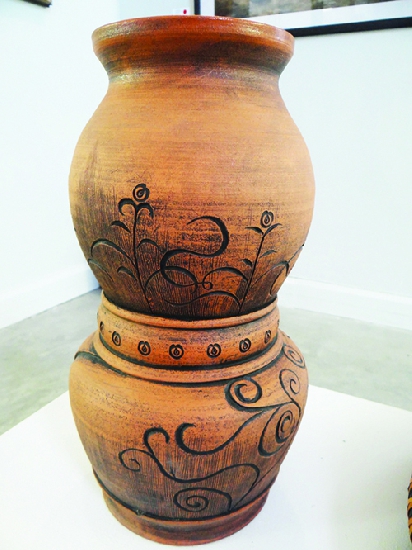
With work in the spheres of sculpture, painting, basket weaving, lino print, cardboard print, woodwork, photography and mixed media, the exhibition offers a cross-section of the techniques currently being used in Namibia while foregrounding the artists most adept at creation within these fields.
Leading the pack in sculpture is Alpheus Mvula whose work is as striking as ever.
Once again displaying ‘One Unity, One Peace’ which depicts the founding father, President Hifikipunye Pohamba, Nahas Angula, Hage Geingob and Pendukeni Ithana, Mvula’s sensibility for sculpture soars and his soapstone creations are met by Elias Shiwoohamba’s ‘Respect me Respect who I am’. A sculpture that picks up on the theme of Gender Based Violence (GBV) in a rendering of a naked woman covering her eye in despair with one arm missing.
Also creating within the theme of GBV is photographer Christopher Johnston who presents ‘Sainoline’s Last Walk Home’. A series of colour photographs which tell a silent story about a girl walking in the bush and then presumably murdered by an unknown assailant.
Captured in six separated segments, the collection portrays blood on buttocks, hands trying to help or drag away and bloodied brush in a disjointed and disturbing tableau of violence. What is unsettling and sobering about this piece is that these staged photographs are far less gruesome than what can be seen in the press, depicting the reality of Namibia in 2014. Still, the scene is striking and shamefully familiar.
Not all gloom and doom, Johnston juxtaposes the ugliness of Namibia with its beauty in ‘Tracks in the Sand’ which captures the rich reds, oranges, browns and yellows that make up our desert and the array of blues that make up our sky. In direct contrast to his horror story, the photograph is a glimpse of heaven, a celebration of solitude and a marvel at creation.
More lighthearted and perhaps nostalgic for a simpler time are the works by Paul Kiddo. True to his own form in his offering of ‘Herero Village’ and ‘The Daily Routine of Life in the Village’, Kiddo indulges his sense of romanticism in his acrylic villagescapes filled with many characters to discover under his famed blue skies.
In terms of sheer spatial dominance, Nicky Marais’ ‘Moving On’ takes centre stage. Looking rather like something that should occupy the outside of a building in a display of public art, this circle-filled and symbolic thing certainly prompts pondering in its crucifixes and crosses. Made of four large panels of yellow and one slender blue one, the work is dwarfing, absorbing and oddly beautiful for no reason that makes itself easily apparent.
Simple and beautiful are offerings from Helena Louw and Hannah Alphers. ‘Beads with Red’ is a wonderfully textured and monochrome painting with red and brown highlights while Alphers’ ‘Washing my hair’ is a blurry crayon on paper piece that subtly suggests the form evoked by the title.
Kabelo Kim Modise’s ‘Poor Men’s Roses’ is a poetic, simple and charming lino print rendering of thorns and Ndasuunje Shikongeni ‘Wealth Land Generation’ elegantly celebrates cardboard print and Namibian cattle culture in his depiction of a small boy chewing on grass while shepherding some cows.
Works by Barbara Bohlke, Susan Mitchinson and Betsi Van Rensburg are colourful and arresting with Bohlke creating within the abstract, Mitchinson presenting her long brush strokes and elongated figures and Van Rensburg taming rough edges to display twin lions lapping at a waterhole seemingly drinking their own reflections. Louise Van Wielligh’s ‘Epupa Falls’ also bursts with colour in a remarkable picture of the falls best viewed from a few paces back for maximum effect of rushing water and slippery stones. Also a revelation in painting is Leandro Solomons’ depiction of President Pohamba which dominates the gallery’s foyer.
Without a doubt, my favourite piece at the NAGN exhibition is Tity Tshilumba’s ‘Fresh from Nam Farm’. Absolutely beautiful, elegant, inspiring and utterly astonishing in its dreamlike depiction of a herd of branded cattle with Namibian flags punched into their ears, Tity finds his signature style and means to impress in a piece that presents a rippling sky like water with birds like fish accented with a windmill and filled with pride.
Certainly the piece to plant yourself in front of, Tity steals the show and here’s hoping government, the NAGN and the public take note and reward him handsomely for his criminal creativity.