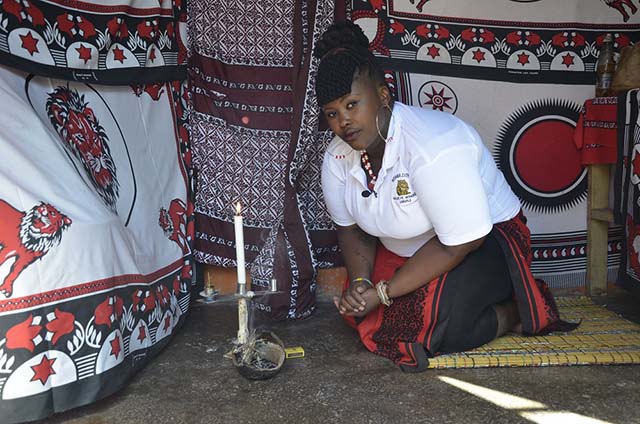
KATLEHONG — Smoke swirled around Badanile Maci as she crouched on all fours, clapping and chanting with half-a-dozen other sangomas – South African traditional healers – to greet their ancestors’ spirits.
Widely respected by South Africans as spiritual guides, healers and counsellors, gay sangomas like 23-year-old Maci are also challenging the idea that being lesbian, gay, bisexual or transgender (LGBT+) is unAfrican.
“When we are together in our traditional ceremonies, we are free,” said Maci, who knew she was gay at the age of 15, and brought her first girlfriend home a year later.
“Our traditional beliefs have created a safe space for the LGBT community … We find the support we never had before,” she said, sitting beside jars of dried leaves, twigs and herbs in her consulting room in Katlehong, 35km east of Johannesburg.
Sangomas – sometimes called witch doctors – believe they are called by their ancestors to heal. By consulting with spirits and using rituals and natural medicines, they predict the future, and help clients with problems from sickness to relationships.
In a country where lesbians are often subjected to the trauma of “corrective rape” to make them straight, and access to mental healthcare is limited, gay sangomas are finding their own remedies to achieve happiness and win social acceptance.
“I have had suicidal thoughts,” said Nomsa Mokoena, a 33-year-old sangoma, recalling how her family rejected her when they found out she was a lesbian.
“But my ancestors have guided me through the worst of my depression,” she said, from eMalahleni, about 140km east of Johannesburg.
Through advice from her ancestors in dreams, Mokoena was able to understand her depression, which she described as an “ongoing battle”, but preferable to going to hospital.
“We find power in ourselves … I don’t have to be ashamed or live a lie,” she said.
Africa has some of the world’s most prohibitive laws against homosexuality, with 32 nations out of 54 criminalising same-sex relations, according to the ILGA, an LGBT+ rights group, with punishments ranging from imprisonment to death.
South Africa is the only country on the continent to allow same-sex marriage, and its 1996 constitution was the first in the world to ban discrimination based on sexual orientation.
But homophobia and violence are an everyday reality, with four out of 10 LGBT+ South Africans knowing of someone who was murdered for their sexual or gender identity, South Africa’s Centre for Risk Analysis think tank has said.
“Lesbians are often gang-raped before being killed in violent ways,” said Ntsupe Mohapi, head of the Ekurhuleni Pride Organising Committee (Epoc), which started a Johannesburg Pride march a decade ago after two gay activists were murdered.
“Often, survivors fear secondary victimisation by police if they report it, so they keep the trauma inside … many turn to suicide and substance abuse.”
There are no official statistics on suicides among LGBT+ South Africans, but Maci said she loses a friend to suicide several times a year.
“I had a friend called Zinhle who was rejected by her family,” she said. “She told me she was struggling over WhatsApp, but I didn’t realise how bad it was until she took her own life.”
Globally, sexual minority youths are 3,5 times likely to attempt suicide than heterosexual peers, often driven by stigma, bullying, isolation and difficulties with self-acceptance, Italy’s University of Milano-Bicocca found last year.
Nearly three-quarters of South Africans reporting mental illness – some seven million people – never receive any treatment, according to the South African Depression and Anxiety Group, one of Africa’s largest mental health support groups.
This is the norm across Africa, where governments spend about US$0,10 per person on mental health, 25 times less than the global average, according to the World Health Organisation, resulting in a severe shortage of mental health workers. “Our hospitals are tackling HIV, diabetes, cancers. Mental health is put on the back-burner,” said Jan Chabalala, a Johannesburg psychiatrist.
“To be gay and to live with a mental health disorder is to live with a double stigma in South Africa.”
Sangomas said they face pushback from some Christians who accuse them of practising witchcraft, but generally, they command respect, and have the freedom to dress and act as they wish.
“When my ancestors take over my body, they can be either male or female,” said 28-year-old Xolani Chamane, referring to the act of channelling his ancestors to give spiritual and medicinal advice to clients.
“When they visit, my gender is naturally more fluid,” he added, wearing earrings, beads and a red, traditional skirt.
Simphiwe Mahlaba of the African National Healers Association, which promotes the sector, said he has registered a growing number of LGBT+ sangomas, although he could not provide figures as members were not asked their sexuality.
“We have no problem registering gay traditional healers,” Mahlaba said. “As long as they are true to their ancestral beliefs, then we are happy to live side by side with them.”
Gay sangomas said their status as community leaders also allows them to educate their clients.
In an age of information overload, Sunrise is The Namibian’s morning briefing, delivered at 6h00 from Monday to Friday. It offers a curated rundown of the most important stories from the past 24 hours – occasionally with a light, witty touch. It’s an essential way to stay informed. Subscribe and join our newsletter community.

The Namibian uses AI tools to assist with improved quality, accuracy and efficiency, while maintaining editorial oversight and journalistic integrity.
Stay informed with The Namibian – your source for credible journalism. Get in-depth reporting and opinions for
only N$85 a month. Invest in journalism, invest in democracy –
Subscribe Now!