





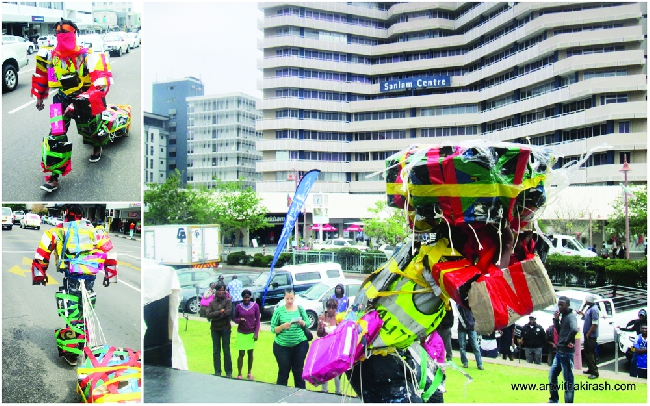
Olaniyi Rasheed Akindiya is surrounded by limbs.
Torsos hang from hooks. Legs sway in the slight breeze and a headless figure sits at a sewing machine as the he grins from below a gravity defying ponytail adorned with a bright white shell.
This is his mannequin mill.
Situated in a little studio at the John Muafengejo Art Centre (JMAC) in Katutura and fighting valiantly against the sound of the Namibian Police Force band practicing in the room next door, his plastic wrap limb factory is where he spends the bulk of his hours as he enters the seventh week in his JMAC artist’s residency.
Intense, articulate and acutely aware of the media’s knack for distortion, Akindiya flips the switch on a tape recorder before introducing himself as “Akirash.” An amalgamation of the first two letters of his surname and the first two letters of his second.
Although the name seems like a clever invention, Akirash admits that, upon travelling to Japan, he found that it was a known word that means “the unique one,” a translation he is happy with and which seems unintentionally apt.
As a resident artist, Akirash has been invited to Namibia to share his techniques and his ideas about creativity with students and with the greater community while learning about Namibian culture.
Nigerian by birth, a resident of Texas and with a studio in Ghana, immersing himself in a country’s culture to further his skill and promote his art is not new to the nomadic artist who works within the mediums of sculpture, mixed media and painting.
“Home is where I am,” he says before reminiscing about his trip to Tanzania in 2012 where he met a Namibian at his exhibition opening who hoped he would visit his country and later led the artist to JMAC’s artist residency programme online.
An application and a few months later he was here. And he was let down.
Extremely frank and unapologetic, Akirash barely blinks as he says that upon interacting with the arts students at the University of Namibia, in his first week, he was disappointed.
Noticing disorganisation in the department, a lack of confidence and courage to make statements through their art, Akirash decided to shock the students’ and the faculty by calling the lecturer who arranged he speak in a classroom and telling them he was currently performing near the university’s gate and that the arts students should hurry there or they would miss it.
The students came.
And since then Akirash has been showing students his work while encouraging originality, the innovation of rotely taught techniques as well as peer review and criticism at the College of the Arts and the University of Namibia.
“You need to give students examples of what you do as an artist as itmotivates them,” he says. “Your role is not just to teach but to motivate, push and help with their ideas. The students will judge if my time with them was fruitful and changed their perceptions.”
In terms of the students’ prevalent attitude to work, Akirash believes it could be better.
“People here feel the country owes them something,” says Akirash frankly. “In the developing world you have to see what you want to have. Who is going to give it to you? Government? The government is individuals. They won’t do everything. It is not up to them to tell you your environment should be clean and you should wake up and go to work. At 12h30 on a Friday, it is like a graveyard here. Students go and at 11h00 and 12h00 everything is stopped.”
Though Akirash hopes to revivify the students, he also cites stagnation in older and established artists as a problem in terms of inspiring the youth.
“At exhibitions here, people don’t say anything about art,” says Akirash. “They drink your drinks and eat your snacks and they are talking about themselves and you can’t blame them because you didn’t give them something to talk about.
I have looked at the Visual Artists Namibia catalogue for the last three years and I am not really pushed by what I see. Artists are lucky here. They get grants from government, not in Nigeria or Ghana, this is a huge opportunity and artists should make use of it and turn things around.”
With regard to what he has seen of the students here, he thinks the biggest problem is unoriginality and the rote repetition of taught techniques without innovation.
“The students don’t have confidence. They don’t believe in the ideas they have and they are stagnant in what they have been doing for years,” says Akirash.
“They don’t take what they’ve learnt and take it to a new level. There are no new materials, we are all just taking materials to different levels. How do you change it and how do you use it and change perception of how art work should be?”
Though Akirash feels there is work to be done to break free and find their voices as individual artists, the guileless and fearless artist remains hopeful.
“After working with the students and seeing the way they have responded and how they come
and discuss and ask opinions, it is a positive,” he says.
Asked how he made it from bright eyed students who regard his travels, confidence and success and can’t reconcile it with financial scourge of being an artist, Akirash tells them there are people who create quickly to eat and those who work hard at their craft.
‘There are artists who want to eat now and people who want to work hard now and enjoy it later,” says Akirash. “Many students think Nigerians have money but I struggled from the grass to grace. You must do what is necessary.
Why did I use waste material? I didn’t have sponsors and I had to get creative. I didn’t have money. I didn’t have paint. I created brushes from horses’ and head hair. I made paint from boiling leaves and from sand.