





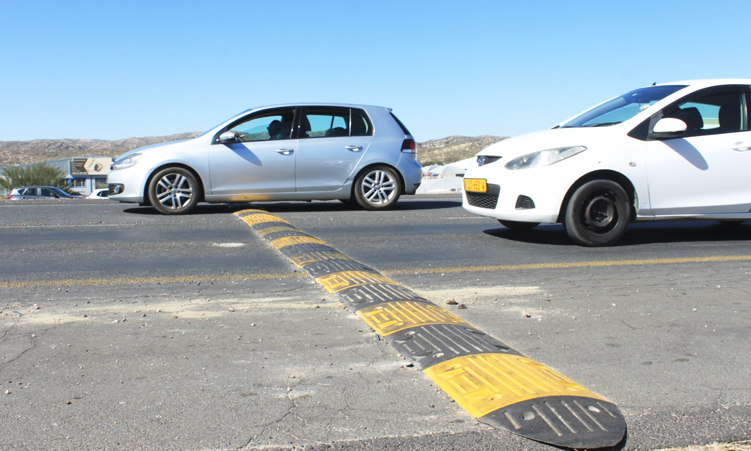
Speed humps placed on Windhoek’s Western Bypass highway 10 days ago endanger motorists using the high-speed road, activist Michael Amushelelo argued in the Windhoek High Court on Friday.
Amushelelo made the argument during the hearing of an urgent application with which he rushed to the court in an attempt to have newly installed speed humps removed from the Western Bypass road.
Judge Gabriel Komboni postponed the delivery of his ruling on Amushelelo’s urgent application to 30 June after hearing oral arguments from Amushelelo and government lawyer Wilhelm Amukoto on Friday afternoon.
Amushelelo is asking the court to declare the installation of speed humps on the Western Bypass road in the vicinity of Windhoek’s Northern Industrial Area to be unlawful, not in compliance with the Road Traffic and Transport Act of 1999 and a public hazard.
He is also asking the court to compel the minister of works and transport and the Roads Authority (RA) to immediately, or within 24 hours to remove the speed humps on the Western Bypass, after the court has issued such an order.
Lastly, Amushelelo is requesting the court to issue an interdict that would stop the minister and RA from constructing or authorising any further speed humps on any national highway or designated freeway in Namibia.
Amushelelo argued that, by having speed humps erected to protect pedestrians, who he said are in the wrong because they are not supposed to be on a highway, minister of works and transport Veikko Nekundi repeated a wrong by endangering motorists.
No rational engineer would advise the erection of speed humps on a rapid-speed bypass, Amushelelo also argued, adding that the minister acted contrary to sound engineering standards.
He further argued that no public consultations took place with people using the Western Bypass and those affected by the installation of speed humps before the traffic-slowing humps were placed on the road.
In a brief sworn statement filed at the court, Amushelelo says: “Placing a physical obstacle of this nature on an unlit, high-speed national highway creates a sudden, unexpected trap.
It is a mathematical certainty that motorists driving at legally permitted highway speeds will encounter these obstructions, lose control of their vehicles, and suffer severe mechanical failure, catastrophic multi-vehicle accidents, or fatalities.”
On the urgency of the case he filed at the court, Amushelelo claims: “Every hour these unlawful structures remain on the B1 highway, hundreds of lives are placed in active, immediate peril.”
In an answering affidavit, Nekundi claims the concept of a “highway” does not exist in Namibian law.
The classes of roads that can be proclaimed in Namibia in terms of the Roads Ordinance of 1972 are trunk roads, main roads, district roads and farm roads, according to Nekundi.
He adds that although a trunk road may be declared a freeway in terms of the Roads Ordinance, “no such freeway has been gazetted”.
Nekundi also says Amushelelo has not stated which provision of the Road Traffic and Transport Act was violated when speed humps were placed on the Western Bypass.
Amushelelo who “purports to act on behalf of others”, has failed to show he has the required legal standing to bring his application to court, and did not demonstrate how he has a direct and substantial interest in the outcome of the legal proceedings that he instituted, Nekundi claims.
In a statement issued on Friday, the RA says the speed humps were installed “as an immediate road safety measure following a rise in pedestrian-related crashes, including fatal incidents”.
The RA states: “The affected locations were identified through road safety assessments and accident data, which indicated heightened risks to pedestrians.
Although these roads carry high traffic volumes and operating speeds, frequent pedestrian movement across corridors required urgent interim action.
“The speed humps are intended to reduce vehicle speeds, improve driver awareness, and enhance pedestrian safety while long-term solutions are being pursued.”
The RA says it has spent about N$704 000 for the procurement of speed humps and road signs and transportation of material from South Africa.