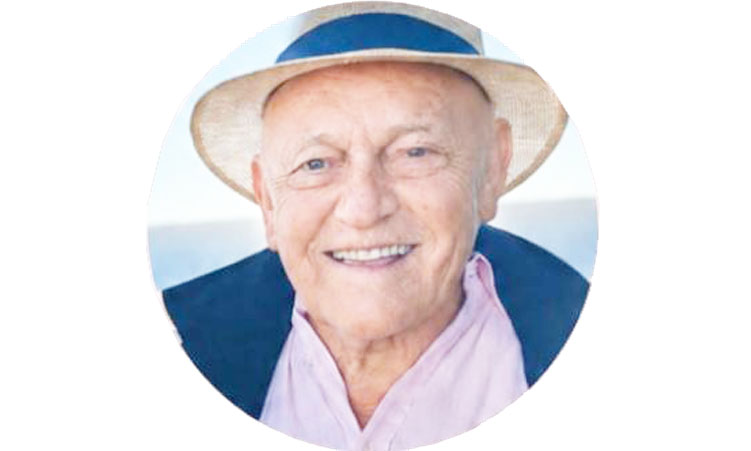
Namibia has lost a reliable friend for all seasons in engineer Vasilije Boskovic.
Boskovic, who was born in the former Yugoslavia, had a long-standing relationship with Namibia, which spanned over six decades, until his death on 4 July.
His relationship with Namibia began in 1961 when he met Sam Nujoma in Belgrade, the capital city of the former Yugoslavia, and again shortly after that at the first Conference of the Non-Aligned Movement in the same city.
Yugoslavia’s founding president, Josip Tito, entrusted Boskovic with the responsibilities of assisting liberation movements.
His engagement with Namibian leaders was rooted in Yugoslavia’s progressive foreign policy of solidarity with oppressed peoples.
From the 1960s up to the 1980s, a good number of Namibian students and People’s Liberation Army of Namibia (Plan) combatants were trained in the former Yugoslavia. Boskovic interacted closely with these students, Plan fighters, as well as Swapo leaders and regular members who visited Yugoslavia on different missions, including free medical treatment.
Swapo had an official representation in the former Yugoslavia and former member of parliament Billy Mwanyengange headed that office.
The students who were educated in the former Yugoslavia included the late Nangolo Ithete (former deputy minister of home affairs), Egidius Hakwenye, Chippa Tjirera and this author, among others.
In the mid-1970s, Boskovic came to Namibia and made this country his home. Over a period of approximately 50 years, Namibia became the centre of his professional, public and family life.
During that period, he became involved in engineering projects, especially public works related to the Ministry of Works and Transport. He played a key role in the creation of the Engineering Council of Namibia and contributed to the development of professional standards, registration systems and institutional capacity within the engineering sector.
In early 2002, Boskovic was appointed Namibia’s honorary consul to the Republic of Serbia; and he served in that capacity until 2024.
His role as honorary consul was substantive and highly effective, requiring consistent engagements in advancing Namibia’s interests in Serbia and the broader Balkan region.
Drawing on his deep familiarity with both Namibian and Serbian systems, he served as an effective intermediary, translating long-standing historical ties into practical diplomatic outcomes across a wide range of sectors.
At a personal level, he and I struck a close bond of friendship and we would sometimes have a nostalgic reminiscence over a cup of coffee about the former Yugoslavia, while bemoaning its collapse. The collapse of Yugoslavia in the early 1990s was one of the most complex and violent geopolitical unravelings of the late 20th century.
What began as a socialist federation of six republics under the charismatic leadership of Tito after World War II, fractured along ethnic, political, and religious faultlines, culminating in a series of brutal conflicts that eventually led to the collapse of the federation.
The most brutal, if bloodiest, offshoot of the Yugoslav wars was the Bosnia civil war (1992–1995). This was the bloodiest conflict in Europe since World War II which was fought between three main ethnic groups: Bosniaks (Bosnian Muslims), Bosnian Serbs, and Bosnian Croats.
The conversation between the two of us would, more often than not, centre on that sad history.
According to his son Rade, Boskovic’s mantra about Namibia was, “once the Namibian sun warms your skin and the heat enters your blood, you will always long to come back.”
“For some as a tourist, but for him as a part of him and his home,” recalls Rade.
Boskovic died in Windhoek, Namibia (his second home and the country he truly loved) on 4 July. His wife, Draga, his two sons, Dr Viseslav Willy and Rade Jimmy, as well as grandsons Max, Tomas and Cole survive him.
Pocivaj u miru, druze nas (rest in peace our friend).
– Uaripi Tjihenuna is a commissioner of elections; however, the views expressed here are his and not those of Electoral Commission of Namibia.