



I remain committed to my search for our forgotten foods. Those foods that are everywhere around us, but that, for some reason or another, have fallen out of favour. Things we should be eating but don’t. Like guinea fowl.
A few years ago, whilst sitting in a blind at a water hole on a friend’s farm waiting for my annual winter quarry, I asked him about recipes for guinea fowl. I figured that since there seemed to be an endless supply of the birds on his farm, they might have tried some, and that I would benefit from their experience. His answer was intriguing. “You start by finding some medium sized rocks. Four to six should be enough.” He had my full attention. “Then you place these in a hot burned-out fire, among the coals for a few hours until they are red-hot. Then before they crack, you remove them one by one and place them inside the cavity of the bird. Next, you need to season the bird, and cover it with a few slices of fatty bacon; place it in the oven and cook for at least six hours.” I made notes in the sand.
“After six hours, remove the bird from the oven and the rocks from the cavity. Then, peel the bacon from the bird and turn the pan juices into delicious gravy by adding red wine and stock and reducing it by half. Finally, when everyone is seated at the table, ready to eat, discard the bird and serve the rocks with some bacon and gravy!” For just a fleeting moment I considered exchanging the life of my winter quarry for that of his. I settled for kicking dust over my elaborate notes.
Later than evening, I asked his wife, a proficient cook whose food I enjoy. “We don’t eat guinea fowl because they are just too tough,” she explained. “And some people say they have worms most of the time.” With that, our discussion about the culinary worth of guinea fowl came to an end.
Since then, I have come across the occasional recipe for guinea fowl (mostly stews) but most were fairly uninspiring: just add bacon, red wine and some vegetables and cook the living hell out it. I thought nothing of this and moved on. Until recently that is, when the folks of Berry Buzz offered some guinea fowl for sale. I suspected these are home-reared birds, but thought I’d give it a go and ordered three. They arrived fresh, already cleaned and ready to cook.
I know from past experience that the French hang their game birds (with feathers on) for close to two weeks to allow the enzymes enough time to break down some of the tough proteins. The feathers protect the meat from drying out. Since my guinea fowl arrived featherless, I vacuum-sealed the birds and left them in the fridge to ripen for eight days. Once done, I could put all my attention to finding the right recipes, techniques and remaining ingredients.
Perhaps the most obvious (but not necessarily the most creative) manner to deal with tough meats is to mince it. But then what? Meatballs? Sausages? Somewhere along the way as part of my exploration of modernist ingredients, I came across transglutaminase. Meat glue, if you like. Despite its horrible name, meat glue is a natural product that is present in the human body and responsible for the coagulation of blood and for formation of skin and hair. Transglutaminase, as far as I know, is not available through local retail outlets so must be sourced on-line. Activa RM is a good brand to start with.
In layman’s terms, transglutaminase is an enzyme that bonds proteins together. It’s been around since the late 1950s but its culinary potential came to the fore much more recently with the rise of the modernist cuisine movement lead by, among others, Heston Blumenthal. With the aid of transglutaminase, just about any protein can be glued to another. If fish encased in chicken skin is your heart’s desire, just add some transglutaminase. Chicken filets layered with Jamón ibérico (Spanish ham)? Transglutaminase will make it appear as if your chicken had rare-breed pigs as direct blood-ancestors.
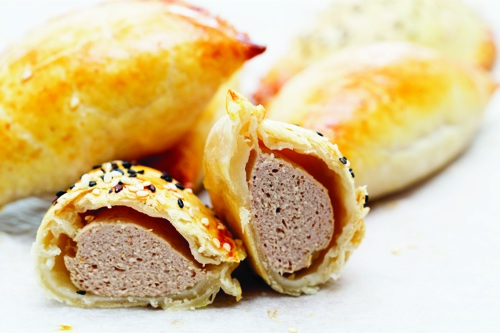
But back to the topic at hand: cooking guinea fowl. What if I could take care of the innate toughness of the meat by breaking it down completely, then use transglutaminase to ‘glue’ it back together again to form a soft, whole piece of guinea fowl meat? And what if I could deliver my reconstituted, modernised version of guinea fowl in a vessel that is easy to carry, delicious to eat and healthy?
My nephew and nieces provided the inspiration: hand-held pies. Tasty treats that would fit right into a school lunch box and not be out of place on a kid’s birthday table. For the pie-maker, there is added benefit when using transglutaminase: should your pies split or crack, the filling will not spill or cook out. You can use any pie dough you prefer – short crust or puff – and for once I’ll forgive you if you use a ready-made, shop-bought variety. This is all about the guinea fowl and trust me, there is nothing to fear.
• 500 grams guinea fowl breasts, skin removed
• 100 grams smoked bacon
• 2 spring onion
• 360 grams chicken stock
• 1 1/2 teaspoons ground coriander
• 1 1/2 teaspoons ground cumin
• 1/2 tablespoon nutmeg
• 10 grams salt
• 8 grams Activa RM – transglutaminase
• white pepper to taste
• 400 grams short crust pastry
• 1 egg, for egg wash
• sesame seeds (a mixture of white and black), optional
• Add the salt and transglutaminase in a separate small bowl and mix very well. Add the mixture to the meat mixture with the blender still running. Continue to blend for a few more minutes until the transglutaminase mixture is well dispersed. Transfer the blended mixture to a bowl and season with spices. Mix well.
• Place a fine sieve over a clean bowl and using a bowl scraper or dough cutter, start passing the meat through the sieve a little at a time. This will remove the larger chunks of meat and sinew producing a very smooth mixture. If needed, return chunky meat leftovers to the blender and blend some more. Keep passing small amounts of meat mixture through the sieve until all the meat is processed and only sinew remain. Discard sinew.
• Roll out the short crust pastry to a thickness of two to three millimeters. Using a fold-over hand pie mould (whatever size you have), cut the dough into circular portions the size of your mould. Add enough filling to each portion of dough and close the mould by folding over and pressing down on it. You should now have a perfect half-moon shaped pie. Continue until all the dough and filling has been used.