LESS than 10% of the working population owe banks N$45.1 billion in home loans.
Data shows that for a person to afford a N$1 million house, they need to be earning N$30 000 or more per month.
However, the average salary of a working Namibian is N$5 000 or less.
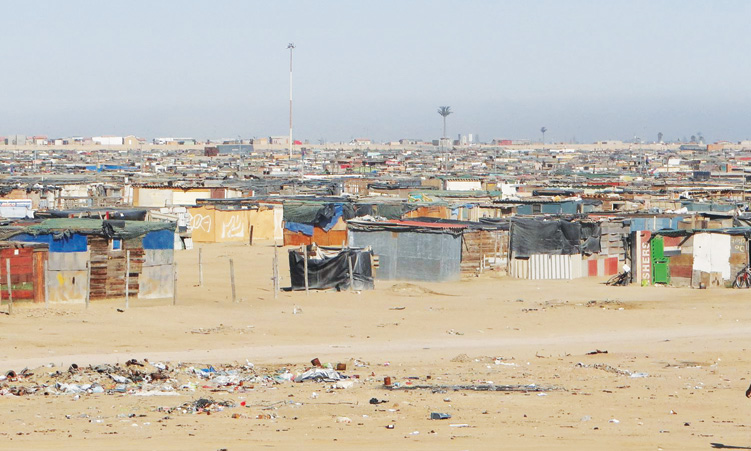
As a result, 70% of the population is unable to afford formal housing, hindered by low incomes and limited mortgage access.
Speaking at a housing seminar, central bank deputy director of policy research Abigail Nainda said average house prices have more than doubled over the past two decades.
According to Nainda, an average house went from N$200 000 in 2000 to around N$783 000 in 2010, and now stands between N$1.3 million and N$1.4 million.
“Approximately 70% of the population cannot afford formal housing due to low incomes and limited mortgage access,” said Nainda.
COST BREAKDOWN
The Namibian used online calculators from major domestic commercial banks to determine the monthly income required to service a basic home loan.
According to the calculations, an individual will need a minimum salary of N$39 497.39 to afford a N$1 million bond. This is under the assumption that no deposit was put down.
The payment period will be 20 years at an interest rate of 11.5% .
At the end of the repayment period, the individual would have paid N$1.5 million in interest, bringing the total cost to N$2.5 million.
TOO BROKE TO BUY A HOUSE
The latest labour statistics show that 302 210 employees in Namibia’s workforce are paid less than N$5 000 per month.
Only 2.6% of employed people earn over N$40 000 a month.
Data shows that 97 785 workers in Namibia earn a monthly gross salary of N$1 000 or less, while 88 348 get paid between N$1 001 and N$2 000.
The statistics show that 59 971 workers receive a wage of between N$2 001 and N$3 000.
Another 56 106 are paid a salary in the range of N$3 001 to N$5 000.
This amounts to 302 210 workers who earn less than N$5 000 per month.
STOP CHASING HOMEOWNERSHIP
Economist Omu Kakujaha-Matundu says Namibia needs a radical shift in how it views the crisis, suggesting that the government stop pushing for homeownership altogether.
“Owning a home should not be the priority.
The priority should be decent, affordable housing.
The central and local government should team up to build decent and affordable municipal flats,” says Kakujaha-Matundu.
Kakujaha-Matundu warns that attempting to create specialised government housing segments for young professionals could destabilise the economy further.
“In a liberal market economy like ours, it is not feasible for the government to interfere in the housing market. Such interference . . . could distort a market in a bad way – a situation which we are experiencing in the farmland prices,” he says.
He adds that relying on the National Housing Enterprise is no longer a viable silver bullet given its “disappointing” track record.
Instead, Kakujaha-Matundu says the struggles of young professionals must be solved by fixing the broader macro-housing framework.
He adds that authorities could drive property prices down by reducing land servicing costs, adopting alternative building materials and shifting municipal engineering to build vertically rather than expanding horizontally.
The headline annual inflation rate for April was 3.1%, a decline when compared to last year.
Numbeo, a crowd-sourced global database for quality of life, has released its cost-of-living index for Africa, ranking Namibia third in southern Africa.
The estimated monthly cost for a single person is US$623.3 (N$11 148), excluding rent.
This means that for a single person to live comfortably, they have to earn more than N$11 148.
As at the end of May, non-performing mortgage loans were standing at around N$3 billion, making up more than half of the total non-performing loans.
This is according to the Bank of Namibia annual report.
This is money owed to banks by Namibians who have missed payments, showing that they are struggling to pay off their homes.
A loan is categorised as a non-performing loan if it remains unpaid for more than 90 days (or three months).