





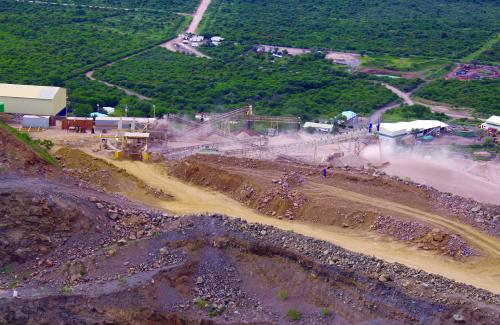
OKORUSU Fluorspar Mine, one of the largest in the world, is expected to shut its doors next month, a process that will see about 407 workers jobless.
Situated north of Otjiwarongo in Otjozondjupa region, the mine is not only known for its success but also for controversies after several people were forced out of surrounding farms to accommodate the mine in 2005.
Solvay Chemicals, the mine’s parent company, yesterday announced that it will close the mine after 26 years of exploration because it is not economical as a result of depleted high grade ore resources.
The mine had 407 workers – 321 full-time staff and 86 contractors.
The company said all employees will be given appropriate notice of termination of employment by the end of November under severance conditions.
Contracting companies will also be given notice of termination of their contracts at the same time.
In addition to setting up a help centre, Okorusu management will be working closely with the Chamber of Mines of Namibia to facilitate the placement of as many employees as possible at other Namibian mines.
Okorusu Fluorspar managing director Mark Dawe, in a statement issued yesterday, said: “It is with deep sadness and regret that we must announce the termination of employment of nearly all our employees and contractors.”
Minister of Mines and Energy Isak Katali said he was informed about the decision by the company.
“Yes, I was informed not only now but when the hardship started. It is very sad to hear that so many people are going to be without work or go and take up employment at the expense of others,” he said.
He also said the reality is that the ore body the company had been successfully mining was depleted and the current ore body is difficult to separate viably.
“They have been researching to find the right metallurgy to recover it, but so far no solution has been found. While they continue to do research, they will also explore the new EPL (exploration prospecting license) to find more ore body and reopen the mine,” the minister told The Namibian yesterday.
According to Katali, the encouraging factor is that Okorusu will put the plant under maintenance and care, so that the machinery will be ready to use any time a solution is found and the workers will be called back.
“It is painful that a mine with a track record of good relationships between workers and management finds itself in this problem. We hope a solution to this problem is found and the mine can be reopened,” Katali said.
The mine became one of the world’s largest fluorspar mines producing some 132 000 tons of 97% pure acid grade fluorspar concentrate per annum.
Production then levelled off at 120 000 tons a year until the financial crisis struck in 2009 and demand dipped dramatically.
The mining company got the contract to supply iron ore to the new Ohorongo cement factory near Otavi in 2010.
However, four years down the line, the company said enough is enough.
The company said preliminary research shows that a significant improvement in the separation of fluorite from the gangue minerals is not economically viable under the current market conditions with low demand and suppressed prices.
The mine will now enter a period of intensified exploration and metallurgical research and development to assess the potential for beneficiation of the remaining low-grade ores and to continue searching for more viable resources.
The company said 30 employees will be re-hired immediately on fixed-term contracts to carry out and supervise the care and maintenance of the mine, as well as the ongoing exploration activities.
Okorusu said it is committed to mitigating the environmental impact of the mine in accordance with the provisions of its Environmental Management Plan (EMP) and the Mine Closure and Rehabilitation Plan.
Another legacy left by the departing miners is the resettlement farmers who are up to today still complaining about land after the government expropriated farms with the farmers thinking that they will get lucrative mineral rights.
The Namibian has in the past reported how government ended up paying N$8 million as compensation for two surrounding farms.
The owner of Okorusu farm decided to sell her farm after she realised that farming activities clashed with the mining company Okorusu Fluorspar just a few kilometres away from the farmhouse.
Although she had received a monthly payment of N$25 000 from the mining company, she found it best to sell Okorusu to the fluorspar company.
It offered her N$750 155 for the 3 410-hectare Okorusu and N$2,5 million for Marburg’s 5 000 hectares, but Lacheiner-Kuhn found the offers too low. – Additional reporting Chamwe Kaira