


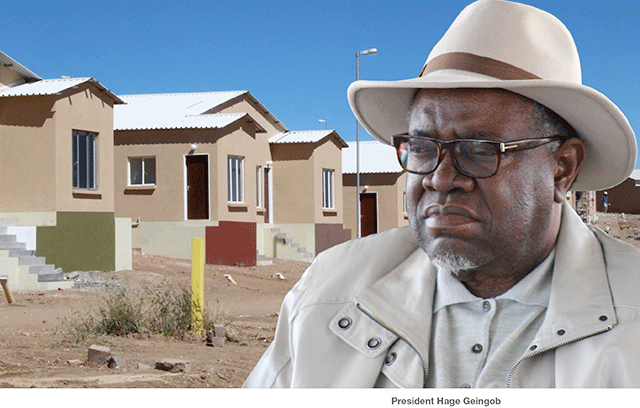
AROUND 360 houses completed under government’s mass housing programme in Windhoek have still not been handed over to beneficiaries, two years after most of them were completed.
The mass housing project was former President Hifikepunye Pohamba’s brainchild and mooted answer to Namibia’s housing crisis, with a promise to build 148 000 houses by 2030.
Pohamba’s dream was wrecked a year after he left office when the Geingob administration reduced that number of first phase houses in Windhoek from 1 000 to 360 units in 2015.
President Hage Geingob promised better implementation of the project when he became President in March 2015, but that promise appears to be a mirage because his administration continues to fail to hand over the 360 completed houses in Windhoek.
Windhoek’s N$350 million mass housing project was awarded to a company called CalgroKuumba, which was owned by businessman Titus Nakuumba and his South African partners, Calgro.
CalgroKuumba was initially awarded a contract to build over 1 000 houses in the Otjomuise suburb in Windhoek – the biggest mass housing recipient in 2013 – where Pohamba launched the project, and pleaded with government officials to implement it.
Questions sent to the urban and rural development ministry’s permanent secretary, Nghidinua Daniel, were not answered by yesterday, but two people familiar with this matter said not a single mass housing programme house in Windhoek has been delivered to beneficiaries.
The completion of the houses was confirmed last year by Calgro’s project manager, Gerhard Botha, who told The Namibian at the time that the houses were completed within the contract period.
“The alignment of service connections for the occupation of the units is problematic, and we have made a proposal to the client to explain the delay,” he said.
An official involved in this matter, who declined to be named, yesterday said the delay in handing over the houses was due to several reasons, such as government bureaucracy, and the manner in which the mass housing programme was halted.
For instance, the initial contract with CalgroKuumba to build mass houses in Windhoek did not make provision for the service connections, a situation that has left the completed houses without connections to basic services such as water and electricity, up to today.
“It’s been an oversight from their [government] side. We kept informing them to rectify this, but there was no action from their side,” said a person familiar with this matter.
“The town planning process took long as it was delayed by government when they stopped the contract,” said the source, who added that the municipality has now approved the township plan, which means the developers need to wait for two more months for the township board to approve or reject the plan.
A person familiar with the value of the units said one house could cost around N$500 000.
It is not only the township plan that is a headache for government. The Namibian understands that the unit register, which is supposed to be with the deeds office, has not yet been completed.
Government is also supposed to issue completion certificates for the houses, but this has not yet been done, a person involved in this process said.
reported last year that the vandalised houses at Walvis Bay were without water and electricity connections, some without window frames, while window panes were removed in most cases. In other cases, some doors were broken or stolen, and kitchen and bathroom sinks were missing and others damaged.
Geingob has been criticised for not being decisive in tackling the housing crisis, and for taking credit for the delivery successes of Pohamba’s housing project.
For instance, Geingob said during his state of the nation address this year that around 3 100 houses were completed last year, while in fact the construction of these houses started under Pohamba.
Geingob has also been playing up the role of the National Housing Enterprise as a solution to give loans to Namibians to buy houses.
However, a person familiar with NHE’s operations, said the housing parastatal has regressed since the new leadership, under chief executive Gisbertus Mukulu and the board that includes Sam Shivute, took over.
The board’s three-year term ends in August this year, and there are already calls by NHE insiders for new faces to come on board who could transform the organisation, which has failed to take off as expected.
Urban and rural development minister Peya Mushelenga told the National Assembly last week that 4 960 houses were constructed last year through initiatives such as the stalled mass housing programme, the Shack Dwellers Federation of Namibia (SDFN) and through public-private partnership developments.
The SDFN, whose patron is First Lady Monica Geingos, has been more visible than the state-owned NHE.
Mushelenga said around 4 420 plots were serviced last year through the massive urban land servicing project and other initiatives. Namibia’s housing backlog is estimated to be over 120 000, and continues growing.
In an age of information overload, Sunrise is The Namibian’s morning briefing, delivered at 6h00 from Monday to Friday. It offers a curated rundown of the most important stories from the past 24 hours – occasionally with a light, witty touch. It’s an essential way to stay informed. Subscribe and join our newsletter community.

The Namibian uses AI tools to assist with improved quality, accuracy and efficiency, while maintaining editorial oversight and journalistic integrity.
Stay informed with The Namibian – your source for credible journalism. Get in-depth reporting and opinions for
only N$85 a month. Invest in journalism, invest in democracy –
Subscribe Now!