



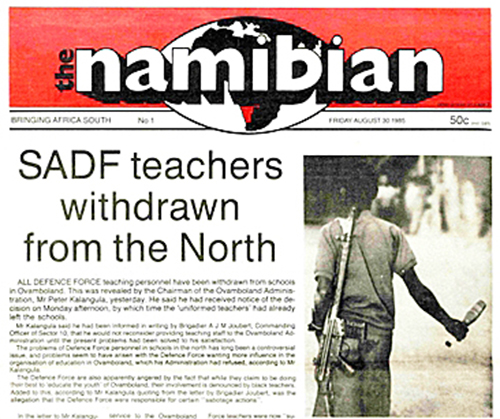
On 30 August 1985, Yang Tze Chinese Restaurant wishes The Namibian newspaper everything of the best for their first edition, a bottle of Sta-Soft costs 46 South African cents and a music reporter describing Whitney Houston on page 29 says she “certainly has potential and should become a major vocalist”.
Abroad it’s been a bad bet for aviation. Japan Airlines 123, Delta Flight 191, British Airtours 28M and Bar Harbour Airlines 1808 have all claimed their share of lives in a grim tally that reaches 720 and which will go down in history as the single worst month in aviation but act as no deterrent to travelling in tin cans floating thousands of kilometres straight up in the sky.
As the world reads about this month of disaster in the New York Times or catches the tail end of a news segment on the BBC, The Namibian is being sold for 50 cents with the tag line ‘Bringing Africa South’ to the left of a photograph of a member of the home guard with a gun casually slung over his shoulder while carrying an unexploded mortar.
The news is all emergency, chaos, blasts, independence, koevet, constitution and Anton Lubowksi re-raising hell as 52 demonstrators are released on bail after police tear gassed them down and loaded them up for trying to commemorate Namibia day in Katutura the Sunday before.
In California, the police are closing in on the Night Stalker. A serial killer and rapist named Richard Ramirez who has terrorised inhabitants of greater Los Angeles through a series of murderous home invasions.
On 30 August 1985, his luck runs out and he returns to Los Angeles from Arizona only to find his face staring back at him from every major newspaper.
The effect is a certain inability to walk down the street without a group of elderly Mexican women calling him ‘El Matador’ (the killer) before two failed carjackings and a hit on the head see him subdued by a group of residents who hand him over to the police in a dazzling display of citizen’s arrest.
As the Night Stalker stews, Namibians read the first of 30 years of Gwen Lister’s ‘Political Perspective’.
Her column photo featuring a coy blonde pensively looking off to the side in all of 80s fashion magazine glory is deceptive and Lister’s impenitent brand of political commentary plays on for the entire page before Cynthia Schimming and Marina Lambrecht add to the whiff of fashion mag mystique by advertising ‘Limited Editions’. A new boutique whose line is ‘we don’t follow fashion, we create it.”
On the People’s Page, Schimming can be seen living up to this boast in a cascade of curls and shiny plunging neckline at Fashion Fair ‘85. “A dazzling, non-stop display of the latest trends in casual and current fashion,” at the SKW Hall.
Meanwhile according to the UK and US Top 40, everyone is listening to Madonna’s ‘Holiday’, Huey Lewis The News’ ‘The Power of Love’, UB40 featuring Chrissie Hynde’s ‘I Got You Babe’, Kool The Gang’s ‘Cherish’ and Tina Turner’s ‘We Don’t need Another Hero’ from the movie ‘Mad Max Beyond Thunderdome.’
Thirty years later, the fourth installment of the indomitable ‘Mad Max’ franchise will be shot in the Namib Desert before being voted the year’s best film by international critics. Though ‘Mad Max Beyond the Thunderdome’ is praised by professional detractors, 1985 ends with the film eclipsed by ‘Back to The Future’, ‘The Colour Purple’, ‘The Goonies’ and ‘Out of Africa’.
In a section called ‘Sound and Vision’, Namibian movie enthusiasts peruse what’s on offer at the bioscope. Kine 300 is showing ‘Rambo First Blood 2’, Windhoek Drive-in is featuring the new Dudley Moore picture ‘Micki Maude’ and Ster Drive-In’s bet is on a Dennis Quaid film called ‘Dreamscape’.
In the classifieds, Jobs Unlimited says it has too many jobs while an article a few pages back laments the living conditions and poverty in Katutura in an article titled ‘What price a roof and a home?’.
Thirty years later and the former boast of a wealth of jobs will have settled into dearth and the latter would have stayed pretty much the same.
What would have steadily risen is the HIV-Aids rate.
On 30 August 1985, the country is proud to announce that, despite 21 cases of the dreaded disease in South Africa, Namibia remains HIV-Aids free. The article goes on to say that out of South Africa’s 21 HIV positive individuals, all are male, 16 are homosexual and one is bisexual.
Though the scourge of HIV-Aids weighs sinisterly at the back of most people’s minds, balm is found in the words of South African Minister of Health, Dr Willie van Niekerk, who says there is no cause for alarm as HIV-Aids tests will be introduced soon.
On 30 August 1985, the number is zero. By 30 August 2015, the number will be over 260 000.
By then I will be 30 years old.
My mother, my family and I will be celebrating her birthday at Roof of Africa while readers wish The Namibian a happy birthday all over social media amidst reflection on how far we’ve come as a country.
The month the Namibian newspaper is born, anti-apartheid lawyer Victoria Mxenge will be assassinated by SA government-backed death squads and PW Botha will refuse concessions to the black majority before rejecting the release of Nelson Mandela but the paper won’t yet be ready.
But soon it will be there calling itself ‘The Namibian’ in a land technically still called South West Africa.
It will be there as a major and mind-changing voice during Namibia’s struggle for independence despite boycotts, arrest and bomb threats.
It’ll be there 30 years later.
Out each weekday like clockwork.
-martha@namibian.com.na; @marth__vader on Twitter and Instagram