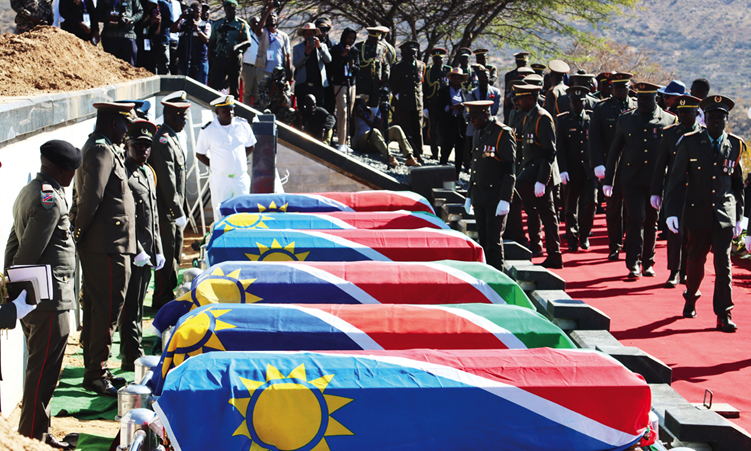
On 26 august 1966, the first shots of Namibia’s liberation struggle were fired at Ongulumbashe.
That day marked the beginning of a journey toward self-determination, not only political self-determination but also economic self-determination.
Our heroes envisioned a Namibia where the wealth beneath our soil and the richness of our waters would serve the prosperity of our people.
As we mark another Heroes Day, it is worth reflecting on how close we are to realising that vision and what more remains to be done.
Namibia finds itself at a genuinely promising juncture.
The anticipated oil production from the Venus discovery, the growing global demand for our critical minerals, and the emergence of green hydrogen as a strategic industry all point toward significant economic expansion.
Reflecting on this massive potential, the International Monetary Fund (IMF) projects that our nominal gross domestic product could approach N$400.8 billion by 2031.
These developments offer an unprecedented opportunity to accelerate development, create employment, and strengthen our industrial base.
ENOUGH FOR ALL?
Yet opportunity alone does not translate into broad-based prosperity.
The question that confronts us is whether the benefits of this extractive boom will be widely shared, or whether they will remain concentrated in ways that limit their impact on ordinary Namibians.
This is where the principle of local content becomes essential: it is not about closing doors to foreign investment.
On the contrary, international partnerships remain vital to Namibia’s development.
What local content seeks to ensure is that these partnerships are structured in a way that builds domestic capacity, transfers skills, and creates meaningful opportunities for Namibian enterprises and workers.
It is about ensuring that the wealth generated from our natural resources contributes to the growth of our own economy, rather than simply passing through it.
There is ample precedent for getting this right.
Countries that have successfully leveraged their natural resources for national development, from Botswana with its diamond sector, to Norway with its petroleum industry, have done so through clear, enforceable frameworks that prioritise local participation.
They understood that foreign investment and domestic empowerment are not mutually exclusive; rather, they are most effective when pursued together.
THE NEXT FRONTIER
Namibia has made commendable strides in this direction.
The National Upstream Petroleum Local Content Policy, recently approved by the Cabinet, provides a solid foundation.
However, translating policy into practice requires sustained attention.
The next crucial frontier, as highlighted by our government leaders at the Namibia Oil and Gas Conference, is embedding this policy into an enforceable legislative framework.
It means ensuring that Namibian small and medium enterprises have genuine access to procurement opportunities in the extractive supply chain.
It means establishing skills development programmes that prepare Namibian workers for technical and managerial roles.
It means creating joint-venture structures that give local partners real equity and decision-making authority, rather than nominal involvement.
We must also be candid about the capacity constraints we face.
Namibia does not currently produce a sufficient number of petroleum engineers, marine construction specialists, or hydrogen technicians to meet the demands of an expanding extractive sector.
Addressing this gap is not the responsibility of industry alone; it requires coordinated investment in our technical and vocational education institutions, targeted scholarships, and apprenticeship programmes designed in partnership with the companies that will ultimately employ these graduates.
The time to begin this investment is now, before the major projects reach full scale.
ECONOMIC DESTINY
The heroes we honour on 26 August did not fight for a Namibia that merely hosts foreign enterprise.
They fought for a Namibia where its people are active participants in their own economic destiny.
Every barrel of oil, every tonne of minerals, every megawatt of green energy produced in our territory represents an opportunity to strengthen domestic capacity, provided we have the laws and partnerships in place to capture it.
This Heroes Day offers a fitting moment for national reflection.
It invites us to consider whether our current approach to extractive industry development truly reflects the aspirations of those who sacrificed for our independence.
It challenges us to ask whether we are doing enough to ensure that the next generation of Namibians inherits not only political freedom, but economic opportunity as well.
The path forward is one of constructive partnership, between the government and industry, between foreign investors and local enterprises, between our education system and our economic needs.
It requires patience, coordination, and a shared commitment to building something lasting.
IT’S UP TO US
Our heroes gave us a nation. It is now our responsibility to ensure that nation thrives. On 26 August, let us recommit to making Namibia’s natural wealth a vehicle for Namibian empowerment through thoughtful policy, binding legislation, and an unwavering belief in our own capacity to build the prosperous, self-reliant country that Ongulumbashe made possible.
– Gabriel Haulyamayi is an entrepreneur, a commentator on socio-economic issues and author of the book ‘Local Content In Namibia’s Extractive Industries: The Upstream Petroleum Local Content Policy and Its Cross-Sectoral Lessons for the Mining Sector’.