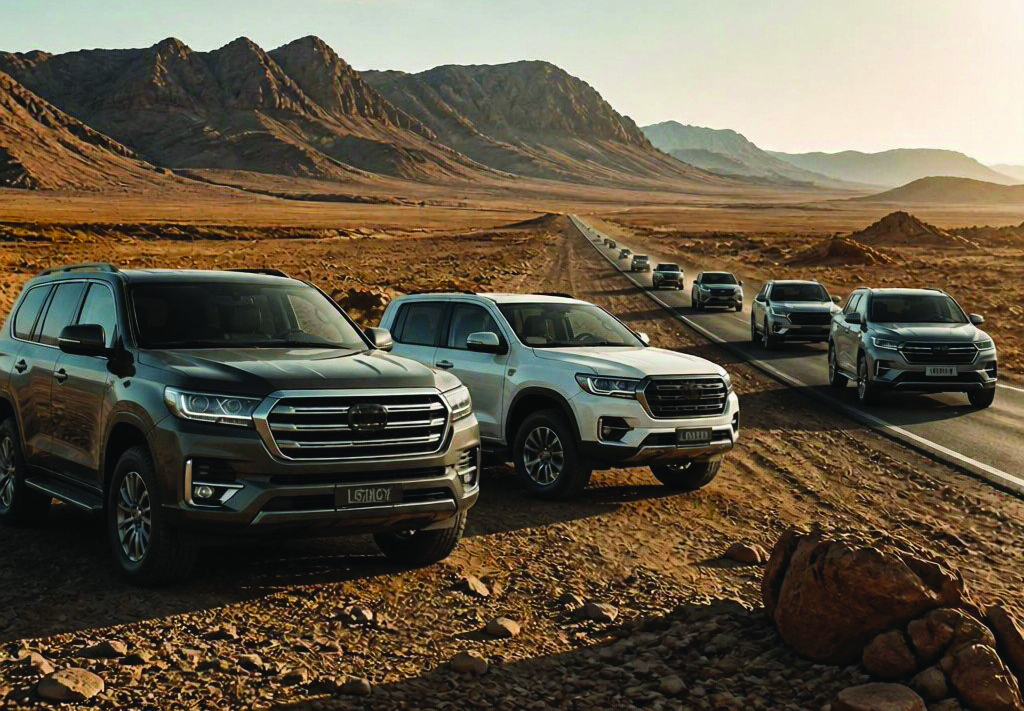
Chinese brands reached 9.1% of the market in 2025, being the strongest year yet for Chinese manufacturers in Namibia.
Chinese brands sold about 1 320 vehicles, giving them 9.1% of the total market. That was up from 7.5% in 2024.
Several brands contributed to the increase.
These included Haval, GWM, Chery, JAC, Omoda, Jetour, Jaecoo, LDV, and Foton.
Newer brands such as Jetour, Omoda and Jaecoo helped expand the Chinese presence, while Haval entered Namibia’s top five brands for the first time, selling 394 vehicles during 2025.
Toyota remained dominant
It is important not to overstate the Chinese success.
Toyota remained overwhelmingly dominant, selling 8 226 vehicles in 2025, representing 56.7% of Namibia’s total vehicle market.
So the market in 2025 was not a Chinese takeover, it was a market where traditional brands remained dominant while Chinese brands rapidly increased their share.
Five-year comparison: 2021 vs 2025
Total new vehicles sold: 9 428 versus 14 498
Toyota market position: 34.9% versus 56.7%
Chinese brands: Small emerging presence 9.1%
Haval: Established but relatively small 394 units
Chinese competition: Limited broad range of brands
Consumer choice: More concentrated, much wider
These figures show something interesting: Toyota actually became stronger over the five-year period, while Chinese brands also became stronger.
This means Chinese manufacturers have not simply taken over Toyota’s position. Instead, they have increased competition underneath the dominant brands.
Why are Chinese cars growing in Namibia?
Price is one of the biggest advantages. The biggest reason is simple: Value for money.
A Chinese vehicle can often offer a strong equipment list at a price designed to compete directly with established brands.
For a buyer comparing monthly finance payments, the difference can matter more than the badge on the bonnet.
A buyer may ask: Why should I pay more for a vehicle with fewer features? That question has become increasingly relevant in Namibia.
Warranty packages
are helping
Long warranties also reduce one of the biggest concerns surrounding newer brands. For example, JAC Namibia currently advertises warranties of up to seven years/200 000km on some models, while its T8 double cab carries a five-year/200 000km warranty.
This changes the conversation. Chinese brands are no longer simply asking customers to take a chance on an unfamiliar vehicle.
They can offer warranty protection that makes the purchase easier to consider. SUVs and bakkies are especially important.
Chinese manufacturers have concentrated heavily on segments that matter to Namibian buyers, with SUVs being a major example.Brands such as Haval, Chery, Omoda and Jetour have built their ranges around SUVs and crossovers.
Chinese manufacturers are also competing in the commercial market.
JAC, GWM, LDV and other Chinese manufacturers offer bakkies and commercial vehicles designed to compete with established products.
This is particularly important in Namibia, because bakkies are used by farmers, construction companies, mining businesses, tourism operators, small businesses, and private owners.
The competition is therefore not limited to family cars.
Where traditional brands still have the advantage
Toyota remains the benchmark. The biggest advantage traditional brands have in Namibia is trust built over decades.
Toyota’s dominance in 2025 illustrates this. Its 8 226 sales were more than six times the combined 1 320 vehicles sold by Chinese brands. Namibian buyers are familiar with vehicles such as the Hilux, Fortuner and Corolla Cross.
They also know where to find parts, technicians and dealerships. That matters when buying a vehicle that may need to survive Namibia’s long distances and demanding operating conditions.