



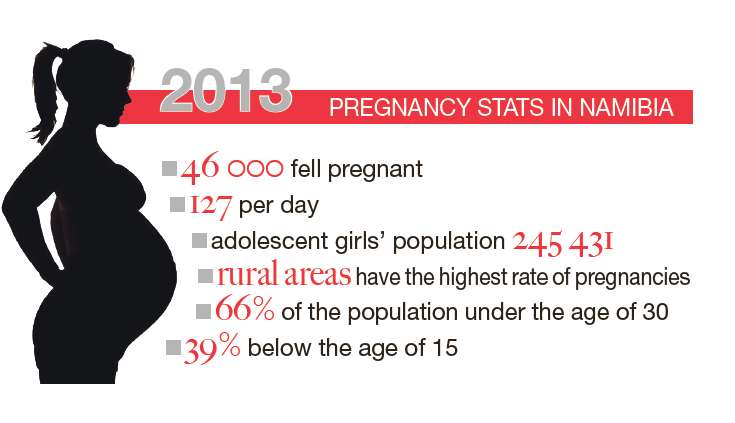
MORE than 46 000 teenagers fell pregnant in 2013 – about 127 girls every day – in Namibia, a United Nations report revealed this week.
The United Nations Population Fund (UNFPA) released these statistics in commemoration of World Population Day, celebrated on 11 July every year.
This year’s theme was “Investing in Teenage Girls.”
When the statistics were compiled, there were 245 431 teenage girls in Namibia aged between 15 and 19.
The report said the figures are higher in some regions, with 20% of teenagers in some rural areas becoming mothers earlier than their counterparts in urban areas.
One of the reasons which the report gives is that rural teenage girls only have primary-level education, while girls in urban areas are better educated.
Apart from the academic factor, the report also said some girls do not know how to avoid falling pregnant, while others feel shy or are ashamed to access contraceptives.
“The use of contraceptives among young people aged between 15 and 19 is 24%, compared to a national contraceptive prevalence rate of 50%. However, sexual activity can be compounded by poverty, peer pressure or lack of education”, the report stated.
Dennia Gayle is the UNFPA country representative, who said a lack of resources might also force girls to become involved in sexual activities in an effort to get material needs and food.
“Because sexual encounters can also happen by force or coercion and in a position of a power imbalance, the adolescent girl is less likely to be able to negotiate contraceptive use, including condoms for dual protection,” Gayle explained.
Education minister Katrina Hanse-Himarua said teenage pregnancy is a societal problem.
“It has been a challenge, and there has been an outcry against the current policies which have been put in place to address, manage and control teenage pregnancies.
“One of the things that should happen is to focus on classes that teach life skills. There is a serious neglect of life science subjects in our schools, and this must change,” stressed Hanse-Himarwa.
She agreed with the report that most of these pregnancies are from rural areas, and that the supervision of learners and teenagers must be strengthened.
Meanwhile, these statistics have triggered panic among civil society organisations, who are calling it an alarming crisis.
Women’s Solidarity Namibia director and gender activist Rosa Namises said she will re-emphasise the need for drastic improvements in sexual education and access to contraceptives.
“Our adolescent girls are the most vulnerable group, and we need men to protect them. The other problem is that children as young as 11 years are already sexually active.
“This is because they are exposed to sexual activities in their homes, the media – be it social or visual. Our children grow up believing in the sexual objectification of women, and that in order for us to have a good life, it’s okay to have sex,” Namises stated.
She further said guardians, parents, government and schools should intensify sex education, and teach girls their worth.
The report also states that adolescents may lack knowledge of, or access to, conventional methods of preventing pregnancy, as they may be too embarrassed or frightened to seek such information.
Furthermore, health facilities and health workers are not always equipped to provide the needed services and information.
“Namibia, with 66% of the population under the age of 30 and 39% below the age of 15, requires comprehensive efforts to address youth health issues. This age is a formidable asset, but if the proper investments in health, education and employment are not made, we run the risk of missing the window of opportunity to harness this demographic dividend,” Namises noted.