



• KELLY HODGKINSAFTER 19 years of construction, the world’s largest fusion reactor goes online this month.
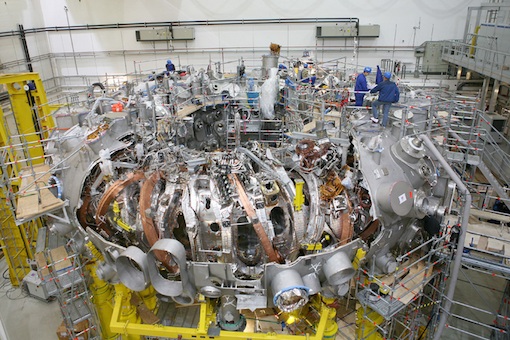
In Germany, a team of researchers are preparing to switch on the largest nuclear fusion plant in the world. Hosted at the Max Planck Institute, the stellarator, also known as Wendelstein 7-X (W7-X), is awaiting regulatory approval for a launch later this month, reports Science. When it goes online, W7-X will best the Large Helical Device (LHD) in Toki, Japan, which began operating in 1998 and is currently the largest working stellarator.
The project to build the W7-X was started in 1993, after the German government approved the project and established the Greifswald Institute to help build the machine.
The project has had its share of ups and downs with faulty magnets and unexpected technical issues delaying the project.
Construction of the W7-X almost almost came to a standstill when a magnet supplier went bankrupt and technical issues forced the team to send back multiple parts for redesign.
After more than 1,1 million construction hours over a 19-year period, the €1 billion stellarator was finally finished in May 2014. In the past year, the machine has undergone vigorous testing to ensure it performs as expected and operates within safe limits. Now, the scientists are waiting for the green light to bring plasma into the facility and test the nuclear fusion reaction.
Unlike conventional nuclear reactors that rely on the nuclear breakdown of atoms, nuclear fusion generates energy by fusing parts of atoms together. The nuclear fusion reactor uses high temperatures, as high as 180 million degrees Fahrenheit, to heat plasma to the point that the electrons are extracted from the atoms. Powerful magnetic fields, up to 50 six-tonne magnetic coils in the case of the W7-X, are used to contain and control this plasma reaction.
These extreme conditions within the reactor break down the normal repulsive forces that usually drive the electrons apart. Rather than repulse each other, the ions instead fuse together to produce energy.
This reactor-based fusion is the same process that fuels our sun. Scientists must now wait until the end of the month for government approval before they can bring in plasma and begin their first real test of the W7-X.
–Yahoo News
In an age of information overload, Sunrise is The Namibian’s morning briefing, delivered at 6h00 from Monday to Friday. It offers a curated rundown of the most important stories from the past 24 hours – occasionally with a light, witty touch. It’s an essential way to stay informed. Subscribe and join our newsletter community.

The Namibian uses AI tools to assist with improved quality, accuracy and efficiency, while maintaining editorial oversight and journalistic integrity.
Stay informed with The Namibian – your source for credible journalism. Get in-depth reporting and opinions for
only N$85 a month. Invest in journalism, invest in democracy –
Subscribe Now!