




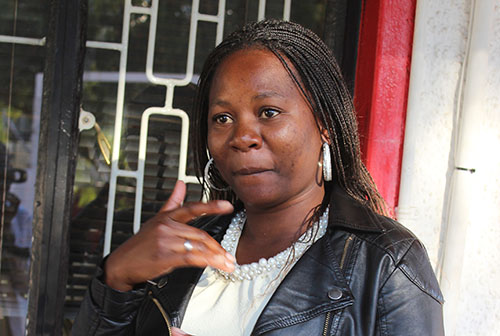
AFTER obtaining a degree in travel and tourism from a Windhoek college in 2013, Sylvia Bathlomeus, who has a hearing impairment, thought her world would open up.
Now, two years later, although Bathlomeus (25) has applied about 15 times for jobs and been called for job interviews four times, she has not been lucky enough to find employment.
It is clear to her that, despite the struggle to complete her studies, her life will not be better any time soon because of her condition.
Bathlomeus is one of 27 000 deaf people in Namibia who could be facing the same predicament of being excluded from job opportunities.
For her, the struggle was hard, since Namibia only offers education for deaf children up to Grade 10, yet Bathlomeus managed to reach Grade 12.
She attended Eluwa Special School in Ongwediva where she learned sign language.
Eluwa is one of six schools in the country that caters for deaf children. The school, that is home to 341 hearing-impaired pupils, offers education up to Grade 10.
Bathlomeus completed Grade 12 in 2010 at Cosmos High School in Windhoek, where there are language interpreters.
Luckily for her, she was not the only pupil with a hearing impairment, as there were other children with the same condition as well.
In an interview with The Namibian, Bathlomeus said an illness she suffered at the age of four left her deaf. She also said the condition has not stood in her way of improving herself and that she hopes to make a difference in society.
This is why she is currently enrolled for an entrepreneurship and business management course at the Polytechnic of Namibia.
“People living with disabilities are not wasting time and waiting for government to give them employment. We do not depend on the monthly grants and spend our days doing nothing. We work hard and can do much more if granted an opportunity,” she said.
Bathlomeus feels that the public needs to understand that there is more to their (hearing impaired people’s) lives than meets the eye and that they should be given similar opportunities as those without disabilities.
“As deaf people, we are fighting constantly, seeking education to uplift ourselves. When we manage to be educated, we cannot find jobs. Deaf people can work as police officers. They know how to write and they can see, so it should not be hard to work as an officer, at least to certify copies of original documents,” she said.
Last year Bathlomeus did voluntary work as a deaf association teacher at Usko Nghaamwa Special School in Eenhana where pupils go up to Grade 7.
Paul Nanyeni, the executive national chairperson of the Namibia National Association of the Deaf (NNAD), said deaf people all over the world are facing employment challenges.
“This is mostly attributed to the negative perspective the hearing world has about the deaf. One cannot wait for the deaf to prove that they are capable,” Nanyeni said.
He also said those with a hearing impairment are mostly judged by their disabilities and that employers always ask themselves questions such as “How can I talk to him/her?” and “How will he/she lead the organisation?”.
“However, some deaf people are smart, well educated, have qualities most hearing persons do not possess, but because of the negative image the hearing society has of deaf people, it is always a difficult situation.
“We have some deaf people who went to South Africa and studied different skills but when they return after finishing Grade 10, the government is reluctant to hire them. It is disheartening,” he said.
Nanyeni added that Namibia has an affirmative action policy about employment of people living with disabilities, but that there seems to be not enough mechanisms in place to ensure this is adhered to.
He requested the National Disability Council to ensure that the policy is operational everywhere and if need be, to be expanded, reviewed and strengthened so that people with disabilities can get jobs.
“In my eyes, every single individual has a disability, hence we all should look at one another as normal in our own skin and feel comfortable with what one is able to do,” Nanyeni advised.
He said the stereotyping of people living with disabilities will not change in the short term, but they will nevertheless continue vigorously with their advocacy work.
The deputy minister for disability affairs in the office of the vice president, Alexia Manombe-Ncube, said they are aware that at times people with disabilities face discrimination in terms of employment.
Manombe-Ncube said it gets so bad sometimes that some employers do not even have interpreters to accommodate deaf people on their interview panels.
Manombe-Ncube said although the affirmative action policy, which she says is supported by the national disability policy, has mechanisms that all people, even those with disabilities, are given a fair chance for employment although it is not enough.