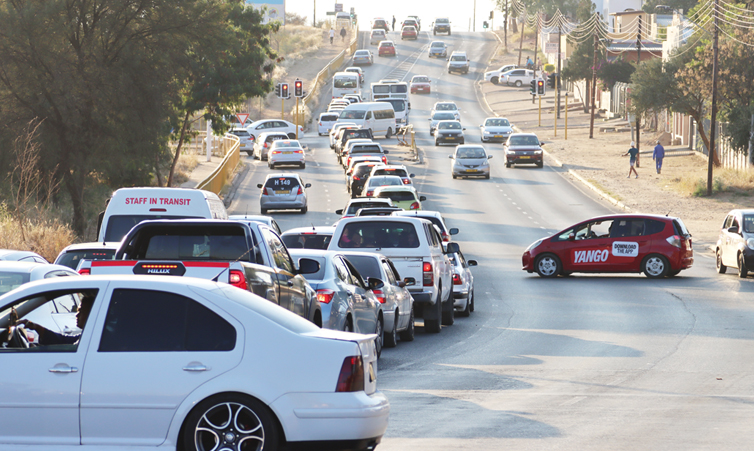
Road users in Windhoek have voiced frustration over worsening traffic congestion, with many reporting that they spend hours on the road during peak periods, making it difficult to reach their destinations on time.
Elisenheim resident Charmaine Nel (56) told The Namibian yesterday that traffic congestion has turned into a daily struggle.
Nel said her family’s morning trip from Elesenheim to Klein Windhoek used to take about 30 minutes, but now takes between 45 minutes and more than an hour.
“It’s really very frustrating,” she said.
Nel said she and her husband moved to Elesenheim last year because they believed the Western Bypass would provide quick access to the city, but traffic conditions have deteriorated significantly.
She said her husband drops their granddaughter at All Nations School before continuing their journey, but congestion now causes delays despite the relatively short travelling distance.
Nel said one of the worst bottlenecks is where motorists from Elisenheim, Osona and Okahandja merge with traffic near the B1 and the turnoff towards Namibia Breweries.
She questioned the conditions of the road and said traffic lights at the intersection have not been functioning for a long time.
“It’s causing frustration and stress for families every morning. Everybody wants to push in because they just want to get to work or school,” she said.
The Namibia Bus and Taxi Association (Nabta) says the concerns are justified, adding that growing vehicle numbers, inadequate road infrastructure and illegal passenger transport operators are contributing to the problem.
Nabta secretary general Pendapala Nakathingo says commuters who rely on public transport are among those hardest hit by the congestion.
“Those who depend on public transport have to wake up very early in the morning to get to work, yet they still spend about an hour or two in traffic,” he says.
Nakathingo says traffic builds up again during lunchtime when parents do school runs, and intensifies once more during the afternoon rush as people head home from work. He says the City of Windhoek should consider expanding roads and reviewing traffic flow to accommodate the increasing number of vehicles.
“We really need to reconsider road expansions or directions because the number of vehicles has multiplied,” he says.
He also blames illegal passenger transport operators for the congestion. According to Nakathingo, private vehicles, including bakkies and vehicles registered outside Windhoek, are transporting passengers for reward without the required operating permits.
He says he supports the concerns raised by commuters and believes urgent intervention is needed to improve traffic flow in the capital.
City mayor Sakarias Uunona told The Namibian yesterday that motorists must use alternative routes where possible, be considerate of other road users and avoid cutting queues.
“You will find a household with five people and all of them have cars,” he said.
Uunona added that “there is nothing one can do about cars or road users increasing.”
Civil engineer Ismael Nuunyango yesterday said Windhoek should prioritise conducting traffic studies to determine how many vehicles use key routes such as the Western Bypass before decisions are made on road infrastructure.
Nuunyango said policymakers do not experience the daily challenges faced by ordinary motorists, adding that officials travelling in VIP convoys often avoid traffic congestion.
“Those guys don’t feel the traffic,” he said. He added that ministers would eventually experience the same frustrations once they leave office and no longer have access to official vehicles and escorts.
Using the road between Ondangwa and Ongwediva as an example, Nuunyango said more investment was needed to expand road networks in high-traffic areas.
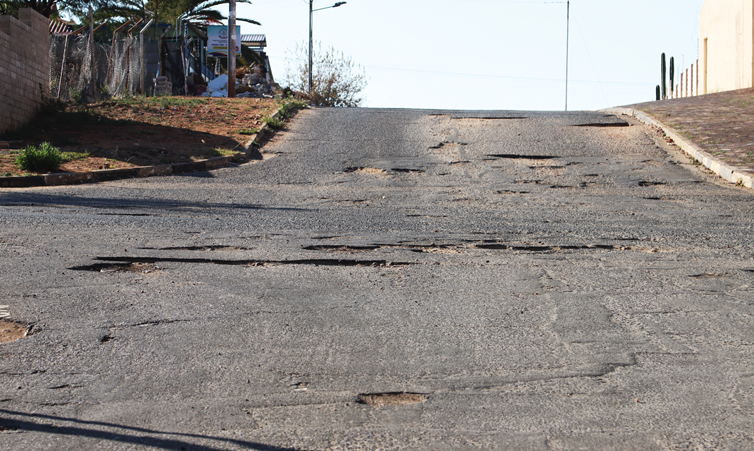
BATTERED … Commuters often have to switch lanes to avoid potholes on Freud Street in Windhoek West. Photo: Mitchelin Kangootui
He said the two towns currently rely mainly on the B1 road, which becomes heavily congested during peak periods, particularly in December and on pay weekends.
“We only have one and that B1, during December or any weekend when people get paid, you will spend two hours just getting from Ongwediva to Ondangwa,” he said.
Nuunyango suggested that the government should consider constructing an additional road between Ondangwa and Ongwediva or upgrading the existing route into a multi-lane road.
Simonis Storm economist Almandro Jansen says Windhoek’s worsening traffic congestion reflects a city whose infrastructure was designed for a much smaller population and vehicle fleet.
“More than 20 500 vehicles enter Windhoek every day, approximately 16 000 via the northern corridor and 4 500 via the southern corridor, in a city with nearly 420 000 registered vehicles and a population of around 500 000,” he says.
He says Windhoek’s metro population reached 511 000 in 2025, growing at about 3.44% annually from 96 057 residents in 1981.
According to Jansen, the city’s road network has insufficient bypass capacity and remains largely radial, forcing traffic onto a handful of major routes such as the B1 North, the Northern Industrial corridor, Hosea Kutako Drive and Sam Nujoma Drive.
He says economic activity remains concentrated in the central business district, the Northern Industrial area and a few commercial areas, creating intense peak-hour traffic flows.
He says outdated intersection designs, traffic signal limitations and ongoing road construction further reduce capacity, with the N$400-million Western Bypass project currently about 5% complete and the N$500-million Windhoek Rehoboth Phase 1A dual carriageway about 92% complete.
Jansen says vehicle growth is the most measurable driver of congestion, with the Khomas region accounting for about 42% of Namibia’s registered vehicles.
“Critically, vehicle ownership in Namibia is not merely a preference; for most working Namibians, it is a necessity,” he says.
To ease congestion, Jansen recommends a combination of immediate and long-term interventions.
Over the longer term, he says Windhoek should complete planned road projects, develop a bus rapid transit system, decentralise commercial activity, expand ring road infrastructure and invest in safe cycling and pedestrian facilities.