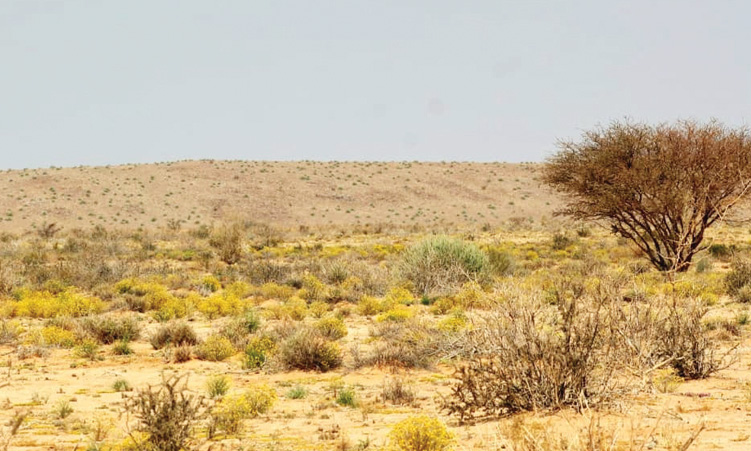
Seasonal rains have triggered the annual wildflower bloom in the Fish River Canyon, with a wide range of species now visible across Gondwana Canyon Park and the adjoining Ai-Ais National Park.
The event, which usually runs from late July to September, occurs once a year and is directly linked to rainfall.
Most species flower for only a short period. Annuals such as Oncosiphon (stinkweed) and Cleome (spider flowers) last only a few weeks, while succulents, including Mesembryanthemum, Aloe and Crassula can bloom for up to two months.
Aloes sometimes begin flowering earlier than other plants.
Among the species currently in bloom are Mesembryanthemum longipapillosum and related species (ice figs), which produce bright purple-pink daisy-like flowers, Arctotis (African daisies) such as Arctotis leiocarpa with orange and yellow blossoms, and Gazania, which produces golden-yellow or orange daisies close to the ground.
Other species include Didelta carnosa (salad bush), a trailing succulent with fleshy leaves and yellow flowers, Crassula, small succulents with clusters of star-shaped white or pink flowers, Oncosiphon, with yellow button flowers, and Cleome angustifolia and Cleome suffruticosa, which display yellow flowers with long purple-pink stamens.
Also flowering are Aloe pachygaster and Aloe claviflora, both striking succulents with clusters of red and orange tubular flowers, Euphorbia, hardy shrubs with greenish-yellow flowers, Jamesbrittenia (Jaybees), which often form carpets of delicate purple to pink blooms on sandy or gravelly soils, and Hermannia stricta, a small shrub with nodding yellow to orange bell-like flowers.
While plants such as Gazania and Arctotis are widespread in southern Namibia and Namaqualand, others like Aloe pachygaster and Hermannia stricta are more locally restricted and are considered particularly valuable in the canyon flora.
Park officials explained that rainfall is the key driver of flowering.
Cool nights and mild daytime temperatures extend the bloom, while the rocky soils of the canyon hold moisture that sustains succulents.


Open, sunlit areas favour daisies, Jaybees and spider flowers. In years of well-timed rainfall, the landscape produces carpets of daisies and fields of Cleome, while in drier years these annuals may be absent.
Succulents, though more resilient, can also shift their flowering period under prolonged drought.
The flowers play an important role in the local ecosystem. Pollinators such as bees, beetles, flies and butterflies depend on daisies, Jaybees and Cleome.
Sunbirds are attracted to aloes, while wildlife feed on moisture-rich succulents such as Mesembryanthemum and Didelta. In addition, shrubs including Crassula, Euphorbia and Hermannia stabilise soils and provide shelter for insects.
The bloom is accessible to visitors from roadsides, viewpoints and walking trails. Activities include the Garas 4×4 self-drive route, as well as guided morning and sunset drives within Canyon Park.
Visitors are expected to follow conservation guidelines, which prohibit off-road driving, picking flowers, or trampling through flower carpets. Wildlife feeding on the plants should also be respected.
Conservation management in the park includes habitat monitoring, invasive species control and measures to minimise visitor impact.
Species with limited ranges, such as Aloe pachygaster, are monitored closely to ensure their protection.
Although short-lived, the annual wildflower bloom remains a significant ecological event for the Fish River Canyon, supporting biodiversity and attracting visitors to the region each year.