






Imagine tourists watching wildlife at the Okaukuejo waterhole in Etosha. Meanwhile, dynamite is blasting a mere few kilometres away, trembling the earth and creating mushrooms of dust across the sunset, frightening wildlife and resulting in a constant flow of heavy trucks driving out the excavated gravel on a popular tourist route.
If only this was mere imagination.
Unfortunately, this scenario has played out in sensitive ecological tourism areas in Namibia’s world renowned and successful communal conservation areas.
One of these clashes of developmental perspectives has reached a critical stage to the point of being addressed in the High Court, and the public domain, including the mass media.
On 26 June, an editorial titled Conservation and development must not become enemies, published in the Windhoek Observer, raises an important question for Namibia. It correctly argues that conservation and development should coexist and that neither should come at the unnecessary expense of the other. Where we respectfully disagree is the premise upon which the editorial is built. After all, conservation is a mode of development, sustainable development.
The editorial presents the dispute presently before the High Court, involving mining entrepreneurs versus communal conservancies and their joint venture partners in Kunene, as a defining moment in Namibia’s attempt to balance mining and conservation. It suggests this is a watershed case in which the country must decide how to reconcile competing economic and environmental interests.
That is simply not the case.
That framing fundamentally misunderstands the dispute before the court and perpetuates a narrative that is divorced from the documented facts that are on public record.
This is not a contest between mining and conservation.
It is not a contest between tourism and development.
Nor is it a contest between private investment and community aspirations.
It is a test of whether Namibia will honour decisions that communities themselves have already made, whether government institutions will remain accountable to the laws they administer, and whether environmental governance means anything if years of lawful planning can simply be disregarded. That is a profoundly different question.
The Communities Had Already Chosen
Perhaps the most important fact missing from almost every public discussion surrounding this matter is that the area in question was not awaiting a decision about its future.
That decision had already been made. Long before the current disputed mining claims were granted, the conservancies that collectively manage this internationally renowned conservation tourism area undertook comprehensive planning processes through their game management and utilisation plans (GMUPs).
These are not informal policy documents. They are statutory conservancy management instruments, developed through consultation with, and approval of conservancy members, and lodged with the Ministry of Environment and Tourism as part of each conservancy’s compliance obligations.
Collectively, these democratically adopted plans designate this area as a wildlife conservation landscape. They explicitly identify mining as an incompatible land use within this core conservation zone.
These decisions were not imposed upon communities. They were made by the communities. That distinction is fundamental.
The editorial rightly argues that communities should not be excluded from decisions affecting their future. They were not. They participated. They debated. They voted.
They adopted conservation land-use plans that reflected their collective aspirations for their land.
Those plans were then accepted by the government.
The same conservancies subsequently entered into black rhino custodianship agreements with the tourism ministry, accepting responsibility for protecting one of the world’s most endangered species from undue disturbance while maintaining habitat integrity across this fragile ecosystem, and aiming to derive a significant generational benefit from that.
These agreements are not ceremonial.
They carry real responsibilities.
Communities accepted those responsibilities because they believed government’s conservation framework could be relied upon.
To now suggest that these same communities (and their joint venture partners) should simply accept large scale industrial mining within the very landscape they undertook to protect, is as good as asking them to abdicate the responsibilities they signed up for in promoting conservation and sustainable development.
A Timeline That Matters
Context matters.
Much has been made of historical mining activity in the area, creating the impression that conservation has suddenly emerged to oppose an established mining district.
The public record tells a different story. A mining licence was indeed issued over parts of this landscape in 1994. That was before communal conservancies existed, with the legislation to support that coming into play in 1996, before community-based natural resource management had matured into the internationally respected model Namibia is celebrated for today.
For the duration of that licence, mining was limited to prospecting, sampling and small-scale operations, nothing resembling what has been happening under the current licences and now being touted as a major mine. The 1994 licence expired in 2019 and was not renewed.
During the intervening decades, however, the landscape changed profoundly in the absence of any large-scale mining. Conservancies were established. Community conservation flourished. Black rhino populations recovered and additional rhino were introduced into these areas to bolster populations and genetic diversity, and to ultimately support the emergence of a wildlife economy to the benefit of local residents.
The government entered into custodianship agreements with conservancies. Joint management structures were created. Wildlife tourism developed. Communities invested in a conservation-based economy. The government itself encouraged and endorsed this transformation, with our current president, Netumbo Nandi-Ndaitwah, the patron of this movement.
Significantly, the area was formally withdrawn from mining after the previous mining licence expired in 2019 and was not renewed on account of environmental sensitivities; that is until 2024.
Unfortunately, without consulting the conservancies and eco-tourism stakeholders, the environmental commissioner reversed this exclusion of mining activities in the middle of the wildlife conservation area.
That decision facilitated the registration of the mining rights currently under scrutiny.
This is one of many questionable decisions made by the environmental commissioner in recent times pertaining to critical conservation areas.
The joint management area (JMA) was established precisely because this landscape had become one of Namibia’s most important community and conservancy conservation areas.
Conservancies, surrounding communities, the government and conservation partners all proceeded on the understanding that this landscape had been designated for long-term conservation.
Only thereafter were mining claims issued over areas that had already been zoned as core wildlife habitat. The zonation was fully supported by all the relevant traditional authorities.
That chronology is not merely historical. It is central to understanding why this case exists.
This Is Not About Opposition to Mining
There is another misconception that deserves correction. The conservancies and their partners are not opposed to mining. Mining has transformed communities, created employment and contributed enormously to national development.
Responsible mining has a legitimate and important place in Namibia’s future. The issue is not whether mining should occur. The issue is where it should occur.
Every successful country manages competing land uses through planning. National parks and other conservation areas exist because society has decided certain landscapes are too important to compromise.
Agricultural areas exist because food security matters. Urban areas are planned because orderly development benefits everyone. Mining areas are identified because mineral extraction is vital.
Community and conservancy conservation areas are afforded the same planning and deserve the promised protection as they in fact carry a similar weight, in some instances more, especially when it pertains to the black rhino and the tourism economy, as national parks do.
When communities and their conservancies, through lawful processes, decide that a particular landscape should be managed primarily for wildlife conservation, those decisions should be respected.
Otherwise planning becomes meaningless.
The editorial argues that mining and conservation should coexist through clearly defined zones. That is precisely the position in this instance.
This dispute exists because those established zones have been ignored. That is not a failure of conservation.
It is a failure of governance, failure of the decision makers, most importantly that of the environmental commissioner.
This Is a Governance Question, Not an Ideological One
At its core, this dispute is not about competing visions of development. It is about governance. More specifically, the issue before the court is about whether administrative decisions that unilaterally alter long-established and lawful land-use frameworks can override community-driven conservation planning.
It is also the issue that public debate has largely overlooked. In this matter, questions have been raised in the public domain regarding the administrative process followed in granting environmental clearance for mining activities, including whether there is a complete and transparent record of decision-making and consultation.
It is also a matter of public record that the government decision-makers responsible for the approvals, (including the environmental commissioner who made a fundamental mistake that has led to this dispute), have elected not to oppose the matter before the High Court. The absence of a substantive defence of the administrative decisions has inevitably shifted scrutiny toward the decisions themselves.
In a recent High Court judgement, similar to this case, but pertaining to private land, the Erindi Game Reserve (Case no HC-MD-CIV-MOT-REV-2024/00282), was awarded a judgement in its favour.
The judge categorised Erindi of national importance, comparing it to the Etosha in terms of importance.
In that case, the environmental commissioner, stated by way of sworn affidavit that he neglected to consider the presence of both black and white rhino on Erindi when granting environmental clearance for mining to occur there although it is common knowledge that there is a moratorium within the tourism ministry to grant environmental clearance for mining in areas that have black rhino.
In the current case, the same environmental commissioner is on record saying there are no written records of the decision to grant the environmental clearance for mining in this hotspot conservation area, which is the undisputed international conservation home to free-roaming black-rhino population.
Black rhinos are a national asset, belonging to the state in the same way that the minerals below the surface belong to the state.
Sadly, lessons seem not to have been learnt.
During the Covid-19 pandemic, in 2022, the //Huab Conservancy was subjected to similar ill-fated mining activities.
Unable to afford court action on account of financial capabilities and appeals to the minister at the time having not received an adjudication more than 4 years later, the //Huab communities lost all their tourism and conservation-based income.
The promises of mining proved empty, driving the people of the conservancy into a state of destituteness. We recently learnt that these very same clearances were renewed by the environmental commissioner, despite the opposition of the conservancy and the pending appeal before the minister.
Two weeks ago we learnt of more court action against the same environmental commissioner on land near the Fish River Canyon, where environmental clearance for mining was issued, seemingly without due consideration of the importance of the area for conservation and tourism.
A common denominator is clearly emerging, and the broader governance question remains for the country to reflect upon and what that means for environmental approvals to be granted in areas already subject to formal conservation zoning and long-term custodianship commitments.
Conservation Is Structured Development
A recurring theme in poorly informed public commentary is the assumption that conservation equates to exclusion from economic opportunity.
The experience of Namibia’s communal conservancy model demonstrates the opposite.
In this area alone, noting there are over 50 such ventures in Namibia, conservation-based tourism has generated measurable and sustained benefits:
More than 60 permanent jobs, overwhelmingly filled by Namibians from surrounding communities;
Additional employment opportunities through planned expansions that have, sadly, been placed on hold by the risk of the latest mining activities;
More than N$3.5 million annually in direct cash payments goes to conservancies;
Between N$7 million and N$10 million annually are invested in conservation, education, community development and wildlife protection on a national level as a result of these ventures;
Long-term skills development, pensions and medical benefits for employees;Protection and recovery of globally significant wildlife populations, including the critically endangered black rhino.
Tangible direct conservancy benefits amounting in excess of N$10 million annually. These are not projections. They are established, recurring outcomes that, in the long run, will most likely outperform most mining outfits in Namibia. They reflect a conservation economy that has been built over decades, with communities as active participants and beneficiaries.
This is not a narrow or exclusive model. It is a broadly distributed one. It is, therefore, inaccurate to characterise this as a dispute between external tourism interests and local communities. The reality is far more rooted in Namibian participation than poorly informed public comments often suggest.
Mining Promises and Real Outcomes
It is not sufficient to assess proposed mining activity in isolation. In this case, there is not a single formal or contractual undertaking from those who want to mine, but merely a set a of promises, promises that the communities of the Kunene region have heard all too often.
In this case, the mining proposals are accompanied by promises of significant economic return, but mainly significant individual benefit to the mining entrepreneurs once the licences are sold on, as is documented in the public domain.
However, as with all extractive projects, the distribution of benefits, longevity of employment and the extent of local reinvestment depend on detailed agreements, enforcement mechanisms and long-term operational commitments, none of which exist in this scenario. By contrast, the benefits are by now well established in the Community-based natural resource management ecotourism sector.
Where such structures are unclear, incomplete or contested, the risks are borne disproportionately by local communities, conservancies, and surrounding ecosystems. They stand to lose what they already have and have built painstakingly over decades.
The Broader Implications for Namibia
While this dispute is geographically specific, its implications are nationwide.
Namibia’s globally respected community-based natural resource management model depends on a simple but critical principle, that land-use decisions made through participatory lawful processes will be respected.
If that principle is weakened, the consequences extend far beyond the Kunene region.
Why would communities invest years in developing conservation plans if those plans can easily and unilaterally be overridden? Why would international partners continue to support conservancy systems if certainty of agreements cannot be guaranteed?
Why would investors commit to long-term conservation tourism if regulatory frameworks are perceived as unstable?
These are not theoretical questions.
They go to the heart of Namibia’s conservation and investment reputation. The strength of Namibia’s model has always been its predictability, having clearly defined conservancies, clearly defined roles, and clearly defined land-use intentions.
That predictability is now at risk of being diluted.
Conclusion: A Matter for the Rule of Law, Not the Rule of Narrative
Ultimately, this case will be decided by the High Court. That process must be respected by all parties, regardless of outcome. The strength of the documentary record and the integrity of Namibia’s legal framework to resolve complex disputes of this nature will resolve this dispute as well.
But the broader public conversation should not lose sight of what is truly at stake. This is not a referendum on mining. It is not a rejection of development. It is not a conflict between conservation and economic progress.
It is a question of whether Namibia will uphold the decisions its own communities have made, honour the conservation commitments it has encouraged those communities and conservancies to undertake, and ensure that environmental governance remains transparent, consistent and accountable.
The real watershed is not whether mining and conservation can coexist. They already do. The real test is whether the country will continue to respect the structures, plans and agreements that make that coexistence possible. If those foundations are weakened, the consequences will not be confined to one landscape or one industry. They will be felt across every conservancy, every investor and every community that has placed its trust in Namibia’s conservation model.
That is why this matters. Not as an argument between sectors. But as a question of governance, credibility and the rule of law. And it is why the communities and conservancies of this landscape deserve to have their choices recognised and not reinterpreted after the fact without consultation.
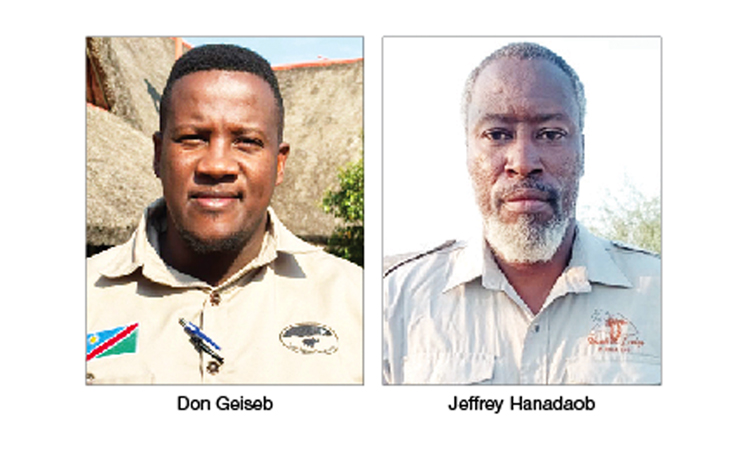
- – Don Andrew Geiseb is the Natural Resource Manager of the Doro !Nawas Conservancy and an advocate for responsible, sustainable development. Jeffrey Hanadaob is the Chairperson of the //Huab Conservancy and a long-standing community conservation advocate.
Together, they bring firsthand experience of the challenges facing Namibia’s communal conservancies when established land-use plans and conservation commitments are not upheld, and have been directly involved in defending community-led conservation and sustainable rural development.