




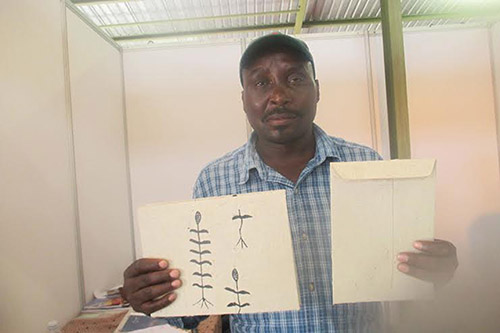
A GROUP of people in the rural north of Namibia make paper products from mahangu stalks, using their hands during the entire process. Onankali Paper-Making Cooperative was registered in 2002 under the Ministry of Agriculture, Water and Forestry.
According to the chairperson Abraham Shikongo, this community-based enterprise provides employment opportunities and income for the group and the community at large, by making and producing a wide range of handcrafted paper and paper products from mahangu stalks and leaves, and millet.
Mahangu is a staple crop in the North. Products include photo albums, envelopes, greeting and christmas cards, bookmarks and notebooks. “We first got our starting capital from the NCCED project which aims to empower communities to make decisions about sustainable use of their natural resources to improve their livelihoods”, he said.
The business makes use of a manual process – doing everything by hand – except for the last stage of printing of the final product.
They contribute to job creation by training the youth from the village for free in order to provide them with jobs. However, Shikongo claims they are mostly understaffed because the youth keep coming and going. He cites the problem of income instability as the obstacle behind this.
“When we pay for water, raw materials and other things, we end up with little money to pay the workers and some months are really bad in terms of profit,” Shikongo said.
He emphasises the fact that they do everything by hand which slows down the process and results in fewer products being made, thus hindering the growth of their rather rare business.
He further made it clear that they have a lot of clients and tourists visiting their workshop from Windhoek and even from as far as Sweden, but delivery is always a problem.
“For example, we got a 2 000 paper order from Sweden, but it took us four months to produce because everything is done by hand,” said Shikongo.
He said as part of the business’ future goals, they plan to buy machines to make the process smoother and improve productivity. “We are in the planning process of getting machines as well as a workshop because we are currently operating in a very small place,” he said.
The cooperative is situated in Onankali, a village situated some 65 kilometres south of Ondangwa in Oshikoto region and is one of the 10 cooperatives that the agriculture ministry paid for to showcase their products at the just ended Ongwediva Annual Trade Fair.
Themed, “Inspire Change to Build World-Class Business Leaders”, the 2015 Ongwediva Annual Trade Fair saw 440 exhibitors showcase their products and services, of which thirty-nine are international exhibitors from countries such as South Africa, Botswana, Zimbabwe, Kenya, Ghana, Egypt, Tanzania, China, Japan and Indonesia.
During previous years, the OATF has accommodated up to 550 exhibitors, but that has proven to be counterproductive as it compromised the quality of the exhibition due to overcrowding and space limitations.
Out of the 440 confirmed exhibitors for the 2015 fair, only two did not turn up while exhibitors such as the agriculture ministry, fisheries ministry and the Oshikoto Regional Council, among others, accommodated other role players in their respective sectors as part of their exhibition.
This has caused the number of individual exhibitors to slightly exceed 440 without compromising on the exhibition spaces that were demarcated for the purpose.
The number of visitors to the Ongwediva Annual Trade Fair has consistently grown and the final statistics are expected to be above 105 000.
The number, which by far exceeded expectations of many, represented an increase of 26% from the previous year. Its set target number is 100 000 visitors.
The financial results of this year’s fair are expected to be released after the audit at the end of the financial year.
In an age of information overload, Sunrise is The Namibian’s morning briefing, delivered at 6h00 from Monday to Friday. It offers a curated rundown of the most important stories from the past 24 hours – occasionally with a light, witty touch. It’s an essential way to stay informed. Subscribe and join our newsletter community.

The Namibian uses AI tools to assist with improved quality, accuracy and efficiency, while maintaining editorial oversight and journalistic integrity.
Stay informed with The Namibian – your source for credible journalism. Get in-depth reporting and opinions for
only N$85 a month. Invest in journalism, invest in democracy –
Subscribe Now!