




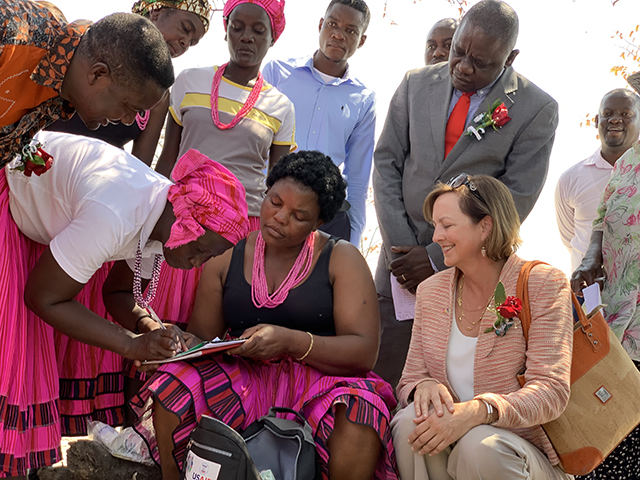
IT is mid-morning, and we are driving to Onkani, Ondjungulume village from Oshakati in the Oshana region. The village is about 95 kilometres from Oshakati. We have driven for over 40 kilometres off the tarred road, and we have not met any vehicle on the road.
However, with about 10 kilometres to go to the village, we see a convoy of vehicles. They are accompanying the US ambassador to Namibia, Lisa Johnson.
She is on a tour to observe how rural community members help each other stay on HIV treatment.
A group of women are dressed up in their odelela – traditional attire for the Oshiwambo. They stand next to a tent where the event will be held, waiting to welcome Johnson.
Johnson is at Ondjungulume village in the Omusati region to meet members of the Community Adherence Groups (CAGs).
Those who are HIV positive tell The Namibian that they have been on anti-retroviral (ART) medication for more than 12 months.
The communities have formed adherence groups to help them stay committed to their treatment. CAGs represent a simple and effective community-based model, whereby groups of stable patients send one or two of their members to the local health facility, and collect HIV medication for everyone in the group.
This community-based service delivery model has been an integral part of the response to HIV to meet the UNAIDS targets to end the AIDS epidemic by 2030, adapting ART delivery systems to meaningfully include community-based services.
Hendrina Ishulu tells Johnson that the group members work together to ensure a smooth process in collecting and distributing their medication. Their support group is called Yambidhidha Mukweni Support Group.
Every three months, the adherence club meets a counsellor employed by Tonata to discuss the side-effects of the medication they experience, and challenges they face to stay on treatment. The counsellor gives them their supplies of anti-retroviral drugs to last until their next meeting.
So far, more than 3 200 people in eight health districts are receiving their HIV medication through Tonata’s 322 CAGs. The United States President’s Emergency Plan for AIDS Relief (Pepfar) funds the CAGs’ activities, supporting Tonata, which is a network of people living with HIV.
“Adherence clubs are for patients who are responding to treatment, and are healthy,” explains Naemi Hauwanga (57), who supervises nine groups at the Okalongo Health Centre. She is based at Oshikuku, and reaches out to over 200 members.
She talks to the members about the HIV-AIDS services offered at the clinic, the importance of consistent anti-retroviral therapy (ART), and how to respond to the challenges of living with HIV.
“The results have been overwhelmingly good. More patients in adherence clubs stay on treatment, and have lower viral loads [the amount of HIV in someone’s blood],” Hauwanga says.
In addition to helping people living with HIV to help each other, the support groups also make it possible to discuss HIV in the wider community, encouraging more people to get tested, and preventing discrimination against those living with HIV.
Hauwanga works with Selma Nuuyoma, who explains that adherence clubs can be tailored to suit the needs of individuals in different setups.
She says before the support groups started at the Oshikuku hospital, people living with HIV were discriminated against by those living without HIV. But after joining support groups, they start participating more in community activities, where they talk about HIV and the importance of getting tested.
Nuuyoma says in the groups, they also share information on the side-effects, and how to minimise them so that members do not give up on their treatment.
“It’s pointless putting people on treatment, and then they default. When someone defaults on their anti-retroviral treatment, the person runs the risk of becoming resistant to treatment, and also transmitting a resistant virus to others,” she observes.
Rauna Iipinge (45) was diagnosed with HIV in May 2008, and started treatment in October 2010.
Iipinge says joining the club has helped her a lot because sometimes she would travel long distances to get medication from the Okahao District Hospital.
“I used to sleep at Okahao for at least two days because transport was scarce. Although I would get to the hospital very early in the morning, I would wait in the queue for a long time, to the point where I would feel like just going home without collecting my medication,” she narrates.
Iipinge says the huge transport fare also discouraged her, as she would spend N$140 on a return trip to Okahao. But since forming the group, they contribute N$20 each per collection.
“The club is better because you get here in the morning, they do a check-up, give you your pills, and you go home.”
Hauwanga says the support groups have also reduced the burden on nurses and healthcare professionals at hospitals and clinics.
“This decreases the burden on the staff, enabling them to put additional patients on treatment. Patients will also be encouraged to join support groups to ensure that they continue to adhere to their treatment,” she states.
Meanwhile, Johnson says if it were not for CAGs, many people would face difficulties in obtaining their medication, and staying on treatment.
In an age of information overload, Sunrise is The Namibian’s morning briefing, delivered at 6h00 from Monday to Friday. It offers a curated rundown of the most important stories from the past 24 hours – occasionally with a light, witty touch. It’s an essential way to stay informed. Subscribe and join our newsletter community.

The Namibian uses AI tools to assist with improved quality, accuracy and efficiency, while maintaining editorial oversight and journalistic integrity.
Stay informed with The Namibian – your source for credible journalism. Get in-depth reporting and opinions for
only N$85 a month. Invest in journalism, invest in democracy –
Subscribe Now!