





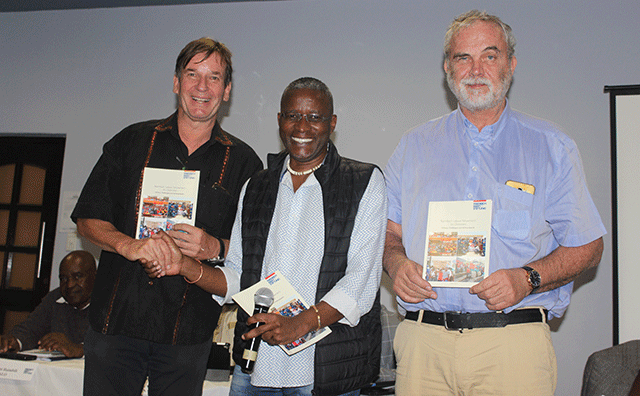
TRADE unions should stand up for the rights of contract and informal workers, who make up the majority of Namibian workers, said labour expert Herbert Jauch at a book launch last week.
Jauch said this at the launch of his new book ‘Namibia’s labour movement: an overview – history, challenges and achievements’, last Wednesday evening.
He said the labour movement was threatened by dwindling membership due to the increasing casual nature of work and flexible forms of employment, as well as a trend towards the informal growth of the economy.
In the book, Jauch discloses the membership numbers of Namibia’s three trade union federations, the biggest being the National Union of Namibian Workers (NUNW) with 84 400 members, the Trade Union Congress of Namibia (Tucna) with 66 000 members, and the Namibia National Labour Organisation (Nanlo), with about 10 000 members.
The combined number of unionised workers is around 164 000, which is almost 25% of the workforce of over 670 000, as per the Namibia Statistics Agency’s 2016 labour force survey.
Jauch said in an attempt to cut labour costs and curb trade unions’ influence, employers have resorted to temporary and casual work for low-skilled workers.
He said this has made it difficult for trade unions to canvass and represent workers, and pointed out that unions now only focused on what he termed “traditional” sectors such as the public service, mining, fishing, construction and the retail sector.
“Unions are unable to reach tens of thousands of workers in precarious working conditions on farms, in private households and labour hire companies, and in the informal economy,” Jauch said.
“Unions need to realise that they need to move beyond their traditional membership base to remain relevant for the majority of working people,” he added.
Jauch also argued that unions were losing relevance because of internal squabbles, and a tendency to get into bed with employers, instead of the workers they represent.
Unions also rarely have meetings between members and leaders, making workers feel less part of the organisation.
“Due to political divisions, unions find it difficult to cooperate with each other on matters of common interest, resulting in detrimental effects on the workers at large,” he said, giving the example of three unions competing to have the bargaining power at Shoprite.
Jauch said the unions in the Shoprite case failed to address the needs of the workers, leading to many being dismissed and suspended when Shoprite decided not to recognise any trade union.
He said a good example of what unity of purpose could achieve was the 2016 teachers’ strike when teachers across federations voted in favour of a national strike for salary increases.
At the book launch, Tucna secretary general Mahongora Kavihuha said the labour law, which is being reviewed for amendment, has handicapped them from representing workers in the informal sector, and has caused the divisions that Jauch highlights in his book.
Kavihuha said “the law is the expression of the elites”, who do not want unions to trample on their interests.
He said the law has caused unionists to only focus on certain sectors because the informal sector was not recognised, and insecure contracts made it difficult to represent these workers.
Matti Haimbili, representing Nanlo, said something must be done about the increasingly precarious jobs that various sectors are thriving on.
“People cannot even plan for their future because they are employed on contracts. We need to join hands and fight this. This book speaks of the real issues at hand. I think we need to pay attention,” he stated.
NUNW deputy secretary general Tame Severin agreed with the findings of the book, and said unions were deeply divided.
“We need to move forward with solidarity,” he said.