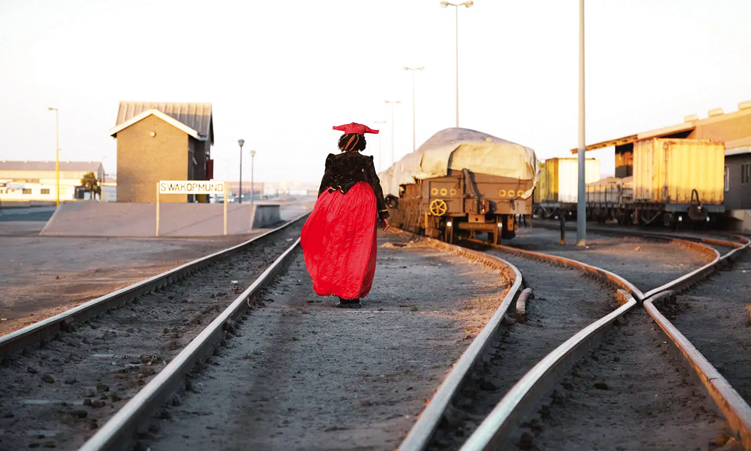
Featuring photographs and video stills made over more than a decade, ‘The Distance Within’ reflects on Nicola Brandt’s German and Namibian heritage and deconstructs established ways of seeing Namibia.
In ‘The Distance Within’, Brandt travelled the country extensively, documenting landscapes and people, structures and encounters, to reveal ensnared histories of German colonialism, national socialism and apartheid.
Markers of these histories range from the ephemeral and private, such as a dilapidated mound of stones as a roadside memorial, to official sites of remembrance and resistance, particularly for colonial atrocities.
Alongside her images, Brandt assembles texts by thought leaders in photography, postcolonial cultures, memory and genocide studies, as well as material from private and public archives, to understand enduring blind spots.
Read an excerpt from ‘The Distance Within’ below:
In the years in which I have worked on this project in independent Namibia, I have witnessed rapid transformations in the urban and the ‘natural’ environment, and new actors entering the political and economic spheres.
Namibia’s new Independence Museum was built by Mansudae Overseas Projects of North Korea, as was State House.
The entrance corridors of State House are lined with painted imagery of dramatic, unspoilt landscapes, even as the Swapo government in 2020 entered into an agreement with a Canadian firm to exploit the pristine Okavango Delta for oil and gas.
In addition, a section of the seabed along the Atlantic Ocean has been allocated to private contractors for mineral and oil extraction.
At the same time, Nama, Ovaherero, and San hunter-gatherers are still fighting to have their pleas for the restitution of their land heard.
And the controversy around the ‘reconciliation’ agreement proposed by the German and Namibian governments in May 2021 continues unabated.
The brutality and indifference of many descendants of white settlers towards those who inhabited the land before the Europeans arrived have never been fully acknowledged.
The body of work in this book touches on numerous intersecting themes from memory and memorialisation in relationship to legacies of German colonialism, national socialism, and apartheid; landscape as a European construct; the process of naming as a function of power and control; dismantling patriarchy and intersectional feminism; human-animal relationships and the environment, to name a few.
I examined my own private family archive and public colonial ones in an attempt to examine blindnesses – my own and that of others – across these spaces and archives. In a certain sense, this work has been about retrieving memory – both private and public – and protesting against its erasure.
I have tried to investigate and be sensitive to this period in Namibian history, because I am aware that, as Ariel Dorfmann describes, “memory, of course, is constantly shifting, so we cannot tell the story if we do not recognise how the past changes as we try to seize and fix it”.
Memory has a way of shifting in relationship to the present and who is describing it, but facts need to be guarded fiercely so as not to forsake key principles such as “justice, equality, freedom, empowerment, democracy, sovereignty, women’s and indigenous rights”.
In his writings towards the end of apartheid, the South African photographer Santu Mofokeng proposed that ‘landscape’ is not separated from the self.
“Landscape is not geography, certainly not in the romantic sense. It is about your view, where you live, where you die, that is your landscape.”
In the context of Namibia and South Africa and the urgency of land restitution, high levels of unemployment, and environmental degradation, Mofokeng’s assertion has become increasingly relevant.
The ‘western’ historical meaning of ‘landscape’ has little relevance to demands for land reparation, but maintains a tenuous, uncomfortable connection to ownership, control, and the construction of a subliminal consciousness of erasure that stretches back many decades.
The aesthetic field of ‘landscape’ is a Eurocentric concept that is wedded to my own ancestry: The very framing of a view is riddled with a certain intractable conditioning.
After paging through many photo books produced in and on Namibia over the past 120 years, I became acutely aware of the “endless rehearsing of certain trends and tropes”, and the frequent emphasis on pictorialism and ethnography.
These ways of seeing and telling continue to direct photographers’ and painters’ preoccupations with the subject.
Extracts from the diary of a British soldier who fought in the South West Africa campaign against the Germans reveal a complete disregard for the presence of the indigenous populations.
His writings are instead preoccupied with the military campaign and the daily struggle in the inhospitable terrain of the Namib Desert.
My great-grandfather, Julius Friedrich Brandt, was among the European men who sought to make their livelihoods in the mineral extraction projects in various African colonies.
As mentioned in the ‘Khan Mine’ section of this book, he arrived in Deutsch-Südwestafrika (DSWA) in 1910 as a procurement officer hired by the German mining company, Khan-Kupfergrube GmbH, that was developing a copper and tin mine in a tributary of the Khan River in the Namib Desert near the coastal town of Swakopmund.
At the time, DSWA was still experiencing the boom mentality brought about by the discovery of diamonds near Lüderitzbucht in the southern desert.
Julius and his wife, Klara, lived in a small house at the mine in the remote, dry Khan river bed for several years, until Klara fell ill and returned to Germany for treatment.
She died soon after her return. Five years after my great-grandfather’s arrival in DSWA, World War 1 broke out, and in 1915 Germany lost its colony to the Union of South Africa.
One layer of white settler patriarchy replaced another.
The political, cultural and expansionist values of these earlier colonialist enterprises continue to this day, but in more opaque, neoliberal compositions.
In conversations during the course of my research, my German grandmother, stubbornly unaware of Namibia’s history of dispossession, and living in a home on the fringes of the unmarked graves of Ovaherero, Nama, and San, once described a romantic encounter in the adjacent German cemetery.
She spoke about how European women had been sent from Germany to quell the restless nature of soldiers and settlers, with few of these relationships born in love.
What remained unsaid was how European women had actively assisted in the construction of the colonial enterprise and in the vision of a new German colony.
Their role was to marry and bear children with settlers, and to create a German society and centre of life with good Christian values. Fragments of diary extracts and oblique views give clues to these mindsets and the contradictions that came with them.
This book, in some sense, is an interrogation of my own ancestry.
- This is an excerpt from ‘The Distance Within’ by Nicola Brandt.
In an age of information overload, Sunrise is The Namibian’s morning briefing, delivered at 6h00 from Monday to Friday. It offers a curated rundown of the most important stories from the past 24 hours – occasionally with a light, witty touch. It’s an essential way to stay informed. Subscribe and join our newsletter community.

The Namibian uses AI tools to assist with improved quality, accuracy and efficiency, while maintaining editorial oversight and journalistic integrity.
Stay informed with The Namibian – your source for credible journalism. Get in-depth reporting and opinions for
only N$85 a month. Invest in journalism, invest in democracy –
Subscribe Now!