






• NACSOA RECENT opinion piece (1) published in The Namibian used our 2021 game count data from the Kunene region to question and criticise Namibia’s community-based natural resource management (CBNRM) programme.
The author’s approach is unfortunate, given that producing this information during 2021 is a testament to the resilience of the CBNRM programme in the context of Covid-19.
The data we produce(2) is part of our joint mandate with the Ministry of Environment, Forestry and Tourism (MEFT) to ensure that management decisions are based on the best available evidence and are done in a transparent manner.
This system of monitoring, in terms of the details provided, the size of the area covered, and the regularity with which it is produced is unparalleled in Africa, and possibly the world. This system is an integral part of adaptive management(3), whereby data from several reliable sources are used to inform decisions like game harvesting quotas.
Under the current quota-setting system, a thorough review of data from several sources is completed every three years to set a benchmark quota. This quota is revised annually thereafter to include data collected each year to either increase or reduce quotas for each conservancy. If harvesting quotas were set and not reviewed for many years at once, they would not keep track of the rainfall and subsequent wildlife population trends.
Annual reviews allow for a highly responsive management system that quickly reacts to prevailing conditions. Doing the exercise at the conservancy level also accounts for the spatial patchiness of rainfall in this ecosystem, as one conservancy may get much more (or much less) rain than their immediate neighbours in a given season.
Because conservancies are not surrounded by game-proof fencing, the wildlife is free to migrate over a large area between the Skeleton Coast and Etosha national parks. Wildlife may thus move to conservancies that receive more rainfall, thus temporarily reducing the population in less fortunate conservancies. Allowing the free movement of game in semi-arid areas is thus critical to their long-term survival.
LONG DROUGHT
Despite this functional management system, there are factors that are beyond our control.
The year 2012 marked the start of a prolonged drought throughout the Kunene region. Adapting to these conditions required slashing game harvesting quotas in 2015 to less than half (springbok) or even a third (gemsbok) of the 2014 quota. The conservancy management committees decided to stop shoot-and-sell hunting, which requires high quotas to make a reasonable financial return. This is an example of adaptive management at work.
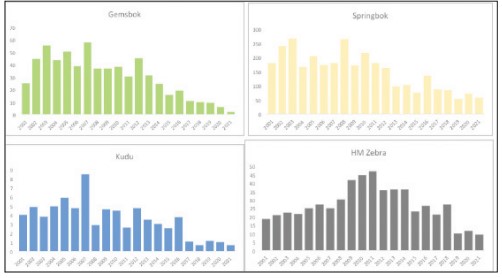
Slashing harvest quotas did not reduce the pressure on vegetation by livestock, or increase rainfall during the next season. The veld condition at the end of the “wet” season in 2016 was far below average throughout Kunene. Our 2017 game sightings index indicated a major decline in springbok, gemsbok and kudu (figure at bottom of page). Once more, the conservancies reduced their harvest quotas, this time to a tiny fraction of the 2014 quota.
Yet the drought persisted. Average rainfall figures in the region declined to the lowest level in 20 years during 2019. The last two years have seen marginal improvement.
Although wildlife declines are clearly linked to drought, this does not necessarily mean that all of these animals died. Since the game count routes remain fixed on roads and tracks, it is likely that fewer animals were counted because they had moved into more remote parts of Kunene.
When the rains return to these areas, these desert-adapted species will also return and reproduce fairly quickly (particularly in the case of springbok) to take advantage of the improved rangeland conditions. In this open system that includes people and livestock, there are many factors that could result in our teams counting fewer game.
The consequence of prolonged drought for livestock is more clear-cut, and devastating. Many households in the Kunene region lost their entire livestock herds – cattle, goats, sheep and even donkeys died in large numbers(4).
Given the aridity of the region, livestock is the main livelihood option, which is supplemented where possible by cash income from various sources. Livestock represent the life savings of many pastoral households, particularly for the Ovahimba and Ovaherero.
Losing a whole herd of cattle for these households is the equivalent of someone cleaning out your bank account, repossessing your house and taking your car, to put it in urban terms. This drought has left them with nothing.
COVID strikes
Yet in 2019 and early 2020, tourism and conservation hunting (using tiny quotas) still provided jobs and kept the conservancies going. Then Covid hit.
Without urgent intervention, this would have delivered the knockout blow to a very tired boxer. The few livelihoods left in the region would have evaporated, conservancies would have had to shut down, and people would have been more desperate than ever – perhaps even turning to rhino or elephant poaching, as in the 1980s(5).
That this worst-case scenario did not happen is a testament to Namibian resilience and commitment to the CBNRM programme.
The Conservation Relief, Recovery and Resilience Facility(6) is an exemplar for the rest of the world. Without this facility, there would have been no conservancy staff to count the game in 2021. Misrepresenting the resulting data in a newspaper opinion piece is therefore a slap in the face of everyone who participated in the count.
As Nacso members responded to the humanitarian and economic crises caused by drought and Covid, others sit back and criticise. Opinion article writer Inki Mandt used alarmist terms to describe the natural result of severe drought, which supposedly justifies her call to undermine the rights of the very people who are suffering most at this time. We are alarmed that someone who works in conservancies cares so little for the people who live there.
While we are not opposed to concession areas and similar initiatives like the Ombonde People’s Park(7), we take exception to the way this idea was presented. We would like to know if Mandt has presented her plan at conservancy meetings? If so, we request the minutes of such meetings and a record of support (or otherwise) for this proposal.
If not, then announcing such proposals in national media without proper consultation at the conservancy level is entirely inappropriate. As support organisations, we recognise that it is not our place to make decisions for conservancies and neither is it Mandt’s.
The Namibian CBNRM programme is resilient because of local buy-in, government commitment, and strong technical support services(8).
In our experience, working with conservancies requires humility and empathy – the former to acknowledge that no one can dictate what communities choose to do, and the latter to recognise that people are the beating heart of conservancies.
1. https://www.namibian.com.na/105407/read/Game-Count-Results-Lift-Lid-on-Brutal-Truths
2. http://www.nacso.org.na/resources/game-count-poster