


It’s not every day that 27 artists representing 13 nations journey into the desert to share their skills with their fellow creatives and the local Topnaar community.
Simply tasked with being inspired by their environment, each other and the thrill of experimentation, an assembly of artists hailing from Namibia, Botswana, Spain, France, Portugal, Australia, America, Zambia, Congo and Cuba spent two weeks sculpting, painting, drawing and installing during the Tulipamwe International Artists’ Workshop held between 15 and 29 August at the Gobabeb Training and Research Centre (GTRC).
Bordered by the Namib dune sea in the south, the Namib gravel plains in the north and situated on the bank of the Kuiseb River, the GTRC was the base for a natural studio boasting a clash of colours, varied textures and wide open spaces.
A stimulating space that is also dotted with indigenous Topnaar settlements, for the fortnight of the Tulipamwe International Artists workshop, the GTRC became a place of exploration, exchange and engagement focused on creating artwork in various media and formats including site-specific work, photography, video, painting and printmaking while living amongst and sharing new skills and ideas with the local community.
Though the experience is one articulated best in the heart of each individual artist, a small segment of their impressions is currently on display at the National Art Gallery of Namibia.
Beginning with big green beetle by Frans Uushona in the upper gallery and ending with a township scene by Petrus Amuthenu in the foyer, the artists’ experiences come to life in painted scrap metal, marble and metal sculpture, large format charcoal drawings, found material installations and even a pinhole camera booth by Helen Harris and Ndeenda Shivute.
Miscellaneous and entirely marvellous, the exhibition in the upper gallery is dominated by installations by Sandra Schmidt whose fascination with tiny creatures and rough earth can be seen crawling up a pillar in the form of larger than life toktokkies and soared above in Lilliputian found wood rafts carrying beetles and bundles below paper or plastic sails.
Offering the whimsical and the wonderful, Schmidt literally brings the experience home in her use of discarded tin cans, a grater, a grill and sand used to make a makeshift fireplace and rural kitchen. This even as she seeks to portray reality in her photographs of corrugated iron and wooden dwellings in their vast, desolate surroundings.
Also presenting photography are Kirsten Wechselberger and Kristin Capp. The former presenting a series of photos depicting the stages of building a functional herb spouting wall while the latter displays a striking collection of archival digit prints woven together in a photographic tapestry of rock, sand flora and the paw print suggestion of fauna.
Equally elegant in his photography is artist Kim Modise who presents superb images of a dune exhibition made of red and grey canvases stuck in the sand as well as a woman embarking on a treasure hunt in the sand sea. A red soled desert Dorothy at the beginning of laddered brick road.
Looming larger than life and calling in the characters from the workshop are French artist Francoise Niay’s huge charcoal on paper drawings which depict impressions of the participants. American LaToya Hobbs alone on her planet painting her superimposed ‘Desert Essence’ self portrait, Betsie van Rensburg creating her piece titled ‘Fruit of the Desert’ and Frieda Luhl’s beautiful anvil on which to hammer out her floor mobile adorned with cast paper leaves displaying the area’s buildings, fences and windmills.
More abstract in her offering is Barbara Bohlke in ‘My Father’s Land’. Painting with acrylic and ash in the muted colours of desert, water and dunes, Bohlke’s work speaks to Cuban artist Yasiel Palomino Perez’s who prefers to depict the landscape in more detail – in all its rock sinking or emerging from the sand under bright blue sky.
For Catarina Nunes, the impression left by Goabeb is a line of rocks in a row. One blue, perhaps to depict the river, as well as a separate three piece offering of smooth and almost white stoneware to depict the silk of the sand dunes.
Working together to illustrate sunset and rural scenes as if rolling by framed in a bus window are Katrina Vivian, Lok Kandjengo, Kefilwe Sentsho, Ndeenda Shivute, Tity Tshilumba, Ismael Shivute and Frans Uunona who paint the pastoral on scrap metal while Marita van Rooyen hangs blue and white in the gallery below rendered in a raisin brush cloth installation.
As for the striking sculptors, they are Martha Ndapewa Haufiku, Ismael Shivute and Alpheus Mvula who work in marble and wood as Kandjengo creates in cardboard print to replicate a scorpion and a beetle.
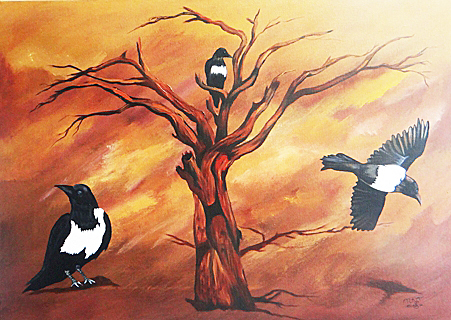
Almost last, not least and not all told in this elegant and inspiring exhibition is Tshilumba’s ‘Soulmate Birds’ – an acrylic trio of black birds on a naked tree which fly, perch and consider the scene.
Though separate and individualistic, Shilumba’s birds exist in a dignified harmony that seems to sweetly suggest what the exhibition and the Gobabeb experience has all along…
‘Tulipamwe’.
We are together.
-martha@namibian.com.na;
@marth__vader on
Twitter and Instagram
In an age of information overload, Sunrise is The Namibian’s morning briefing, delivered at 6h00 from Monday to Friday. It offers a curated rundown of the most important stories from the past 24 hours – occasionally with a light, witty touch. It’s an essential way to stay informed. Subscribe and join our newsletter community.

The Namibian uses AI tools to assist with improved quality, accuracy and efficiency, while maintaining editorial oversight and journalistic integrity.
Stay informed with The Namibian – your source for credible journalism. Get in-depth reporting and opinions for
only N$85 a month. Invest in journalism, invest in democracy –
Subscribe Now!